3 months ago
117
3 months ago
117
Hello and welcome to The Long Wave. This week, it comes to you from Cartagena, Colombia, where I was attending a literary festival but, to be honest, have been mostly eating empanadas. It was my first time in Latin America, and I was not quite ready for a strange sort of culture shock, one that was as much about alienation as it was about recognition. I walked around the city in circles, trying to pound my way into absorbing a place of complex, layered histories.
But it was Cartagena’s racial legacy that, at points, I found overwhelming. It sounds naive, but there is something about travelling halfway across the world to meet others of African descent that brings home the scale of the impact of centuries of enslavement. And it was in the “palenqueras” of Cartagena that I felt that history, in all its contradictions and legacies, resided.
The fruit sellers at the crosshairs of history
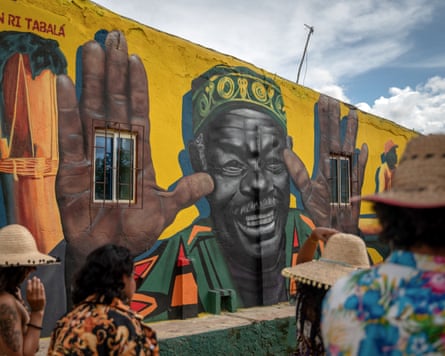
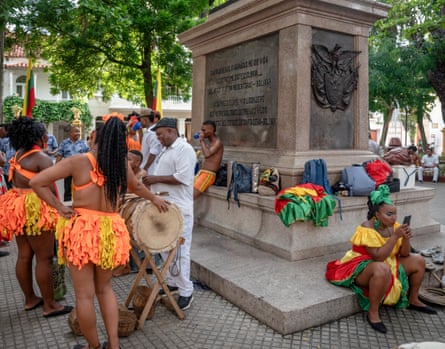
I saw the first palenqueras minutes after I walked out of my digs. Black women in the same colourful dresses and head wraps, carrying bowls of fruit and sweets either on their heads or in their hands. They were so perfectly coordinated, always in small groups, that it looked as if they were part of some photoshoot. And it turned out that they, in a manner, were modelling for pictures to be taken. But it was tourists who took those photos, sometimes posing with them, and paying for the privilege. I would come to learn that these women came down from San Basilio de Palenque, a town more than an hour away, to make their living.
I had read about San Basilio and, indeed, had conversations about its history with our South America correspondent, Tiago Rogero, who wrote a richly reported deep dive into the town. It is the most famous Colombian Palenque – a town or village established by people who escaped enslavement. San Basilio, home to about 4,000 residents, was founded in the 1400s and is broadly recognised as the first “free” town in the Americas. Its inhabitants created their own community and a language that’s a mix of African languages, Creole, and Spanish and Portuguese. But I had not been aware of the particular history of the palenqueras. They seemed to me, in that fugue of trying to absorb a new place, less like colourful features of Colombia’s tapestry and more ghosts from the past; a serene haunting presence that seemed to only recall the centuries of forced displacement that brought them to the street corners of Cartagena.
A picturesque, historical hub of the enslavement industry
More than a million captive Africans were brought to Cartagena over three centuries. The city was one of the largest ports for the trade of enslaved people across Colombia and other colonised territories in Latin America and the Caribbean. I stood in the Plaza de los Coches, now a hub of performers and street food but once one of the largest markets for the sale of human beings. Across the plaza is the new Four Seasons hotel.
The contrast between Cartagena’s affluent tourist areas and its industrial human trafficking and enslavement history, as well as the presence of the colourful smiling palenqueras sandwiched between the two, was head-spinning. I know this is starting to sound a bit like I was having a fever dream, and I’m sure jet lag and heat played a role, but the swirl of it all inspired a swell of undefinable but strong, new feelings. I sat on a stump on the street to still my head, only to realise that I had already started to weep.
Palenqueras pride
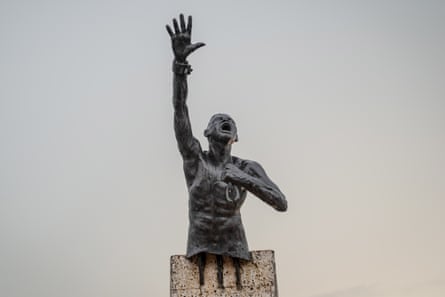
At one point, I began chatting to a group of palenqueras sitting on a park bench, swigging beers under gathering storm clouds. We were a stone’s throw from a statue memorialising Benkos Biohó, the legend who escaped Spanish bondage in Cartagena and founded the Palenque from which they came. One of them, Milena, told me that her mother was a palenquera and she was following in her path. Her predecessors would make the arduous journey from their town to Cartagena, and sell fruits and sweets to support their families, while the men concerned themselves with planting and harvesting fruits from their lands. Today, she said, she and others would spend two to three days in Cartagena a week, to avoid making the daily journey, which was still on a difficult road.
Before I had even asked her, she said, stressing to a Colombian friend of mine who was translating, that she is from a place that is “a small Africa, the first free Black town in America. We have our own dialect. It’s called Bantu.” So I ask her what it’s like, and how the culture that founded her town remains. “We have never changed the traditions – we keep our origins intact. We are protected,” she says, as a place of precious heritage. Palenque has its own traditional ancestral community policing forces and the language is taught in its schools, and the town is on its way to securing autonomous local governance (Unesco also classified Palenque as a site of intangible cultural heritage of Humanity in 2008). She then adds that her home town is “untouchable”, laughing. “And it should never change”. She went on to say, “palenqueras never have limits”. When I asked her what she would say if someone questioned who she was and where she was from, she replied, with a sharp distinction between being Colombian and being from Colombia. “I would say that I am from a town that is a small Africa in Colombia.”
I spent the rest of the time in Cartagena trying to reconcile the strident, almost miraculous ability of San Basilio de Palenque to maintain such a strong identity, language and even self-administration over the years, with the fact that the cost is that such communities remain carved out of the prosperity of the cities that thrived due to the labour of San Basilio’s founders. But what began to take shape in my mind is an understanding that the palenqueras, and their entire communities, were nonetheless living full, self-fashioned lives, ones that were so syncretic in culture and language that they had become a new thing. Neither one-dimensional victims of the past, nor, like all of us, ever fully able to escape it. They were entirely foreign and unknowable to me, as well as entirely familiar. People separated by violence and history, but otherwise always conjoined.