6 hours ago
13
6 hours ago
13
Noor-un-Nisa Inayat Khan was a second world war spy codenamed Madeleine. A mixed-heritage British Indian and Special Operations Executive (SOE) agent in Nazi-occupied Paris who showed extraordinary courage, her story is ripe for dramatic retelling. So why does it feel so fractured and unsatisfactory in director Elin Schofield’s production?
Perhaps because of the limited documentation of this medalled war hero’s life. That is not helped in the delivery of her story in playwright Stephanie Street’s non-sequential narrative, beginning with her interrogation in 1943, after being caught by the Germans, and shuttling back and forth across the years, from early family life to her death in Dachau concentration camp.
Because the story is already filled with holes, it gains more lacunae in this broken-up telling to become less than the sum of its parts. It creates unnecessary confusion and does not relay who Khan was beneath the facts of her life, what drove her or exactly what she did in what turned out to be a highly dangerous lone mission.
Priyanga Burford plays Khan across the decades, from a girl playing piano with her mother to a young woman getting ready for a date. We are told Khan wrote fiction but not much more. A character likens storytellers to spies but the play lacks the essential conflict and suspense of either. Burford’s performance is solid but workmanlike.
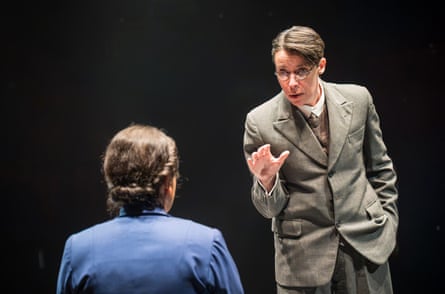
Scenes are often short and static. Accompanying characters include Vera (Amanda Hadingue), the handler who sends Khan to France, as well as Viennot (Léa des Garets), Khan’s sometime lover, and Vogt (Caoilfhionn Dunne), her mild-mannered interrogator. There are others but sometimes it is not clear who they are, and they all remain shadowy.
Khan’s American-born mother (also Hadingue) and her musician father (Paksie Vernon), who we hear knew Debussy and Tolstoy, provide backstory but do not illuminate what drove Khan. We are told that she feels a greater purpose on her mission but this sounds pat. There is a tantalising suggestion that she feels more herself as Madeleine, and that life as a spy is more real to her, but there is no follow-through.
Overall, the tone is too polite and restrained, Nicola T Chang’s melodramatic compositions and Tingying Dong’s big sound design doing all they can to insert some charge.
This is not the first attempt at dramatising Khan’s life. Kali Theatre’s production at the Southwark Playhouse in 2022 was imperfect but did manage to capture the peril in her mission by focusing the action on her work in France. This play skirts around dramatising that. So scenes lack tension, despite the best attempts of the all-female cast to convey jeopardy, which seems like a fatal flaw for a drama about high-stakes espionage.
It stalls itself at the end to remind us that we cannot nail down the story of Khan’s life (or death) with any certainty, that it is fraught with unknowns. This drama goes some way towards telling us who she was, and certainly conveys her heroism – but she never comes to life through these jagged pieces of a remarkable life.