6 hours ago
17
6 hours ago
17
Out of pocket, out of business, retired early. These are the tales of the “sunlit uplands” experienced by small-to-medium-sized businesses across Britain after Brexit.
Between 16,000 to 20,000 businesses stopped exporting to the EU altogether, but others who soldiered on complain Boris Johnson’s government catered for the “blue chips”, not the small, everyday companies when they designed the hard Brexit for Britain.
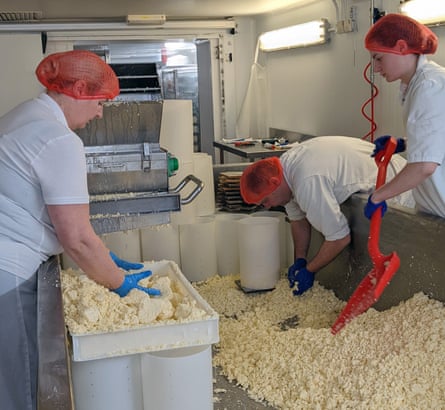
Cheshire cheesemaker Simon Spurrell says Brexit didn’t just leave him with a £250,000 hole in his small but fast-growing firm, but ultimately lost him his business.
Back in 2021, he described Brexit as the “biggest disaster” any government has negotiated. Looking back, nothing has changed his view.
“Brexit is the biggest self-harm that any government has inflicted on itself in recent history,” he says.
In the first few weeks of 2021, Ben Fletcher, the head of Logistics UK and then at Make UK, described Brexit as “Dante’s fifth circle of hell”.
Five years later? “We got even further down, to Dante’s seventh or eighth circle of hell, at its worst,” he says.
Spurrell was a case in point. He discovered he could no longer export his award-winning cheese to the EU because every sale, even those only worth £30, would need to be accompanied by a £180 health certificate confirming they conformed with EU standards. He sold out to a bigger company that could cope with the paperwork.
“Every small business that issues animal foodstuff – meat, cheese, dairy, eggs, even pet food – suffered massively because they didn’t have the luxury of a large organisation that could blend in the paperwork and have someone dedicated to doing that,” says Spurrell.
In November, he joined a small, artisan stilton cheese firm in Derby, part of Hartington Creamery, where his daughter’s family look after a herd of 300 cows.
He says the market is tougher because of Brexit for those not big enough to cope with the red tape.
“Small producers are just trapped on this island and we’re all fighting each other for the same market share,” Spurrell says.
Analysis of HMRC data by the National Farmers’ Union earlier this year showed exports to the EU of farm products, from beef to cheese, had fallen by 37.4% in the five years since 2019.
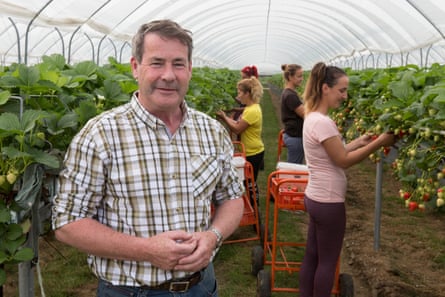
Alastair Brooks, the owner of a berry farm in Kent, also ceased trading, with Brexit precipitating a retirement earlier than planned.
“We stopped the business probably because of the politicians that gave us Brexit rather than Brexit itself,” he says, citing “the lack of preparation by the civil service and government” and their inability to “design a 10-year strategy or vision” for farmers after the departure from the EU.
For farms, one of the big Brexit issues was seasonal workers, who for years had been recruited from the EU – largely from Romania and Bulgaria. After Brexit ended free movement, farms had to go farther afield.
“They were replaced by people from the ’stans: Uzbekistan, Kyrgyzstan,” says Brooks. Before Brexit he had built up a team of loyal European workers who would come for the season and return home.
“We had a system designed with countries we knew people would return to, but then suddenly we had a seasonal workers’ scheme where some would arrive and, as soon as they got a national insurance number, they were gone. They mistakenly thought an NI number allowed them to work anywhere,” he says.
Although staff shortages never materialised, says Brooks, running a business that relied on government pronouncements every March about how many people you could get to work on your farm that year “was simply too big a risk”.
Along with other changes unrelated to Brexit that small businesses have faced, including minimum wage and national insurance increases, Brooks also decided to sell up and retire early.
Another entrepreneur thinking of retirement due to Brexit is battle-hardened Daniel Lambert who, like Spurrell, did much to draw attention to the plight of small businesses in the run up to Brexit.
The British-French dual national left the UK for good after Brexit, but has continued his wine import/export business from France.
He says the cost of doing business in the UK since Brexit has “spiralled five times”, from £30,000 to £166,000 a year.

“Every single thing I forecasted in terms of difficulties: paperwork, administration, generally people not knowing what’s going on, the government being clueless; everything came to fruition and has basically become a total, utter nightmare,” he says.
“In terms of Brexit, there have been no positives at any point at all.”
Before Brexit there were three key steps to sell into the UK: the name of the winery, an export document and the excise paperwork, known as EMCS.
That has now mushroomed into about 20 steps involving exact commodity codes for the wine, which differs according to alcohol level, and export and excise duty for both sides of the channel and a host of other paperwork.
In addition, HMRC requires wine importers to take out insurance if their trucks are burgled, guaranteeing the tax authority still gets its excise duty. Since Brexit, Lambert has only been able to find one company, based in Gibraltar, offering it.
“One of the customers said something and said it beautifully – legislation is always made by governments for blue-chip companies first. They start with them, consult them and they never think about the small guys who cannot conform to stuff that is being introduced,” he says.
“Britain is only going to move on when it starts realising it’s one little cog in a whole load of cogs that make up the EU, that make up global geopolitics, and the UK on its own, not being a cog anywhere, is really unwise,” he says.
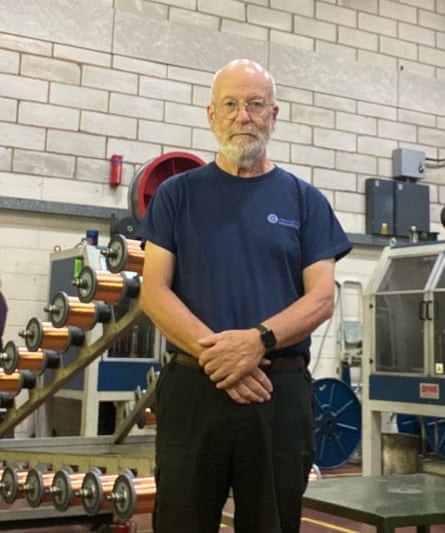
Mark Ormiston, a sixth-generation supplier of wires to a broad range of customers, from military to the film industry, has previously said small businesses had been “flushed down the toilet” by Brexit.
Initially, he saw his EU business halved. It is now down 33% from pre-Brexit days, he says. He adds he “cannot name one advantage of Brexit”, which he describes as “terrible – the stupidest decision the British public has made”.
Earlier this year, a parliamentary select committee heard of the “hell” of Brexit checks, with one transport company telling how they had a truck of frozen beef stuck in Calais for a month, costing the owner of the cargo £16,000 to keep the driver of the refrigerated trailer parked up while they waited for paperwork to be verified.
Overall exports of goods to the EU have decreased 15.9% from 2016 to 2025, according to HMRC data with hopes that the food and drink deal will be lured back to the continent.
Beyond restoring the market urgently for lost trade, Fletcher worries about Britain’s ability to grow markets for new products.
“What we are doing well is moving tried-and-tested products. Firms in the EU are worried about taking new product because they don’t know if they will be able to get them across the border,” he says.
“If all we’re doing is selling products that we’ve sold for years, at some point those products will be replaced – they’ll be superseded. Someone in Europe will find an alternative.”
As legislation in the EU progresses with legislative proposals on tech sovereignty, cyber security and an industrial accelerator act all designed to reduce reliance on foreign produce, the UK could find exporting ever more difficult, Fletcher fears, unless the UK keeps up the the pace on law making.