3 months ago
126
3 months ago
126
People thought they were looking at an AI image: an Amazon delivery van half-submerged at the mouth of the Thames estuary where it meets the North Sea. “I thought someone had just knocked up a photograph,” says local guide Kevin Brown about first seeing it online.
It turned out the image was genuine, and it proliferated. There was something delightfully primordial about it – such a dominant sight of modern street life, just out there on the mud, vulnerable and surrounded by nothingness. Banter followed, images of an Amazon package floating in sea water: Amazon has made your delivery.
Yet you couldn’t help but feel for the driver, who seemed to have descended on to the Essex mudflats in the darkness of Valentine’s Day in some kind of panic. They were attempting to access the Ministry of Defence-owned Foulness Island, and the usual entrance via a road bridge was closed for the evening.
Their valiant mission to ensure the delivery was still made was thwarted after the concrete access road on to an ancient tidal byway known as the Broomway – claimed as the country’s most dangerous path, no less – broke up until it was nothing but gloop.
To make matters more complicated, the six-mile route of the Broomway juts out into a military firing range. The driver had tried to turn around and head back to dry land, but it was too late.
“They go so far down that muddy track until it gets impassable,” says Roger Burroughs, a farmer from Foulness. “And then they try to turn around. That’s where they get stuck.”
The vehicle was at the mercy of the Broomway, and the tide was coming in. The driver had no choice but to leave the van and walk back to shore. Abandon shipment.
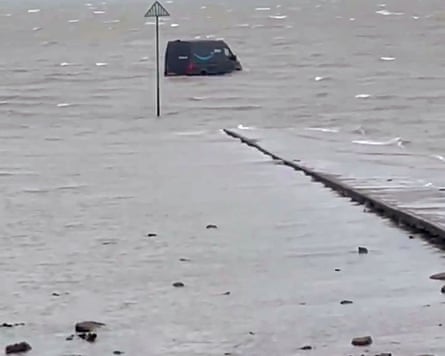
It fell to Roger’s son, Jason, to save the delivery van from being washed out to sea. He was called on Saturday evening by the private security firm that guards the MoD testing range of Maplin Sands, as well as Foulness Island, but he was out at a friend’s birthday party. So the van stayed there. Another local farmer took a picture and posted it online and it spiralled into a news story.
“In some ways, I feel slightly guilty,” Jason says. “I should have gone and pulled it out and there would have been none of this drama, but I thought, I haven’t been contracted, or, you know, I’ve got no authority to go and do this officially from Amazon, so if I damage their van I could be liable.”
Instead he retrieved the abandoned van using his telehandler the next day. By that time, two tides had rendered it unusable.
“Apparently the Amazon driver was a lady who’d been in the job three days,” says Jason. “She, I believe, got to the top of the sea wall and phoned her supervisor and said: ‘Am I doing the right thing here? I’m questioning this.’ And they said: ‘Does the satnav tell you to go that way?’ She said: ‘Yes.’ So they said: ‘Well, carry on.’”
An Amazon spokesperson says all supervisors and delivery drivers are “delivery service provider/independent couriers, not Amazon employees … happily, the driver is safe, the van removed and we’re looking into why it happened.”
It isn’t the first time this month Jason has been called upon to rescue a hapless delivery driver from the mud. Security guards phoned him the previous Saturday night as another delivery van had got stuck.
“I spoke to QinetiQ [which runs Foulness] and said: ‘Can’t you block this off?’ They said it’s a byway, and they can’t. I said: ‘Well, can’t you put a sign up?’ And lo and behold, the following week, exactly the same happens.”
It’s almost become a family business in its own right. Roger tells me of the day – 23 June 2018 – when he was tasked to rescue a brand new silver Land Rover Discovery. “It had done 100 miles. He paid just under £70,000 for it and I recovered it before the tide came in.”
The Broomway has been used for more than 600 years. It first got its name as a track marked by sticks with shrubs tied to them – the brooms – stuck into the mud, which were placed 30 paces apart along its length. The brooms have long gone, and so these days walkers have to go by a blend of experience, vibes and, if that fails, GPS.
“There’s no actual footpath,” says Brian Dawson, who took me out on the Broomway before he retired as a local guide in 2017. “You just sort of gauge it by what you can see ahead, and keep going for it.”
The Broomway stopped being the main route on to the island after the MoD took over in 1915. It has been known as the country’s most dangerous path thanks largely to Robert Macfarlane’s description of his walk along it in his 2013 book The Old Ways. It is recommended you go with a guide.
Set off at the wrong time, or in bad conditions, and you could be done for. Islanders have died in their scores over the years when they have misjudged the tide or simply lost their way. But then the thrill of dicing with disaster was once said to have been part of the attraction.
The 19th-century writer Philip Benton, in his history of the Rochford Hundred, suggested some islanders relished the inherent risk the route posed to those who travelled it.
“It is extremely perilous for any stranger to attempt the passage to or from this island without a guide, but the dangers attending it have been a pleasurable excitement to many. Some farmers would stay to the last, and then race the tide, and swim the creeks.”
But in some ways, to call it Britain’s deadliest path feels a little hyperbolic. My memory of walking the Broomway is that it feels like an alien landscape, one where you just lose all sense of time due to the effects of an enormous and ever-changing sky and the reflection of light on translucent mudflats. And yet many people have died here, as the gravestones in the churchyard on Foulness attest.
The last person to die on the Broomway was in 1919, a luckless man on the way back from the market at Rochford. “He’d probably had a skinful of booze and then on his way back, you know, left it a bit late,” says Brown.
There have been more recent close shaves: Dawson tells me of two girls some decades back who had been out on the mainland and wanted to go home to Foulness, but it was raining and beginning to get dark.
A search party went out to look for them in the morning, and they were found under the Foulness sea wall, sheltering from the worst of the weather.
Dawson says people have wandered off the path and had to be pulled out of their boots on his excursions. The fact that weapons are often tested on the flats makes the quicksand more deadly.
“When the ministry lets bombs go off, they make a hole,” says Dawson. “They don’t fill it in. Nature fills it in, but it never fills up as solid as it was before it was blown out.”
Dawson is in his 80s and doesn’t feel he can physically go out on the Broomway any more, but he misses it. “Just being out there … you’ve got Southend, and you’ve got all the hassle and the fighting down there. You go a little further out and it’s peaceful. There’s nothing there, but you can enjoy it. For me, it’s so comforting.”
We live in a world shaped by tech disruptors relying on cheap labour, but I wonder when looking at the picture of the Amazon van with water rising around it whether it might represent the limits of our faith in this model.
Google is building a gigantic AI data centre up the Thames at Thurrock. You can have all the tech prowess in the world, but it’s not going to save you from the mud.
-
Tim Burrows is the author of The Invention of Essex, now out in paperback and available to order at guardianbookshop.com