2 months ago
70
2 months ago
70
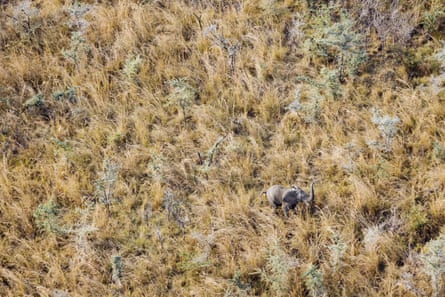
It is late on a January afternoon in the middle of South Sudan’s dry season, and the landscape, pricked with stubby acacias, is hazy with smoke from people burning the grasslands to encourage new growth. Even from the perspective of a single-engine ultralight aircraft, we are warned it will be hard to spot the last elephant in Badingilo national park, a protected area covering nearly 9,000 sq km (3,475 sq miles).
Technology helps – the 20-year-old bull elephant wears a GPS collar that pings coordinates every hour. The animal’s behaviour patterns also help; Badingilo’s last elephant is so lonely that it moves with a herd of giraffes.
Fifty years ago, life for elephants in this part of Africa was very different. In the early 1970s, an English ecologist called Dr Murray Watson crisscrossed the skies of Sudan in a bush plane to measure wildlife populations. While Watson’s methodology wasn’t as reliable as modern counts, he estimated there were about 133,500 elephants in what is now South Sudan.
Today, the country’s known population of elephants is down to about 5% of what it was 50 years ago, says Mike Fay, a US conservationist who has spent 45 years documenting and securing wildlife populations in the Sahel and central Africa.
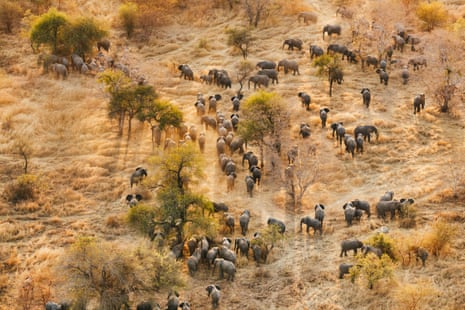
Meanwhile, in southern Africa, the opposite problem exists. In parts of the Kavango Zambezi transfrontier conservation area, or Kaza – a contiguous protected landscape encompassing swathes of Botswana, Namibia, Zambia and Zimbabwe (and part of Angola) – law enforcement and conservation work has been so successful that local people struggle with too many elephants, leading to an increase in human-wildlife conflict.
The problem is especially pressing on Kaza’s eastern edge, where people and pachyderms are being squeezed into tighter land parcels without the ecological resources to sustain them. Governments, communities and conservationists debate whether the elephants should be culled for food, hunted to generate community income, fenced or translocated.
To document the challenge in different parts of Africa, I teamed up with photographer Tom Parker to follow this story in the north – in South Sudan, Garamba national park in the Democratic Republic of the Congo, and Gambella national park in Ethiopia – and in the south: Zimbabwe, Botswana and Zambia.
Too few elephants: South Sudan
In the African Parks office in Juba, the capital of South Sudan, Fay looks over a map of the protected area made up of Badingilo national park, Boma national park and the Jonglei landscape. “It’s mind boggling how big it is,” he says. Fay is African Parks’ landscape coordinator for the Great Nile migration landscape. The NGO has a 10-year agreement with the government to manage 150,000 sq km of land – a region about the size of Nepal.
“This is the greatest conservation opportunity on Earth, but also one of the greatest challenges that any conservation organisation has ever taken on,” he says.
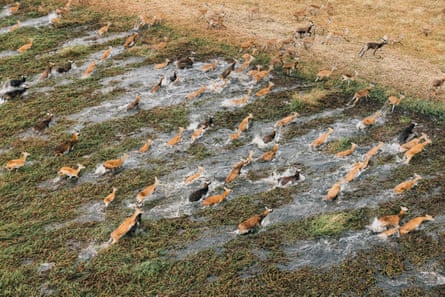
Optimism about that potential has been boosted by the discovery in 2023 that this ecosystem hosts the largest land mammal migration left on the planet, dominated by white-eared kob. The migration has endured despite Africa’s longest-running civil war. But other fauna have not fared so well – including the region’s elephants.

A hunter in Boma’s Maruwa village says he last saw an elephant four years ago. The last one he killed was two years before that. “I was hungry,” he says.
The hunter made some money from the ivory – $50 (£37) for each tusk, divided between five men. Our conversation draws in bystanders: occasional goldminers, ex-soldiers, a teacher who has not been paid for a year. “We don’t think [the elephants] are dead,” says one of the men, “but they’re going to faraway places.”
The hunter says that if he encountered an elephant again, he’d kill it: “For food. We’re really poor. We have nothing. No one standing here has a job. All we can do is survive.”
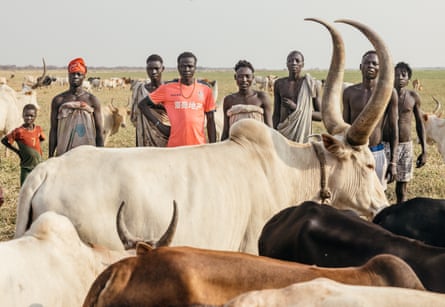
In another village in Badingilo, African Parks’ community officer, David Liwaya – a refugee from the civil war who returned to South Sudan from Kenya to work in conservation – puts the debate into stark perspective: “It’s really difficult. Who cares about an elephant when you’re losing your brothers?” But giving up on the future isn’t an option, he says.
At the end of 2025, 11 months after our visit, news comes from the African Parks team: Badingilo’s last elephant has been killed by suspected poachers along with one of its giraffe companions.
Too many elephants?: Zimbabwe
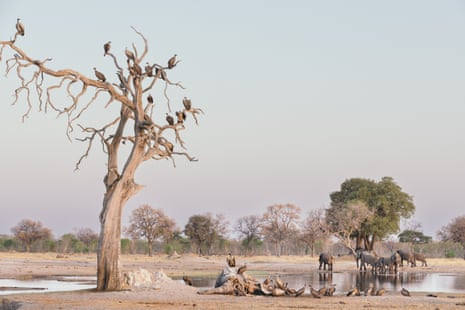
About 3,200 km (2,000 miles) away, outside Victoria Falls international airport in Zimbabwe, a road sign warns of elephants on the move. The road passes through a township called Mkhosana. Among the tightly packed homes, stories of human-wildlife conflict are ubiquitous – a situation aggravated by climate breakdown as elephants search for food and water in a worsening drought.

Fransica Sibanda was recently widowed by an elephant, which trampled her husband yards from their home. “I now live in fear,” she says; “the park needs to put in a fence, or chase the elephants out.” A neighbour, Ireene Nyathi, describes watching a man being picked up by an elephant and crushed against her wall: “I think the elephant should be found and shot,” says Nyathi.
“Tourists don’t see this,” says Miriam Esther, a local water development coordinator: “They just go to the hotels, see Vic Falls, photograph the animals.”
Farther south, near Zimbabwe’s Hwange national park, a herd of 12 elephants has come into drink in front of the swimming pool of the lodge where we’re staying. To the right, another herd is heading towards the setting sun – a perfect marketing image for safari tourism. But this is a romantic version of reality. On an evening game drive, we encounter a juvenile elephant’s corpse, its grey skin lying in the dust like a castoff winter coat. Then the bodies of two more adult elephants, their bellies pulsing with maggots.
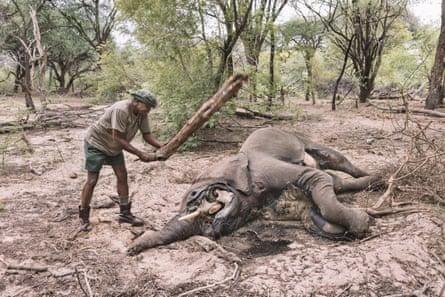
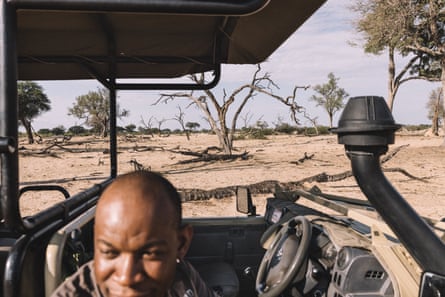
Hwange’s dense elephant population is the result of decades of conservation successes, but also an ecosystem out of balance. About 60,000 of Zimbabwe’s 100,000 elephants come through Hwange in the dry season, which is about twice the broader region’s capacity, says Zimbabwe-based safari guide and conservationist Rob Janisch.
When Hwange was first created as a game reserve in 1928, colonial officials put in artificially pumped water holes in a naturally arid area – but because of this intervention, as well as expanding human settlements, the herds aren’t migrating enough for the ecosystem to replenish. “While this was seen as a conservation necessity at the time, hindsight would prove otherwise,” says Janisch.
In late 2024, Zimbabwe and Namibian authorities announced significant new elephant culls – often involving big-game hunters who bring much-needed revenue. Botswana floated reintroducing this strategy too, to global outcry. Many local people who don’t derive their incomes from the wildlife economy say outsiders don’t understand the pressures. Godwill Ruona, a taxidermist in Victoria Falls, calls elephants “the heartbeat of the bush”, but says there are too many of them. “You can’t sit in Paris and tell us what is happening in Zimbabwe.”
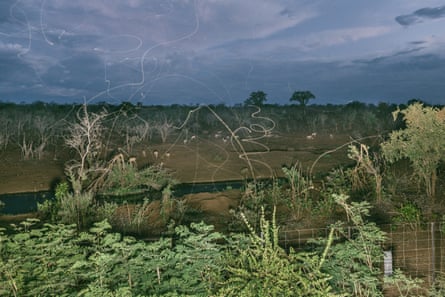
Some solutions are having an effect. Deterrents include whips that sound like gunfire, bonfires, “chilli fences” (the pungent chemicals irritate elephants’ sense of smell). Communities such as Ngamo are investing in high-voltage rhino fencing to separate the park and villagers.
While this helps on a local level, it doesn’t get around the fact elephants still need space to move. In some cases, relocation is possible – in 2016, African Parks moved 500 elephants hundreds of miles between two parks in Malawi, the biggest in-country elephant translocation ever undertaken – but with conservation NGO budgets being cut across the continent, doing so at scale is challenging.
None of this is to diminish the pockets of well-managed landscapes that have had remarkable successes, or the work of heroic grassroots conservationists chipping away to facilitate human-wildlife coexistence.
Each of these victories matter. And while there is no single solution for Africa’s elephants, the vast differences between Kaza and South Sudan also share common ground – that in an age of mass extinction, failure isn’t an option.
Travel for this reporting was supported by Michael Lorentz, Rob Janisch and the Safarious Fund
Find more age of extinction coverage here, and follow the biodiversity reporters Phoebe Weston and Patrick Greenfield in the Guardian app for more nature coverage