3 months ago
173
3 months ago
173
Lt Col Antonio Tejero, who has died aged 93, terrorised much of Spain on 23 February 1981 when he led an armed assault on the Spanish parliament, the Cortes, in Madrid.
At 6.23pm, some 250 civil guards burst into the semi-circular chamber of the lower house during the investiture of Leopoldo Calvo-Sotelo as the new prime minister. For 18 hours the entire parliament was held hostage until a negotiated surrender the following morning; the Communist party leader Santiago Carrillo said he had expected to be shot.
Tejero’s bushy moustache, angry stare and traditional civil guard tricorne hat became iconic images of the failed coup, the attempted return to the fascist Spain of the Franco dictatorship of 1939-75.
Pistol in hand, Tejero strode to the rostrum shouting “¡Quieto todo el mundo!” (“No-one move!”). A few minutes later, with shots fired into the ceiling – since conserved to commemorate the defeat of the coup – he screamed the notorious phrase “¡Se sienten, coño!” (“Sit down, fuck it!”).
The coup followed a year of crisis for the new democracy, born in the 1977 elections. The Basque terrorist group Eta had been killing members of the army and police every week. The government of Adolfo Suárez was in freefall in the midst of economic slump. Several politicians were irresponsibly calling for “a touch on the rudder”, ie a bloodless intervention to “correct” the faltering democracy.
There were three main conspirators, Tejero, General Jaime Milans del Bosch, the head of the army in Valencia, who brought the tanks out on to the streets of the eastern city, and General Alfonso Armada. That night, Armada went to the congress, ostensibly to negotiate with Tejero and protect the kidnapped members of parliament. Armada had been secretary to the royal household, and the conspirators sought to give the impression that King Juan Carlos supported the coup.
At 1.12 am, seven hours after the start of the coup, the king went on television in full military uniform to condemn the insurrection and defend the democratic process. By noon Tejero had surrendered.
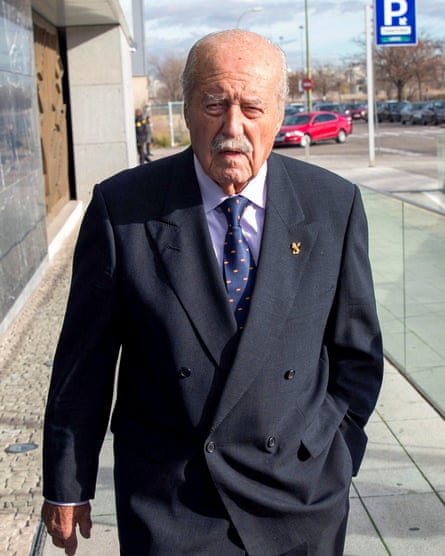
By coincidence, Tejero died the very day that government documents on the coup were declassified, 45 years after the event. The documents support the official version: that the king saved the day by vigorously opposing the conspirators. However, Tejero, in an interview with the online newspaper El Español in October 2023, said that he himself halted the coup when he realised that Armada wanted a “government of national salvation” including leftwing representatives, instead of a full-blown military dictatorship. He felt betrayed, used for the dirty work then, in the words of his wife, Carmen, “tossed aside like a used cigarette butt”.
While in prison on remand after the coup, Tejero set up a political party, Solidaridad Española (Spanish Solidarity), with the striking slogan “Enter Parliament with Tejero!”. In the 1982 general election he received only 28,451 votes and failed to enter it by democratic means.
Tejero, one of 32 conspirators to be tried, was convicted in June 1982 and sentenced to 30 years. Despite expulsion from the civil guard, he spent several years in a military prison in Figueres where conditions were comfortable and staff sympathetic. He was released in 1996.
After leaving prison, Tejero devoted himself to painting and gardening. He lived between Torre del Mar, a coastal town near Málaga, and Madrid. He attended weekly mass. He kept a low political profile, but on the few occasions he appeared in public, it was clear that his politics had not changed.
All his life he defended military dictatorship to conserve the unity of Spain. In 2019 the socialist government ordered the removal of Franco’s remains from his mausoleum at the Valle de Cuelgamuros and his reburial in the family tomb. Tejero was present, and was greeted by the crowd of fascists with cries of “Long live Spain! Long live Tejero!”
He was rumoured to have written his memoirs in prison, but when in 2000 the publishers Planeta offered him a blank cheque for them, he was not interested.
The 1981 assault on the Spanish parliament was not Tejero’s first military rebellion. In 1978 he had conspired to attack the Moncloa palace – the office and residence of the prime minister – and arrest the entire cabinet. The plot was named “Galaxia” after the Madrid cafe where the conspirators met.
The coup was stillborn because someone invited to take part informed the police. Remarkably, Tejero was sentenced to only seven months in prison and was not demoted or expelled from the civil guard, which left him in a position to try again.
Tejero was born in Alhaurín el Grande, near Málaga in southern Spain, into a poor family with military connections. His father was a rural school teacher. He attended the Military Academy in Zaragoza and entered the civil guard at the age of 19. He led a typical military life, posted to at least six destinations during the following 20 years, and was steadily promoted until becoming lieutenant colonel in the Basque country in 1974.
In 1958 he married Carmen Díez Pereira, herself the daughter of a civil guard officer. She predeceased him. Tejero is survived by their three sons, three daughters and 16 grandchildren.