3 months ago
99
3 months ago
99
Despite its modest population of about 400,000 – that’s roughly the size of Bristol – Iceland punches significantly above its weight, artistically. Musicians from Víkingur Ólafsson to Björk, and composers from what has been called the First Icelandic School regularly top the bill in concert halls worldwide. But is there such a thing as an Icelandic sound?
An afternoon programme of chamber and choral music suggested not. Casting its net wide, the 20th-century European mainstream was much in evidence. Hafliði Hallgrímsson’s Seven Epigrams for violin and cello, stylishly performed by Phoebe Rousochatzaki and Kosta Popovic, might have been by Schnittke. A homage to leading Soviet artists, it included a suitably jittery portrait of Shostakovich.
The choral works, impeccably performed by the BBC Singers, were more idiomatically Icelandic, rooted as they were in a plainspoken Lutheranism. Anna Thorvaldsdottir’s sparse yet sonorous Hear Us in Heaven was the standout; Hjálmar H Ragnarsson’s tangy Ave Maria suggested Poulenc. More experimental works, such as Thorvaldsdottir’s quirky Sequences for bass flute, bass clarinet, baritone sax and contrabassoon, were intriguing, if less concrete than her striking orchestral scores.
If anyone defines the current Icelandic aesthetic, it’s Thorvaldsdottir, so it was a pity none of her music appeared in the BBC Symphony Orchestra’s evening concert. As it was, two of the works were repurposed from earlier projects with varying success. Ólafur Arnalds’ Another Kind of Peace, here receiving its world premiere, was a collaboration with composer Viktor Orri Árnason. A symphonic suite based on Arnalds’ album of the same name, it never quite hid its ambient roots, coming across as a series of introductions that generally went nowhere, and with souped-up orchestrations that felt insufficiently differentiated.
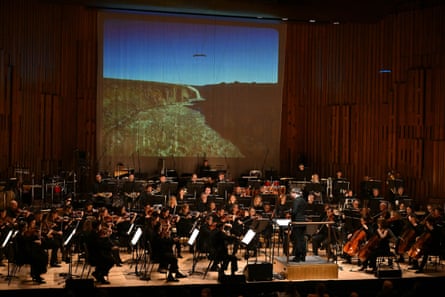
More successful was Valgeir Sigurðsson’s Dreamland Suite, arranged from his score for a 2008 documentary examining the impact of a hydroelectric power plant in the country’s eastern highlands. Sporadically portentous, and deftly stewarded by conductor Christian Karlsen, the music nevertheless failed to capture the visceral impact promised by movements with titles such as Helter Smelter.
The most individual voice on display was Bára Gísladóttir, here performing the UK premiere of her double bass concerto, Hringla. Spun out over a high, persistent drone, real-time sampling and playback pitted her edgy lines against an orchestra often required to explore extended techniques. Restless and distinctive, it was a haunting, strangely beautiful affair.
Daníel Bjarnason’s I Want to Be Alive was the longest work of the night, a 40-minute triptych on the dangers of unbridled AI refracted through the mythical prisms of Echo, Narcissus and Pandora’s box. An abrupt, shapeshifting opening movement gave way to central reflective pools of sound, before a colourful percussion section, flowerpots and all, built the vivid, predatory finale. Bjarnason’s work could usefully lose 10 minutes, but what a sonic imagination.