2 months ago
100
2 months ago
100
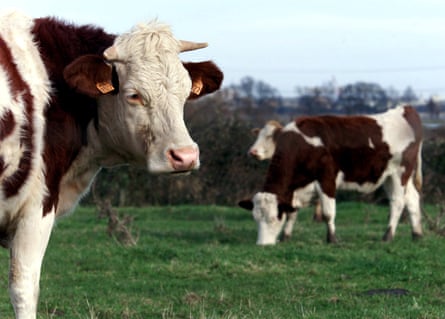
Beef and lamb receive 580 times more in EU subsidies than legumes, a report has found, despite scientists urging people to get more of their protein from less harmful sources.
Analysis by the charity Foodrise found the EU’s common agricultural policy (CAP) provides “unfair” levels of support to meat-heavy diets that doctors consider unhealthy and climate scientists consider environmentally destructive.
It found beef and lamb were subsidised 580 times more than legumes in 2020, while pork was subsidised nearly 240 times more. Dairy, meanwhile, received 554 times more in subsidies than nuts and seeds.
The EU spends almost a third of its budget supporting farmers, with the bulk of CAP funds allocated on the basis of farm size, rather than strategic considerations. Meat and dairy – which use land to grow crops to feed animals – take a larger share than plants, particularly once the subsidies in feed have been counted.
Martin Bowman, a campaigner at Foodrise and author of the report, said the analysis showed livestock benefited from disproportionate support even before counting hidden societal costs, such as pollution.
“It’s scandalous that billions of euros of EU taxpayer money is being used to prop up such a high-emissions industry at a time when scientists are telling us that we need – on health and environmental grounds – to shift to lower-meat diets,” he said.
The data comes from an academic study, available as a preprint, that traced EU subsidies for different foods in 2020 using the same methods as a study published in Nature Food in 2024. Some experts expressed caution about the scale of the disparity the first study found, but did not dispute it existed.
Anniek Kortleve, a researcher at Leiden University and lead author of the academic study, said it showed that reforms needed to consider the full chain of subsidies flowing through feed to livestock, rather than just direct payments to livestock farms.
“Our analysis shows CAP support is highly concentrated in animal-sourced foods relative to the calories they provide, while plant proteins like legumes receive very little support,” she said. This was happening “even though EU strategies increasingly call for more plant-rich diets for health and sustainability”.
The report found meat and dairy received €39bn in subsidies in 2020, fruit and vegetables €3.6bn, and cereals €2.4bn. Cows and sheep, which require more land than animals such as pigs or chickens, tend to benefit from subsidies that target struggling regions and sectors on top of hectare-based payments.
A number of green strings have been tied to CAP payments since 2023 but experts do not expect the overall composition of EU farms to have changed significantly.
In 2024, a “strategic dialogue” between farmers, supermarkets, scientists and green groups – formed by Ursula von der Leyen, the European Commission president to quell furious farmer protests – resulted in an acknowledgment that Europeans eat more animal protein than scientists recommend and a call for support to shift diets toward plants.
Donal Murphy-Bokern, an agricultural scientist who used to work for food and agriculture ministries in the UK and Germany, and who was not involved in the study, said Europe’s protein economy was “not operating within sustainable limits”.
Considering public health in policy would challenge current levels of livestock production, he said. “We now need a common agrifood policy that explicitly integrates environmental and public health goals into how EU farmers are supported.”
Improvements in alternative proteins and an emerging consumer shift to reducing meat consumption have been resisted by big farming lobbies and some politicians. In November, the EU parliament voted to ban plant-based foods from using terms such as “steak”, “burger” and “sausage” unless they contained animal flesh.
The vote was ridiculed by green groups, which pointed to accepted terms such as peanut butter, which does not contain dairy, or hotdogs, which do not contain canines. The proposal also divided conservatives, with some feeling it violated free market ideals.
Bowman said politicians were deeply involved in influencing food production and consumption. “Don’t believe the meat and dairy companies who say that politicians promoting healthy and sustainable diets are telling people what to eat,” he said. “It’s a very cynical position.”