3 hours ago
5
3 hours ago
5
‘What do I do now that I no longer have my mother?” Lero Lero sing on Com’haiu a Fari, the opening track of their self-titled debut album. “If I still had my mother, I would not love you.” What may sound like the kind of honest self-reckoning a modern songwriter has dragged out of therapy sessions is actually a traditional Sicilian folk text once sung by a washerwoman, reimagined here through three voices modelled on Sicilian Settimana Santa polyphonies. For this Palermo collective, maternal loss is also metaphor: symbolic of Sicily’s ruptured cultural inheritance, which they recover through archival labour songs, carters’ cries and lullabies, then reshape through electronics and microtonal instrumentation.
In the Italian imagination, Sicily has long been more than the island at the country’s southern edge. It has functioned as a symbolic South, carrying fantasies of archaic beauty and rural authenticity alongside associations with poverty, criminality and backwardness. Its culture is often romanticised and patronised at once.
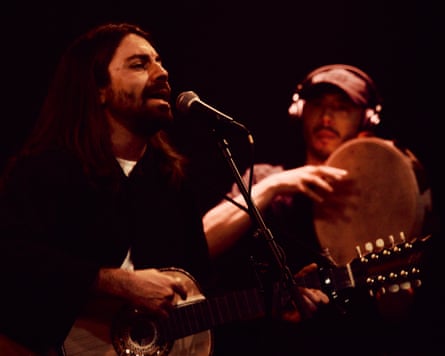
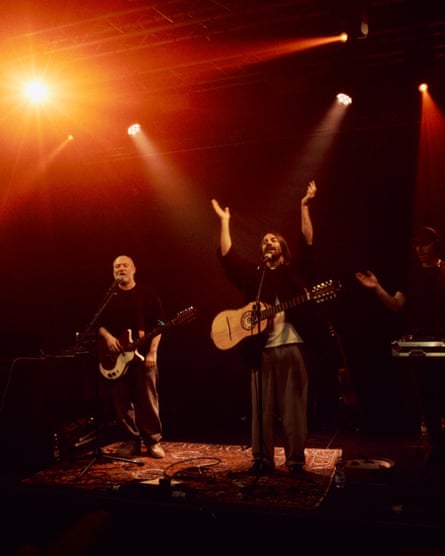
Lero Lero’s debut digs beneath those familiar representations. Formed by singer-songwriter Alessio Bondì, synth player Donato Di Trapani and producer and guitar player Fabio Rizzo, the project grew out of years combing through 20th-century Sicilian field recordings, driven by the sense that the version of Sicilian music handed down was only a fraction of what had once existed. What survived, they found, had often been detached from the social worlds that produced it.
During his research, Di Trapani witnessed that detachment first-hand: older peasant singers were often remembered as rough, out-of-tune figures marked by poverty and shame, while later generations of folklore musicians saw themselves as having “ennobled” those traditions, simplifying them into a version of southern identity they felt could be publicly embraced. By contrast, his own generation had “ennobled” those traditions, simplifying and cleaning them up to better suit the version of southern identity they felt could be publicly embraced: the kind of exportable Sicily later familiar from Dolce & Gabbana’s black lace or the Inspector Montalbano books and TV series, where crime unfolds amid fictional baroque towns, long lunches and seaside landscapes.
The line between homage and stereotype continues to provoke debate around representations of southern Italy. A recent flashpoint was Al Mio Paese, a wildly successful single by three southern artists – Puglia’s Serena Brancale and Sicily’s Levante and Delia – which wraps pop production around pizzica-inflected rhythms and a vivid montage of familiar southern imagery: women seated outside on plastic chairs, bustling piazzas, white sheets billowing above market stalls. For some listeners, it was an affectionate ode to diasporic longing and homecoming; for others, it crystallised a more uncomfortable pattern, reducing the south to a picturesque, consumable collage of nostalgia.
In contrast, Lero Lero engage with Sicily less as a postcard image than a complex social and sonic inheritance, shaped by a kaleidoscope of different histories and experiences. On Salinai, they rework the surreal rhymes once shouted by salt workers as they counted their salt baskets, where playful, near-nonsensical refrains gradually accumulate until the worker’s hunger, deprivation and misery are revealed: “Last night I went to work for Campanella,” Bondì’s voice strains over a steady beat, “who gave me bread one slice at a time with nothing to eat alongside it but a hazelnut shell, just to keep my belly lean.”
With its light, uplifting atmospheres, the following Cuori ri Canna feels like a sudden release. Built around a canto di sdegno – literally “song of indignation”, an agro-pastoral form ignited by lovers’ betrayal – it transforms bitterness into irony and liberation. Di Trapani recalls playing it in Palermo and watching “people standing up and singing like each one was freeing themselves from their own life’s problems.”
Much of Lero Lero’s process begins with close study of the archival material, with singer Bondì painstakingly decoding lyrics and obscure metaphors. The point is not faithful reproduction, but entering the generative processes of oral tradition itself: the haunting Bedda ca Cantari A Mia Sintisti, for instance, began with a short 1955 vocal and marranzano mouth harp prison recording. Lero Lero expanded its fragments by piecing together other ottave siciliane, Sicily’s traditional oral verse forms, transforming it into a larger lament of love, solitude and lost freedom. For Rizzo, that reconstructive process is entirely faithful to the oral tradition itself: “We don’t submit to a fixed text,” he says. “We shape and modulate different inputs to create something that people in 2026 can connect with.”
Their aim is to forge their own sound from the source, rather than lean on easy external references. “It would be easy to hear a carter’s song and think, we could put some flamenco here because that’s the musical scale,” says Bondí. “But we’re conscious that from this music, from these songs and these melodies, we can make entirely new music.”
Rizzo’s “Palermitan guitar” is central to this project. He modified his own instruments to create a microtonal, double-stringed guitar capable of following the shifting tonalities of Sicilian archival song. On Franculina, its serrated riffs cut through pounding bass-synth and tamburello; on Aieri Ci Passava, it coils around an insistent bassline, sharpening the song’s tension and sarcasm.
The tension between submerged history and disruptive return is captured in artist Giulia Parlato’s album artwork, which features the mythical crocodile of Palermo’s Vucciria market: a creature said to have reached the city from the Nile through the waters of the Papireto, the now-buried river that once ran through Palermo, hiding beneath the market’s fountains before emerging to terrorise children. Partially glimpsed beneath an otherwise ordinary scene, it lurks as though it has always been there; like the voices Lero Lero pull from Sicily’s sound archives, it feels like a latent presence, poised to rupture the polished image of the present.