3 months ago
159
3 months ago
159
Funerals are conventionally designed to smooth a person into graceful solemnity, carefully editing out the unsavoury bits of a life. But Martin Parr spent more than half a century sending up the idiosyncratic and the awkward, in a way that was sometimes unflattering, mischievous, and always unflinching. So his own funeral was never going to be a typical farewell. At the ceremony at the chapel in Woodlands Memorial Garden near Bristol, people who had known Parr throughout his life spoke, and Parr’s favourite music played – guests arrived to Astrud Gilberto, João Gilberto and Stan Getz’s The Girl from Ipanema. Parr had recently photographed the original girl from Ipanema, Helô Pinheiro, who is now 82.
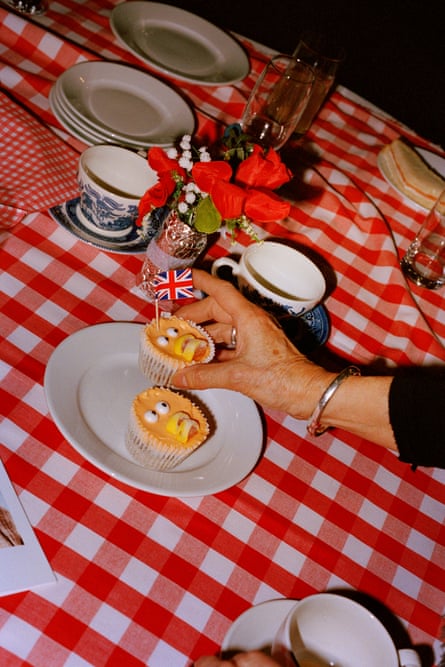
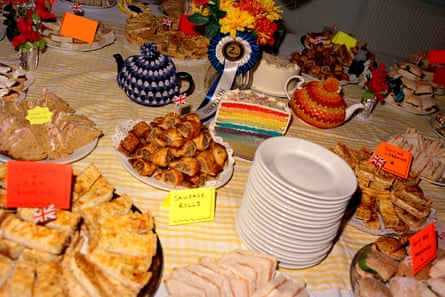
With the help of the staff at the Martin Parr Foundation, the family organised the ultimate Martin Parr send-off after the ceremony: a colourful country fete-themed celebration decked out with bunting, with clingfilm-wrapped sandwiches, cupcakes with sad faces on, a collection of teapots with natty tea cosies, and a tombola of unwanted Christmas gifts – in memory of the annual auction the Parrs used to put on. (The proceeds went to food poverty charity the Trussell Trust.) The Art of Dining, a collaborative duo creating interactive dining experiences formed of Parr’s chef daughter Ellen and set designer Alice Hodge, recreated the food from many of the late photographer’s most famous images.
Grayson Perry was among the guests. “The service at the chapel was very tasteful, in a pared-back way, and very touching,” he tells me on the phone. “It was a lovely nondenominational venue, with a green burial place. There were lots of cultural people there. The fete-themed tea modelled on his photographs was a very sweet tribute to him.”
Perry, who had been a fan of Parr’s work since the 1990s, first met Martin at a house party in Notting Hill, west London, in 2004. “I was drunk and I went up to him and gave him a big hug and said: ‘I love you, Martin Parr.’ He didn’t flinch.” The two became friends after that. “He was pretty dry, and very obsessive. I remember when I would go to stay at his house, he would have at least 10 bids running on eBay at any one time for Saddam Hussein matches or Barack Obama Cheetos, for his collection.” Perry describes Parr as “a trainspotter of a photographer” and the “most hard-working person I knew. He makes workaholism look attractive. He’s a school of photography – many owe him a lot.” One of Perry’s regrets is that they never made the television programme they had long joked about: “The Ten Most Disappointing Tourist Attractions in the World. I once thought about going to Machu Picchu – Martin said: ‘Oh don’t go up there, you get all the way up the mountain and it’s crowded and misty.’”
Unorthodox as it is to photograph a funeral, the idea that Parr’s would go unphotographed was unthinkable. Sophie Green met Martin in Bristol in 2019, and he later helped her edit images for her book, Tangerine Dreams. She also showed Parr her ongoing project, documenting death rituals: “He was really enthusiastic about it.”
Funerals are virtually absent from visual culture and something of a photographic taboo. Though it seemed the perfect Parr subject, one of his only published photographs of a funeral was taken in a village in Indonesia in 1993 – it was advertised as a day trip on a minibus for tourists to attend a traditional ceremony, and photographs were welcomed. “That was something I thought I’d never see,” Parr reflected on the image in his book, Utterly Lazy and Inattentive. Though he never made a body of work about funerals, he did photograph his mother’s funeral, and in 2013 he invited people to send in their own photographs of funerals for an exhibition at the Photographers’ Gallery. Susie Parr, the photographer’s wife of 40 years, remembers him being “very keen on the idea of funeral photography, of breaking the taboo”.
After Parr died in December 2025, Green reached out to the Martin Parr Foundation “to see if they might be interested in me taking pictures of the funeral, and they were so receptive. Given Martin’s interest in the subject, it felt like something he would want. I was honoured to go and photograph his funeral, after he so generously supported me. It felt right to include him in it.” It was a feeling shared by Susie Parr. “I’m sure he would have wanted this,” she says.
Green’s photographs give glimpses of the special nature of Parr’s unique send-off. The artificially coloured, sugary cupcakes with their tiny union jack flags; plates piled with sandwiches and sausage rolls; the reconstruction of Parr’s famed fete picture, a bowl of cherry tomatoes with the sign “Please do take ONE cherry tomato with your roll”: these shots sensitively steer the gaze to the small, thoughtful and personal details that reflected Parr and his life. Grief comes through in snatches; the pictures are soft and spontaneously shot, avoiding complete views or direct gazes.
Green’s aim, she says, is to challenge the idea of what funerals can be. “Funerals are solemn and sad, but they can be really beautiful parties where people connect, and there’s something quite transformative about the spaces too.” Her Death Rituals project began six years ago, during the Covid pandemic, when funerals had to be small and with limited choices. “It got me thinking about death rituals more broadly and how a funeral could be celebrated.”
Through meeting celebrants and funeral directors, Green connected with families who saw documenting the occasion as a way of memorialising the event. It’s still not easy to find people who are willing – on average, she photographs five funerals a year. She has been to woodland burials among oak trees and funerals with Britney Spears drag impersonators. “Funerals are such an intense social gathering, there’s nothing like them. It can be an immersive space; it can be moving and healing.”
Funerals reflect a cultural attitude towards death. “People can be quite private about it – it’s a taboo in Britain. Because of that, people don’t want it documented, or they think it’s disrespectful to the dead, or they feel self-conscious with the camera there. But other people see the power in having a photograph of a landmark moment in their lives. There’s nothing more immense you can experience than the passing of someone you love.” She believes that the absence of funerals from photography and the public sphere reinforces the taboo, the “feeling there’s something wrong with it and it’s not meant to be there. But we can only normalise a subject through discussion. It’s so universal – it’s part of everyday life. I think we should be able to talk about it.”
As for Parr’s funeral, it’s fitting it lives on in Green’s photographs: a last, affectionate, wry reframing of ritual, still nudging us to look again at the ordinary. Green’s hope is that her photographs, a final collaboration with Parr, will inspire others. “Everyone who attended will always remember that day. It was an amazing event; there was something so charming and fun and wonderfully Martin about it. I hope that might influence other people to think about what a funeral could be – and maybe even start planning our funerals more.”
‘It was a real celebration’: Susie Parr on Martin’s send-off
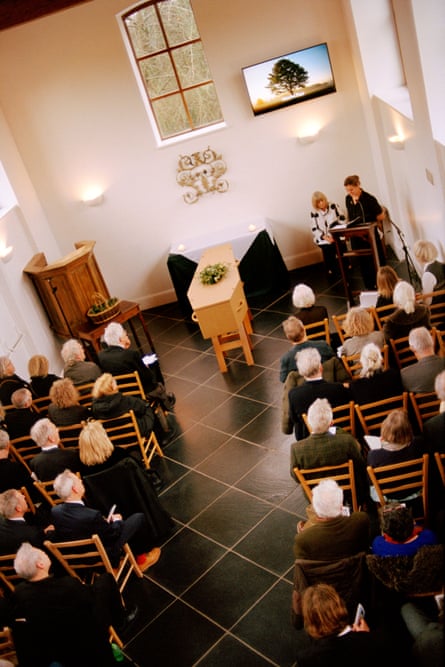
As Martin died at the beginning of the Christmas period, we had several weeks to plan his funeral. Ellen and I thought very carefully about what we should do and ended up with a fittingly homemade event. We planned the ceremony so that Martin’s family, friends and colleagues could talk about every stage of his life, from childhood to setting up the foundation. We chose music that Martin loved and represented the different places we had lived: Hebden Bridge, Ireland, Wallasey, Bristol. We decided on a very simple cardboard coffin, topped with an arrangement of flowers and greenery taken from the garden of the Polygon [a terrace of Georgian houses in Bristol]. We provided a basket of rosemary sprigs that people could place on the coffin – a token of remembrance.
After the sadness of the ceremony, the reception was a real celebration of Martin, his work, and his many quirks. He adored country fetes, so we made that the theme of the reception. A friend made cakes that reproduced some of Martin’s images including sad cupcakes and a sponge in rainbow colours. We couldn’t have done all this without the exceptional support of the foundation staff. The Art of Dining attended to every detail in recreating many of Martin’s images.
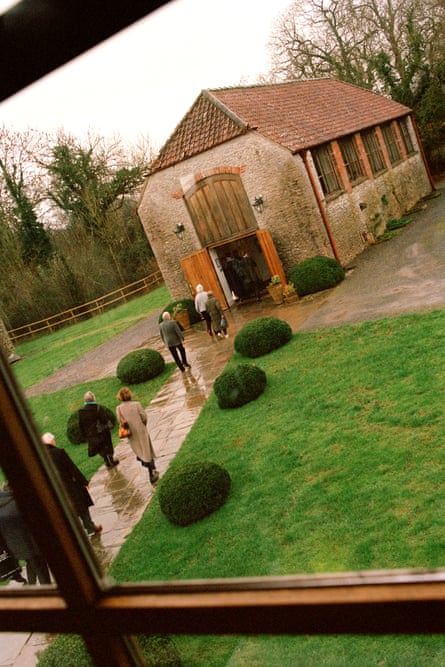
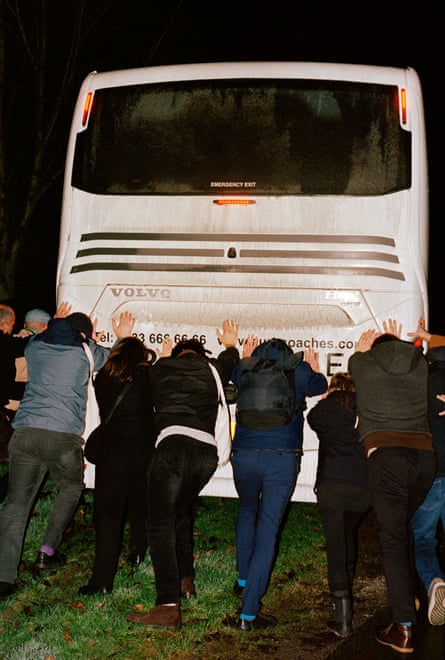
The Woodlands Memorial Garden is a beautiful space, with a simple chapel and comfortable reception facilities. One of the many benefits of this place is they give you time – our service and reception took up an entire afternoon. As the venue is located some miles north of Bristol, we decided to put on a bus for the many guests travelling from abroad who did not have their own transport. Unfortunately the bus that arrived to take people back to Bristol got stuck in the mud, and would not budge despite valiant attempts to push it back on to the road. This was a fitting and very amusing end to a wonderful afternoon. Martin would have loved it.
Tangerine Dreams is at the Martin Parr Foundation, Bristol, 6 June to 4 September.