2 months ago
106
2 months ago
106
Cutting language courses at universities and schools risks undermining social mobility and vocational skills, former education secretaries and experts in the UK have warned.
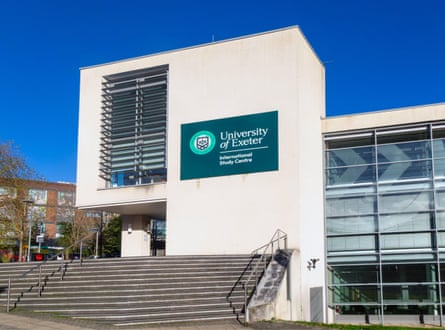
More than 70 languages academics were among 500 staff at the University of Exeter to be told last week they were at risk of redundancy as it seeks to cut 150 full-time posts, predominantly in the humanities. The announcement followed the proposal by the University of Nottingham to become the first Russell Group university to offer no language degrees.
The cuts come against a backdrop of increasingly difficult university finances and years of falling GCSE and A-level entries, which have exacerbated inequalities. Languages are now compulsory for all pupils at GCSE in only 22% of state secondaries, compared with 41% of independent schools, according to this year’s Language Trends survey.
Former education ministers and other experts said the downgrading of languages at elite universities could further harm the life chances of pupils, in particular those from working-class backgrounds.
David Blunkett, the Labour education secretary from 1997 to 2001, said: “Instead of the current tendency to go for retrenchment as the only way of balancing the books, we need universities to think really creatively. [Cutting courses] precludes you from a joined-up approach to learning. If you haven’t got a language faculty any longer in the university, it can’t link with tech and engineering, and digital, and all the other possibilities that now exist.”

Scrapping language degrees was therefore “a missed opportunity” to improve social mobility, he added, “but it needs to be linked with the revitalisation of languages in the school system, so you’ve got a pipeline”.
Estelle Morris, his successor, said: “It’s a terrible message – these are our country’s leading universities. I’d like to think that they felt they had a role to play in the solution, not make it even worse. If Nottingham or anywhere else closes down a modern foreign language degree, middle-class children might go elsewhere. But working-class children won’t.
“They will be more likely to choose a subject available to them locally. And then all the skills and job opportunities modern foreign languages give go out of the window because those pupils haven’t taken a degree.”
The warnings come as Guardian data analysis suggests that language degrees could enable students from poorer backgrounds to get into the most selective universities more easily, because there is less competition for places and grades required can be significantly lower.
Latest figures show that at the University of Oxford in 2025 there were just under 17 applicants per offer to study economics and just under 10 for every offer on computer science, law and maths. In contrast, around half of applicants for languages were offered a place. Similarly at the University of Cambridge, more than half of applicants for modern and medieval language courses got a place, compared with 14% of applicants for chemical engineering and 13% of those for psychological sciences.
Comparison of Ucas entry requirements by the Guardian shows that required A-level grades at the most elite universities are on average two to three grades lower for single honours language degrees than other popular subjects. Whereas median entry requirements at Russell Group, Bath and St Andrews universities are A*AA for maths and economics, and AAA for law, they are ABB for French, German or Spanish degrees.
At some universities the grade difference is four grades: at University College London and Bristol, for example, you need A*A*A for maths, but ABB for languages. For combined degrees the required language grade at A-level is also typically at least one lower than the two or three other A-levels studied.
Lee Elliot Major, professor of social mobility at University of Exeter, said: “Schools need to recognise that languages are a powerful pipeline for social mobility. If state schools want to improve the life chances of all their pupils, they should be actively promoting language study.
after newsletter promotion
“GCSEs and A-levels in languages are a hidden passport to elite universities, a potential social mobility pathway that could transform many pupils’ lives.”
Jo Johnson, the former Conservative universities minister, said “student choice is not formed in a vacuum”, adding: “If pupils have poor access to language teaching at school, fear harsh grading at A-level, experience weak careers advice, miss out on Erasmus-style mobility and have few local HE options, then low demand partly reflects system failure rather than settled student preference.”
The former school standards minister Catherine McKinnell said: “It is so important for young people from across the country to have the opportunity to study a language” that “offers rich transferable skills for life that should not be the preserve of the more wealthy”.
A Department for Education spokesperson said every child wanting to learn a language should be able to. “That is why we are supporting the next generation of language teachers with tax-free financial incentives to train in key subjects including French, German and Spanish.
“Universities are autonomous and make their own choices about courses – but our decision to increase tuition fee caps will shore up their finances, enabling them to continue offering a breadth of courses, including languages.”