8 hours ago
10
8 hours ago
10
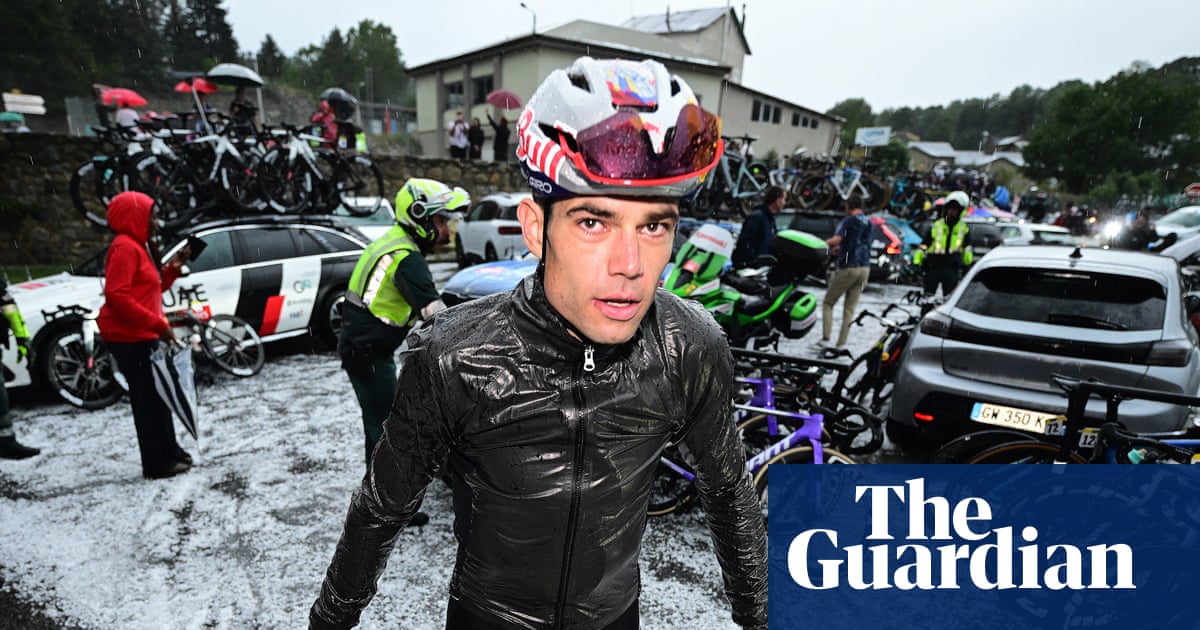
Richard Plugge, the manager of the two-time Tour de France winner, Jonas Vingegaard, has criticised cycling’s governing body, the UCI, for a lack of action following the death of the teenage rider Fin Tarling 10 days ago and said cycling’s leading teams should take responsibility for ensuring safety in races.
“Neither UCI president David Lappartient, nor anyone else, stands up and says: ‘Wait a minute, we really need to think about how we are going to prevent this from happening in the future,’” Plugge, the manager of the Vingegaard-led Visma-Lease a bike team, told the cycling website WielerFlits.
“Maybe we as teams need to take responsibility for safety in races ourselves again. The lack of anger about what has happened is very disappointing to me.”
The 19-year-old Tarling was killed during the Volta a Portugal when he was descending mid-race in pursuit of the peloton and collided with a non-race vehicle that was coming towards him on the race route, despite the road closure.
“This boy encounters a car on a descent,” Plugge said of Tarling. “Can you imagine this happening during Formula One? That a car is suddenly driving on the track in the opposite direction? This actually does happen in a cycling race.
“We are just carrying on. What disappoints me is that everyone says it is terrible, but then immediately a ‘but’ follows. We need to skip everything after the ‘but’. This simply cannot happen.”
Jonathan Vaughters, the manager of the EF Education-EasyPost team, has called for a reduction in the number of races on the professional racing calendar.
“The problem is lack of standards and oversight and the need to keep too many races that do not meet professional standards on the calendar,” he said.
“There are many races running on too small a budget to be hosting a professional-level race. We don’t need 600 days of racing. How about 100 days of racing, all of which are safe?”
While a formal investigation into Tarling’s death is now under way, neither the UCI nor the Portuguese Cycling Federation (FPC) have been willing to comment any further, particularly on media statements made by the Portuguese police (GNR) which confirmed that Tarling had been isolated and racing without a police escort.
The FPC said: “As the organiser of the Volta a Portugal, we believe it would be neither appropriate nor responsible for us to speculate on matters that are currently being investigated by the competent authorities.”
The UCI said: “As the circumstances surrounding the incident are still being established, we will not be commenting further at this stage.”
Unlike Europe’s three Grand Tours, in France, Italy and Spain, the Portuguese race, like many other smaller events, operates a rolling road closure, which relies on secure policing at the front and back of the race convoy.
Rolling road closures were highlighted again last week when the Australian rider Maeve Plouffe said that she had nearly been hit by a car while racing in the Tour of Britain Women.
“There is a hole in the system of rolling road closures,” the Association of Professional Cyclists president and former professional Adam Hansen told the Guardian. “We have to fix this.”
Hansen added: “The most dangerous moments I had in a race did not result in a major incident. It was pure luck that I did not die sometimes. The organisers just think if nothing happened, it was fine.”
Plugge argued that the serial failures to prioritise athlete safety meant that changes to the structure of many races had now become inevitable.
“If cycling from A to B on public roads over 200km is no longer feasible, then we must ride laps of 15, 20, or 25km, provided those routes can be 100% secured. The riders must be certain that they can race on a safe course.”