3 months ago
149
3 months ago
149
David Hockney reassured postwar Britain that it was OK to take pleasure in beauty and freedom. Emerging in the late 1950s, when the energy released by the artistic revolutions of half a century earlier had dissipated into dull academicism or tiresome machismo, his unabashed celebration of conventional forms of beauty revitalised modern painting. These coolly sentimental double portraits and domestic scenes celebrated the liberated (if not uncomplicated) lifestyles made possible by the economic and social reforms of the period, without the angst or irony afflicting the work of those peers for whom these changes were more ambivalent. (If you were working-class and gay, after all, what wasn’t to like?)
To call Hockney a gifted sentimentalist is no backhanded compliment. In this he resembles Andy Warhol who, for all that he is painted as some arch manipulator, was distinguished by the purity of his love for the fruits of the capitalist US and his genius for communicating that love to those who shared it. Hockney’s work, for a decade after about 1963, should likewise be treasured for disproving the lie (maintained by those who prefer to read about paintings than look at them) that great art must be difficult to comprehend, despise the everyday world, and remain inaccessible to a wider public.

But then, lamentably, the critical sniping seemed to catch up with Hockney. Whether because he was anxious to be taken seriously or had run out of steam, an era-defining painter retreated into ill-advised historical dialogues with Picasso and Van Gogh, and started experimenting with media from set design to fax machines (with mixed results). And so our greatest pop artist entered his jazz phase. For the past 50 years, Hockney has flitted between these two modes, returning occasionally from noodling to remind us of his gift for direct communication (see his portrait of the performer Divine, the affecting drawings of his ageing mother, or his paintings of the Yorkshire landscape in the 2000s). But, sad to report, it is to the late stages of the jazz tendency that most of this exhibition belongs.
At its heart is the 90-metre long frieze titled A Year in Normandie. Dramatically installed to run like a ribbon around the perimeter of the Serpentine’s North gallery, this monumental print depicts the changing landscape around Hockney’s house in France through the seasons. It is constructed out of about 100 separate digital images, each of which was composed by running a rubber-tipped “brush” across the screen of an iPad. These pictures have been collaged together on a computer, enlarged to meet the dimensions of the gallery, and then printed on to a single strip of paper to tell a story about the seasons, as the Bayeux tapestry tells a story about a conquest. Theatrically lit and presented against a dark-blue wall so that it glows like a screen in a dark room, the curators have made of it an impressive visual spectacle that will reproduce well on phone screens. Which is an intelligent decision, because in reality it is underwhelming.
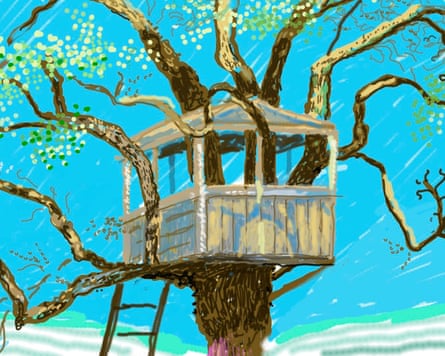
A Year in Normandie expresses a pet theory of Hockney’s, namely that the single-point perspective of what we call “realist” painting does not describe the way that humans see. This sounds abstruse, but is easily demonstrated. You are reading the Guardian, and so are likely in the vicinity of a potted plant. Close your right eye and look at it. Now close your left and do the same. You will have observed two different pictures through your two “windows” on the world; when both are open, your brain stitches their images together to create a seamless composite. Unlike cameras, we do not see from a single position in isolated instants, but are always consolidating information – from different viewpoints, and the memory of them – to create the illusion of narrative continuity. Hockney runs with this idea to construct a “many-windowed” perspective on the landscape, composed of multiple moments in space and time.
All of which is interesting in the abstract. But the revelation that every picture is a construct only matters if the painter can make you believe in theirs. And I cannot believe in this picture. It is undone by the details: the joins between each panel are unaccountably messy, the clangorous colours resist even determined efforts to harmonise them, and occasional nice touches – a shimmering reflection, a veil of lilac rain – cannot escape the limitations of the medium. Nor can this artist escape his own vernal temperament, which infuses even shedding trees with that slightly chill impression of possibility that presages spring. Yet the greatest problem is the picture’s artificiality: by rejecting the “mechanical” perspective to which photographs have accustomed us, Hockney has defected to an equally confected “painterly” way of seeing. Taken as a whole, the work resembles nothing so much as Normandy run through a digital filter trained on every painting made in the region between about 1880 and 1940, from Monet’s poplars to Raoul Dufy’s wheatfields.

The most successful works in the show, by a considerable margin, are two portraits evincing the close attention that painting in acrylic demands and that personal relationships facilitate. Hockney’s partner, Jean-Pierre Gonçalves de Lima, appears to have been caught in the act of looking up from his phone. His expression is at once ironical and indulgent, suggesting that he has only agreed to sit for this portrait under duress and on the condition that he can answer his emails. It calls to mind Hockney’s justly celebrated 1977 portrait of his parents, in which his father, bored by the process, is engrossed in a book, while his mother looks dutifully, lovingly out towards the easel. A second portrait of the artist’s nephew, while less compelling, offers more glimpses of Hockney’s ability to conjure character as charged by affection.

But even these portraits are marred by their subjects’ placement at tables presented in distractingly steep reverse perspective. Not so much nods to Van Gogh and Cézanne as violent kicks to the viewer’s shins, these tables reappear in five “paintings within paintings”. Besides making the tired point that every painting contains elements at once abstract and representative, this treatment of artworks as arguments or guessing games seems to me a betrayal of Hockney’s connection with audiences far beyond those who, to paraphrase Baudelaire, go to the Tate and stand in front of the masterpieces only so that they can believe themselves cultured.
The real connoisseurs, and the people to whom Hockney’s work has always so appealed, are those who can find beauty in whatever surrounds them. When I leave the Serpentine gallery, the sun has overwhelmed the morning’s clouds and Kensington Gardens are in bloom. Spring has arrived, as it has been threatening to for several paragraphs, and a violently blossoming magnolia tree on Exhibition Road seems entirely unconcerned that it may appear derivative or kitsch to passing art critics. The lesson of Hockney’s best work remains the same: even in these deeply dispiriting times, we must be allowed to take pleasure in the world.
-
David Hockney: A Year in Normandie and Some Other Thoughts About Painting is at Serpentine North, London, 12 March to 23 August