3 months ago
104
3 months ago
104
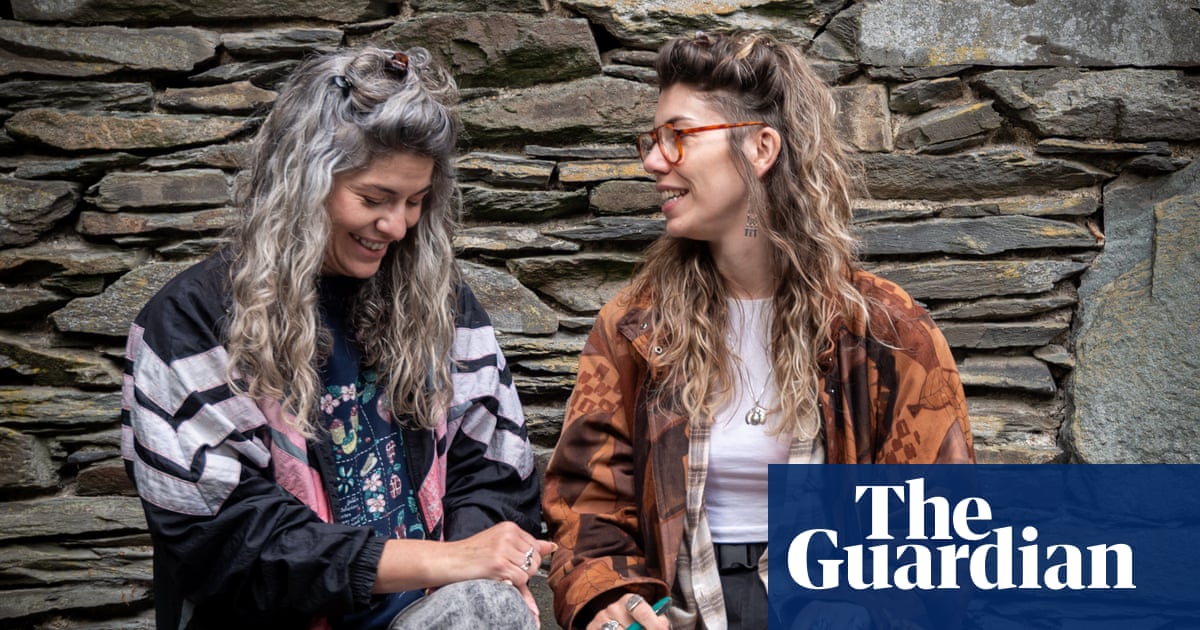
It was while reading a landmark report about the poor health of people who live on the English coast that documentary photographer Polly Braden had her big idea. “I was just blown away by it,” she says. “I thought: this is about England. And it affects all of us.”
At the same time, as a single mother of teenagers, she had become interested in the lives of young people who had grown up under austerity, lived through a pandemic and were becoming adults during a cost-of-living crisis.
What is the Against the tide series?
ShowOver the next year, the Against the Tide project from the Guardian’s Seascape team will be reporting on the lives of young people in coastal communities across England and Wales.
Young people in many of England's coastal towns are disproportionately likely to face poverty, poor housing, lower educational attainment and employment opportunities than their peers in equivalent inland areas. In the most deprived coastal towns they can be left to struggle with crumbling and stripped-back public services and transport that limit their life choices.
For the next 12 months, accompanied by the documentary photographer Polly Braden, we will travel up and down the country to port towns, seaside resorts and former fishing villages to ask 16- to 25-year-olds to tell us about their lives and how they feel about the places they live.
By putting their voices at the front and centre of our reporting, we want to examine what kind of changes they need to build the futures they want for themselves.
Photographing the lives of young people in coastal towns would, she thought, tell a story about our “island nation” and shine a spotlight on 16- to 25-year-olds who are growing up, unsung and overlooked, on the neglected fringes of England and Wales. “It’s about reaching the edges,” she says.
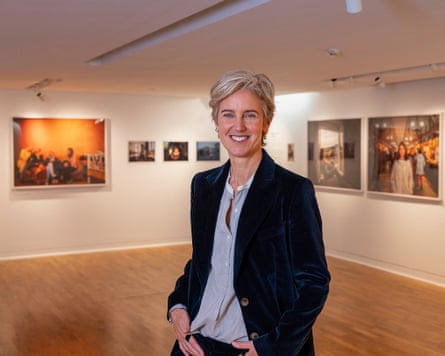
Braden has collaborated with the Guardian’s Seascape section to produce our groundbreaking Against the tide series, a wide-reaching year-long journalism project reporting on the lives of young people in coastal communities across England and Wales.
Now, Braden’s work will form a touring exhibition which opens at Arnolfini gallery in Bristol in June and moves to Colchester’s Firstsite gallery in October.
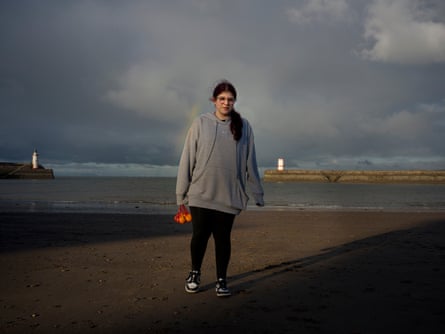
Highlights include a photograph of Libby, a young woman from Whitehaven in Cumbria, who is depicted on a beach underneath a gloomy sky, holding a bag of oranges. A rainbow is faintly visible in the centre of the image, behind her right shoulder, giving her a slight halo as she looks down, away from the camera. “There’s beauty in it,” says Braden. “And there is bleakness.”
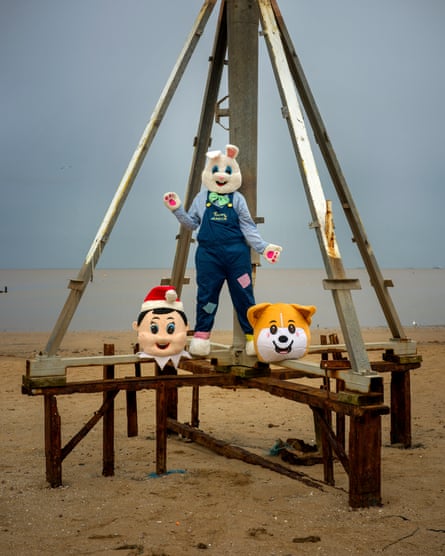
Another photo shows Cohen, a young man from Grimsby in Lincolnshire, dressed as an Easter bunny. “Cohen has a learning disability and has been trying to get a job,” says Braden. He wore the outfit because, unable to get work locally, he has set up his own business as a mascot at parties. “He’s become an entrepreneur,” she says.
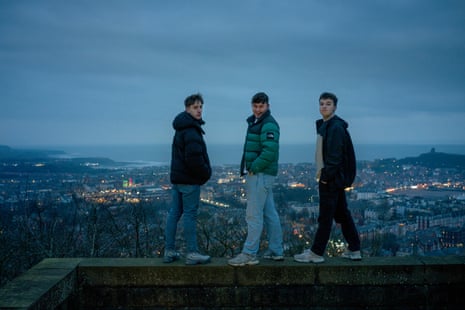
In Scarborough, she photographed Jake, Keane and Charlie on a wall on Oliver’s Mount, looking away from the Yorkshire coast. “They took me to where they hang out,” says Braden. There is something powerful about the trio in the image, she thinks, because the photo has a kind of momentum to it. “You wonder if there’s a big drop on the other side of that wall. There’s a bit of trepidation.”
Braden’s exhibition marks the end point of over a year of work, funded by the Arts Council, and published alongside writing from the Guardian.
Braden, 51, who was born in Perthshire in Scotland, is based in London and has never lived on the English coast. But for Holding the Baby, a 2021 photojournalism project about lone parents, she spent a lot of time in Brighton and Liverpool talking to young single mothers about the pressures and financial challenges of parenting alone in coastal communities, where there is often less work.
In the past, Braden has also worked with young people with learning disabilities who have been through the criminal justice system and with young Ukrainians trying to start new lives in different European countries.
I’m interested in unheard, overlooked or stereotyped stories,” she says. “In this series I wanted to challenge the idea that young people are lazy or disengaged and instead show their creativity, resilience and care of their community”
Since winning the Guardian young photographer of the year award in 2002 and the Jerwood photography prize in 2003, she has exhibited her work all over the world, including at the Institute of Contemporary Arts in London and the Museum of Contemporary Photography in Chicago.
Alongside Braden’s work the exhibition will feature photographs taken by young people on the coast at workshops she has organised. Turned into postcards, these contain messages sent between the young people involved. “Weston-super-Mare is writing to Blackpool and Blackpool is writing to Whitehaven … They’re talking about what it’s like to grow up in their area,” she says.
The postcards highlight how young people living far away from each other are connected by a shared experience of growing up on the geographic and socioeconomic periphery of England and Wales, she says. “The combined coastline of England and Wales is 5,581 miles long. By bringing these voices together, we can highlight the shared challenges faced by young people living on the coast.”
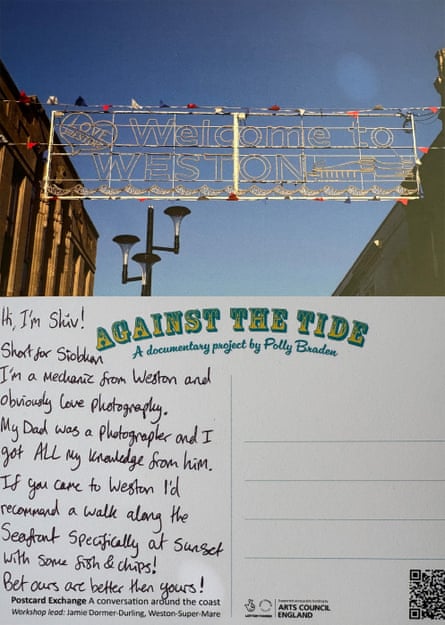
Visitors to the exhibition will also be invited to write postcards and share their testimonies about how they feel about the coast. They can also view a film about a year in the life of four young people who attend a dance and youth-culture hub called House of Wingz in Blackpool. It draws attention to the dilemmas and difficulties young people face when they have to leave coastal towns in order to excel in creative careers, and the resilience – and hope – they need to follow their dreams in challenging circumstances.
Support from youth clubs, charities and education programmes can be vital, Braden says, and yet many have had their funding cut by successive austerity policies.“Three-quarters of youth services have closed. How did we let that happen?” she asks.
Braden knew from the start that visiting the communities she wanted to document multiple times and having “sustained” contact with the people she was photographing was key. “The last thing I wanted to do was go to Blackpool, take a couple of photographs, leave and never go back again. That way everyone would feel dissatisfied and used, once again, to tell a miserable story of deprivation.”
Instead, her aim was to listen, and collaborate to celebrate the talent and creativity coming from coastal communities, showing the aspirations of young people and highlighting that given the right resources, they will thrive just as much as their peers in more affluent areas.
“I want people to look at these pictures and go: oh wow, young people [on the coast] do so many different things … they’re amazing, they’re really fun. Let’s celebrate – and remember – who they are: they’re full of life, and given opportunities, they can thrive like any other kids.”
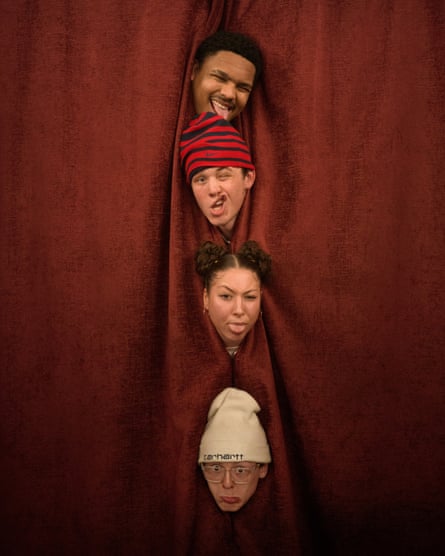
The project has taught her how important it is for politicians and policymakers to listen to young people living on the coast who need their help. “Just go and sit in that youth centre. Have conversations. Because the young people are really powerful. They know what they want and they will tell you, if you listen.”
-
Polly Braden: Against the Tide, in collaboration with Guardian Seascape, runs from 27 June to 27 September at the Arnolfini gallery in Bristol, and from 1 October to 1 March 2027 at Firstsite in Colchester.