2 months ago
82
2 months ago
82
As the hunger strike by Palestine Action-affiliated prisoners dragged on, it seemed to be moving towards an inexorable and grim conclusion.
With those taking part steadfast in their demands and ministers refusing to even meet their representatives, it began to seem that only a death might end the protest; and even then it was unclear what the others refusing food would do.
But late on Wednesday, Prisoners for Palestine announced that Heba Muraisi, Kamran Ahmed and Lewie Chiaramello were ending their action. Four others, who had also been on hunger strike but were officially on a “pause”, would be doing likewise.

The announcement came on day 73 of Muraisi refusing food, the same number of days as reached by the Irish republican hunger striker Kieran Doherty, who survived the longest of 10 men who died in a 1981 action.
Shahmina Alam, the sister of Ahmed, who she said stopped his strike on Tuesday (day 65 for him), spoke of her relief. “For the first time I woke up today not afraid,” she said. “We don’t need to think about the prospects of more health complication.” At the same time, she stressed that residual fear remained over the re-feeding process, which is in itself precarious.
The end of the action was presented as a victory, sealed by the government’s decision not to award a £2bn defence contract to Elbit Systems UK, a subsidiary of Israel’s largest arms producer. This was described by Prisoners for Palestine as a key demand of the hunger strikers and this was partially true.
One of five key demands was to shut down the UK sites of Elbit, which some of those refusing food are accused of targeting. While this has not happened, within that demand was a requirement not to grant the Ministry of Defence contract to Elbit Systems UK, which would have seen it train 60,000 troops a year.
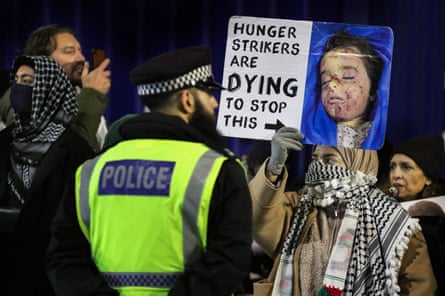
Francesca Nadin, of Prisoners for Palestine, said: “We’ll never know for sure but it’s quite clear to me that all of the campaigning, whether it be the hunger strike, whether it be Defend Our Juries, whether it be the judicial review [challenging proscription of Palestine Action], all had an impact on that, because now the public is talking about this in a way that wasn’t happening before.”
Alam said her brother had been feeling “deflated” about the prospect of stopping when she spoke to him on Monday, as he did not feel enough progress had been made towards the demands, but he had succumbed to pressure from those close to him. However, she said the news about Elbit would cheer him up and Nadin said Muraisi was very happy when she told her about it on the phone.
Other key demands were clearly not met, such as immediate bail for the prisoners – none of whom have been convicted and all of whom will have spent well over a year in jail before trial – and the de-proscription of Palestine Action. However, the latter is still a possibility through the judicial review, the decision of which is keenly awaited.
Prisoners for Palestine also pointed to other “victories”, including, it said, HMP New Hall, in Wakefield, agreeing to Muraisi’s transfer back to HMP Bronzefield, in Surrey, which is near her family and friends and from where she was moved last year. Another key demand had been to end the censorship of communications and, to that end, it said that, during the hunger strike, some of the prisoners started receiving bulk packages of withheld mail.
They might also note that the death of the hunger strikers would have been a devastating loss which might have achieved little beyond what has already been secured – and that the sacrifice to their health has been enormous.
While they did not get all of their demands, nor did the Irish republican prisoners in the last hunger strike of such scale and longevity in a UK prison, yet they were retrospectively recognised as changing the course of the Northern Irish conflict.
This is not to say that the results of the modern protesters’ action will be on anything like the same scale. But with the US congresswoman Rachida Tlaib posting on X about their plight, intervention by UN experts, and international news coverage, they drew attention to their cause as well as wider problems in the prison system. And Prisoners for Palestine said that, in the last few weeks, 500 people had signed up to take direct action – more than the amount of people who did so with Palestine Action over its five-year campaign before proscription.
Nadin said: “From the very beginning – all the hunger strikers said this – it was a rallying cry to the people, and that was the big success. Demands were kind of secondary to all that, we know what the government’s like.”
Alam said: “I think their name was very much in the shadows for a while, but people are very aware of Elbit Systems now and a lot of that is due to the hunger strike.”