3 months ago
146
3 months ago
146
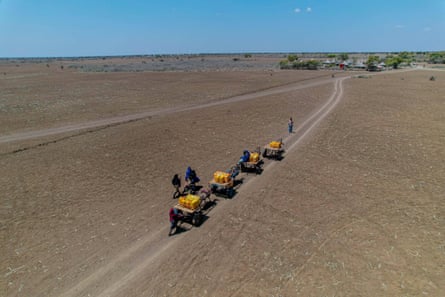
For three years, Zeynab Ibrahim watched as her little town shrivelled up and died. The rains never came, the reservoirs were depleted and the farms gradually turned to dust. Hunger and sickness swept through the village, claiming the lives of many, including four of Ibrahim’s 10 children.
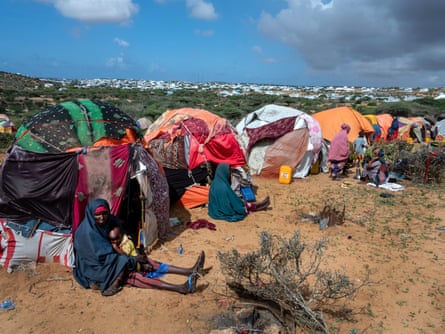
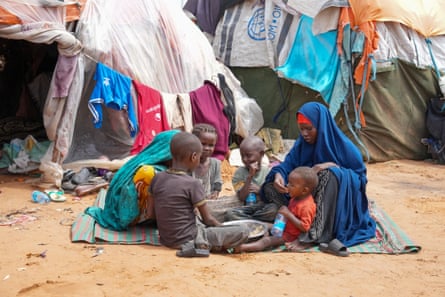
“We tried every means to survive – selling dried grass and digging up water from the barren earth. Unfortunately, there was nothing left, so we had no choice but to escape to save our children,” she says, sitting in front of her shelter in a camp for internally displaced people (IDP) in the Kahda district of Somalia’s capital, Mogadishu.
“So hunger is what brought us here,” says the 38-year-old single mother, who was helped by a truck driver transporting other families from the drought-bitten land around Burhakaba in central Somalia to the capital.
They joined more than a million displaced people who now live in abysmal conditions in informal settlements across the city.
“Our livelihoods depended on what we could grow on the ground, including maize, beans, sesame and vegetables. But the ground dried because there was no rain,” says Ibrahim, echoing the story of Somalis from across the country, where communities are increasingly trapped in a brutal cycle in which drought, floods and violence force them from their homes.
Adan Roble, 77, has lived through all three. Years of drought destroyed his crops and dried up his farmland.
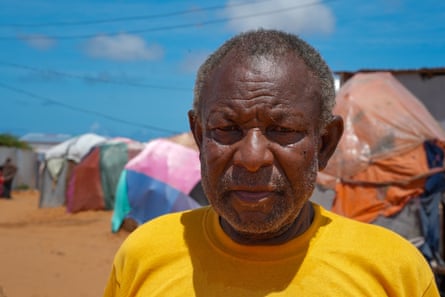
Then, last month, there were rains which, falling on the parched earth, created flooding that swept through his village near Janale town in the Lower Shabelle region. As the water washed away everything, above them the sky was full of military drones as government forces fought al-Shabaab nearby.
“Imagine losing everything and trying to survive without food and clean water, while fighting continues around you and drones keep flying overhead,” Roble says.
“We lived in fear every day, and there was no help coming, so we had to flee.”
This is not the first time Roble has had to move. Two years ago, the fighting pushed him out temporarily to an IDP camp in Afgoye town.
“It is hard to raise children in this camp, and I do not think we will go back to our village any time soon,” he said. “The only thing we have now is hope that things will get better.”
More than 6.5 million Somalis have been pushed to the brink of severe hunger – nearly a third of the population. Internally displaced people are the worst affected, living on overcrowded sites with limited access to water, sanitation, health and hygiene facilities.
Ibrahim and her six surviving children share a small hut they made from sticks and covered with old clothes and plastic, offering little protection from the elements.
The situation is aggravated by the significant international humanitarian aid cuts and President Donald Trump’s war on Iran, with the closure of the strait of Hormuz driving up the cost of fuel, food and transport.
Children are bearing the brunt of the crisis, with nearly 1.9 million under-fives facing acute malnutrition, according to the latest integrated food security phase classification (IPC) report. Nearly 500 nutrition clinics have now closed because of a lack of funding, leaving children such as Ibrahim’s youngest, who is two, without care.
Malnourished children – with emaciated bodies too weak to cry – are crowding the few stabilisation centres, which are operating under immense pressure, forcing staff to make impossible choices on who to prioritise.
In the past three months, more than 700 children under five were admitted to Kismayo general hospital’s specialised facility, and 10 of them died, according to the International Committee of the Red Cross.
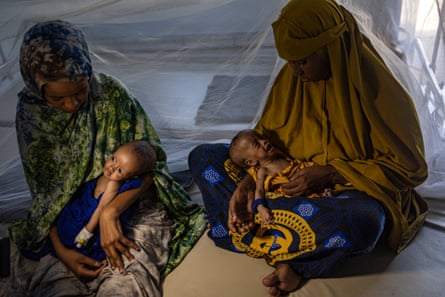
On a recent visit to Somalia, the UN humanitarian chief, Tom Fletcher, highlighted the compounding effect of the climate crisis and expressed frustration over the shrinking ability of aid agencies to respond because of severe funding cuts.
Speaking from a camp in Baidoa, he described the grim reality displaced families were facing. “On top of conflict and displacement, you have got the flash floods and the drought getting worse,” Fletcher said, “and that should make us furious, about the lack of humanity being shown at this moment – this moment of reckless geopolitics, of war, conflict, indifference and cruelty.
“It just frustrates me because we are running out of ways to try to drive this message home, about the reality for so many people in need right now globally. And we can’t understand why people will not listen, why people will not hear the voices of the mothers and children that I am meeting here,” he added.
The worsening humanitarian crisis in the Horn of Africa comes against a backdrop of high political tension, which analysts say will only hamper efforts to help displaced Somalis.
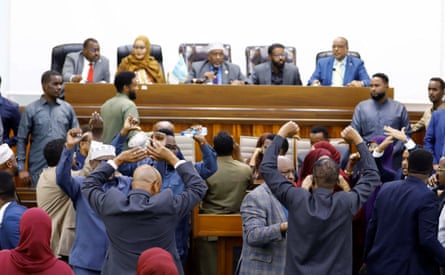
The federal parliament’s mandate ended on 14 April, while the president’s term expired on 15 May. Controversial amendments extended their terms but opposition leaders, including the former president Sharif Sheikh Ahmed, accused the government of President Hassan Sheikh Mohamud of illegally extending its mandate and seizing public and private land.
They called for a public rally against the government this week, but police dispersed the demonstration, with reports that one civilian was killed and several others injured.
“Those who took to the streets today were unarmed civilians expressing legitimate grievances,” said the former prime minister Hassan Ali Khaire on X. “No opposition forces were present among the demonstrators. The only armed actors at the scene were government security personnel deployed under the authority of the federal government,” he wrote.
“The use of lethal and excessive force against peaceful civilians constitutes a grave violation of fundamental rights, including the rights to life, peaceful assembly and freedom of expression. Those responsible must be held accountable.”
After the protests, the government said peaceful demonstrations were lawful, but warned against “any attempt to convert lawful protest into armed confrontation [and] disruption of public life”.
The situation remains tense as opposition leaders vowed to continue the protests, while analysts warn that renewed instability would only worsen the suffering of millions already reeling from the worst drought in decades.
“The political situation in Somalia has entered a critical stage, as the four-year mandate of the current federal government leadership is coming to an end without a political agreement on the next federal electoral process,” says Mahad Wasuge, director of the Mogadishu thinktank Somali Public Agenda.
“Key national political stakeholders are not currently part of the direct elections that the federal government has been working on over the past years. We do not know how long the demonstrations and stalemate will continue.
“As this is a pressing and critical political development, the humanitarian situation and efforts to address humanitarian emergencies seem secondary. I do not see a refocus on the humanitarian situation from the leadership without dialogue and agreement on the national electoral process.”
In the Kahda camp, Zeynab Ibrahim says she has not received any support from the government or aid agencies since arriving two months ago. She relies on neighbours, who are also struggling to make ends meet. With her children, every morning she goes to Mogadishu’s Bakara market to beg.
“We are lucky if we get one meal a day,” she says. “I’m not healthy enough to work, and I don’t have any skills other than farming. I just walk around the market asking people to help feed my children.
“We need support from everyone including the government, aid agencies, the Somali people and anyone who can come to help us because we desperately need help,” she says.
For Roble, in addition to the daily struggle for food, shelter and water, he is deeply concerned about his children. He said the challenge of accessing basic services has become so overwhelming that education is no longer even part of the conversation.
“No one even talks about school here,” he says. “I fear my children will not have a future.
“I’m old, weak and cannot do much to support my children. Their mother goes out to wash clothes for people in the city. And sometimes when she fails to find a job, she resorts to begging to avoid coming back home empty-handed,” he says.