3 months ago
133
3 months ago
133
Aidan Doyle was an estate agent in Liverpool before he decamped to Dubai and turned a £30,000 annual income into £500,000 a year and climbing.
Acting as an agent for buyers and sellers, Doyle has seen his commission soar beyond anything he could hope to generate in the UK after just three years in the city, one of seven city-states in the United Arab Emirates.
Dubai is becoming a significant threat to the US, Europe and the UK as a destination for bankers, hedge fund managers, lawyers, accountants and the people offering services that facilitate their globetrotting, including travel and estate agents.
These days its lure is so potent, the city, nestled on the eastern side of the Arabian peninsula, has attracted both young entrepreneurs such as Doyle and more established figures. They have quit the UK to benefit from the ultra-modern facilities on offer such as 5G telecommunications and state-of-the-art hospitals, to register their businesses, buy vast live-work spaces, and trade with the rest of the world.
Last year, the billionaire steel magnate Lakshmi Mittal joined a long procession of wealthy incomers after saying he was quitting Britain for Dubai in protest against Labour’s abolition of non-dom status – a previously longstanding arrangement that allowed him to keep his wealth offshore free of UK tax.
The 75-year-old, who bought a palatial home in a gated community known as the “Beverly Hills of Dubai”, was recently joined by Mukesh Ambani, often referred to as Asia’s richest person.
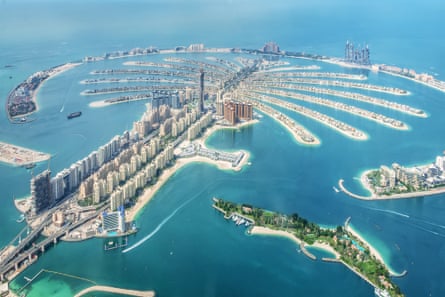
Ambani bought one of Dubai’s most expensive home on the beachfront estate of Palm Jumeirah. The property has 10 bedrooms, Italian marble, a 70-metre private beach, and set him back $163m (£120m). As one local real estate consultant posted on TikTok: “This isn’t a home – it’s a statement.”
High-profile celebrities such as the former tennis player Roger Federer and the footballer Cristiano Ronaldo have also bought expensive homes in Dubai.
As a measure of the city’s popularity, figures from the international estate agent Knight Frank reveal a frenzied trade in property last year. It reported that more homes worth $2.5m to $10m were bought in Dubai than any other city in the world in the fourth quarter, ahead of New York, Los Angeles, Hong Kong and London.
In the $10m-plus bracket, there were 9,050 sales in Dubai compared with 6,577 in New York and 3,089 in London. In 2022, the UK capital was kingpin and sales of $10m-plus homes reached 5,826 against 4,543 in Los Angeles and 3,982 in Dubai.
However, legions of middle-income fortune hunters are also swelling the 4-million population by about 200,000 a year.
One of Dubai’s main attractions is zero income tax. The local government relies on sales taxes, a modest corporate tax, and substantial administration fees and charges levied by public authorities for the money to provide state services.
During the pandemic Dubai became famous as a host to thousands of professionals working virtually, and for the prominent band of influencers who could dispense their advice and services against a backdrop of permanently blue skies and golden sands.
While the zero tax on income played a part, so did the relatively short flight from Europe, which compares favourably with travelling to and from places such as Singapore.
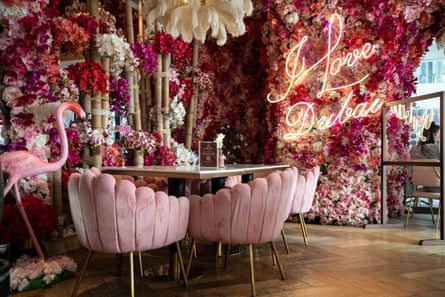
Professional migrants also like the strict street-crime laws, which keep Rolex and Ferrari theft to a minimum, and the relaxed attitude of the government to residencies, allowing anyone with a visa the chance to use the city as a base from which to mastermind their growing fortunes.
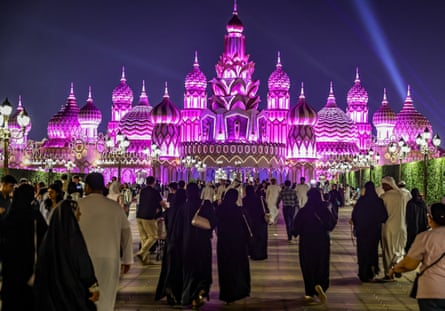
To complete the picture, there is the hi-tech digital infrastructure, an abundance of luxury properties, 12 Michelin-starred restaurants, and a growing number of business and cultural events all year round.
Such is the mix of people joining the 200,000 incomers each year, the band Madness jetted into Dubai for a gig last November while performances of the musical Wicked will occupy the city’s opera house for much of this month. Migrants from Russia make up a large minority, hence the performance last month of the Nutcracker by the Russian State Ballet at the Zabeel theatre.
Many of the 1 million or so Russian-born residents arrived after Vladimir Putin ordered the invasion of Ukraine. Flights between Russia and Dubai were maintained well after the war started, and the Gulf city allowed Russian incomers, as with others seeking residency, a visa in return for the purchase of a property or sizeable deposit account.
Critics of Dubai say the authorities ignore money laundering, organised crime and crypto-currency trading that would not be tolerated in London or New York.
The UAE government denies this and points to a move last year to deport Sean McGovern, a leader of the Kinahan organised crime group, which smuggles much of the cocaine that enters European markets. He was flown from the UAE to Ireland in the first extradition of its kind between the two countries.
It is understood the gang’s founder, Christy Kinahan, and his sons Daniel and Christopher remain in Dubai and their children attend local international schools.
The UAE has put in place financial regulations covering digital money that other jurisdictions, including London and New York, are struggling to piece together, according to the economist Brunello Rosa.
Rosa, who counts many central bank executives as close contacts, recently co-wrote the book Smart Money, which describes how digital money fits into three layers – central bank coins at the base, followed by a layer of money issued by private financial institutions and lastly, cryptocurrencies.
He says: “So far, one of the only jurisdictions that seems to have recognised the importance of implementing this ‘pyramid’ of digital currencies is the UAE.”
Nigel Green, the chief executive of the investment group deVere, says: “Dubai is what happens when a trading and commercial hub, a tax-efficient jurisdiction, and a future-focused vision all move into the same geographically advantageous location.
“You’ve got a city where roughly 85-90% of residents are expatriates, all here to work, build and invest. Capital follows energy like that.”
But incomers soon discover a huge disparity in pay between the richest and most other workers, says Azad Zangana, an economist at the consultancy Oxford Economics, who has lived in the city for four months.
“The level of disparity in pay levels is much higher than in Europe, but there is a range of housing and amenities in surrounding places that reduce the cost of living,” he says.
Zangaza says traffic is the main problem across the region. That, and the summer heat, which can rise to 50C. Workers who have returned to the UK have also complained about a long-hours culture that means high pay is diluted.
Doyle, an Instagram star since a series of hit videos laying out his investment philosophy, admits he misses the English countryside, but there is a nearby park and the city is becoming more family-oriented. And if he wants to see a greener environment, Oman is not far away.
Talk of another property crash has failed to deter him from developing his business in Dubai. He says the demand for homes outstrips the number being built by a large margin.
“Dubai sells itself the more you are here. I had a three-year plan to stay before leaving, but that doesn’t exist any more,” Doyle says.