3 months ago
132
3 months ago
132
There is strong evidence that the Rapid Support Forces (RSF) committed a war crime by depriving the villagers of north Darfur of the means to produce food, legal experts argue in a new analysis published today calling for the Humanitarian Research Lab’s (HRL) revelations to be used in international courts.
The destruction of the villages, farming equipment and infrastructure all provide strong evidence of a “starvation strategy” against a population already struggling with food insecurity because of the war, says Tom Dannenbaum, a professor at Stanford Law School and a leading expert on the use of starvation in war.
“People were at the brink of starvation and objects indispensable to their survival were being destroyed,” says Dannenbaum, who co-authored the analysis alongside Yale Law School professor Oona Hathaway.
He says it was not merely the fact the villages had been attacked but the targeted destruction of livestock enclosures, as well as the forced displacement of the farmers, that led to reduced farming activity that suggested a deliberate attempt to prevent the villages from being able to produce food.
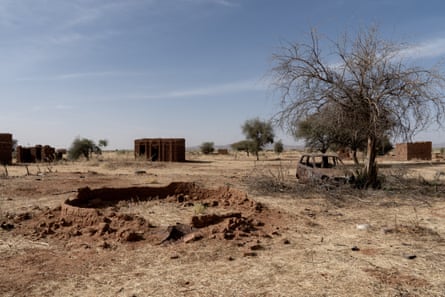
Dannenbaum and Hathaway believe the HRL research is a breakthrough in attempts to prove how a starvation strategy was imposed because of the way it uses remote sensing technologies. They also think there is potential for the same techniques to be used to investigate war crimes in places such as Gaza and Ethiopia.
“It’s evidence of extraordinary cruelty and the real horrors people have been facing,” says Hathaway. “The report provides a unique level of fine-grained, over-time analysis documenting exactly what was attacked, going far beyond our general knowledge of the fighting … [it] is of a quality that could be submitted in a court for criminal prosecution.”
The international criminal court has been investigating genocide in Darfur since the 2000s, and has issued calls for evidence related to recent violence including the takeover of El Geneina in West Darfur in June 2023, when RSF fighters imposed a months-long siege that killed tens of thousands and displaced hundreds of thousands more people from the Masalit community.
The UN human rights council has also been documenting rights violations throughout the war and last month published a report saying the RSF’s attack on El Fasher last year bore the “hallmarks of genocide”, including a siege that imposed conditions designed to destroy non-Arab communities including the Zaghawa and Fur.
There have also been investigations into the “genocidal attack” on Zamzam in April 2025, which at the time was Sudan’s largest displacement camp, hosting about 700,000 people just south of El Fasher.
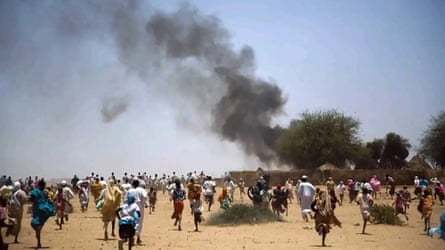
HRL’s researchers used sensors that can remotely detect the presence of fires, together with satellite imagery to monitor the locations of the attacks on these 41 villages, where it found there was a 2040% increase in fires during the period studied.
A quarter of the villages were attacked more than once, and after being attacked 68% of them show no signs of normal life. The researchers found that vehicles consistent with those used by the RSF could be identified near the scenes of the violence.
Yasser Abdul Latif, a teacher from the village of Jughmar, two miles (3km) south of Ammar Jadid, is among those who cannot return home.
Before the war he had been studying in El Fasher but returned home to help his family farm and wait out the fighting.
Men on camels would often come to raid the village and, not far behind them, there were always armed men on trucks to intimidate anyone who considered resisting.
Then, one day in March 2024, the situation escalated. Abdul Latif saw smoke rising from neighbouring villages; reports arrived that the people of Ammar Jadid had fled. By the afternoon, the RSF fighters had arrived in Jughmar.
“We heard gunshots and everyone started running, no one understood what was happening,” he says.
He saw the fighters kill two people – one who had tried to defend his house and another who had been running to find his family. The raid continued until sunset when the fighters moved on to the next village.
But they returned later that night as the villagers were burying their dead, forcing them to flee to Golo, a village where the displaced from Ammar Jadid and other nearby communities were already gathering.
“The next day they started to burn Ammar Jadid, Jughmar and so many villages,” says Abdul Latif.
The attacks on villages began just months before the siege of El Fasher. HRL researchers believe this was part of a plan to cut the city off from the areas that fed it.
“They ripped out the breadbasket of El-Fasher as an intentional strategy to starve the city,” says Nathaniel Raymond, HRL’s executive director.
During the subsequent 18-month siege of El Fasher the RSF prevented food, water and medicine from entering the city, and constructed an earthen berm at least 19 miles long to physically prevent civilians from leaving.
Throughout the war the RSF have imposed long sieges on cities with large non-Arab communities such as El Geneina and El Fasher, before militarily taking them over.
The RSF now controls all of Darfur’s main cities but its use of siege tactics has continued in its fighting against the Sudanese army elsewhere, which has most recently been focused on the neighbouring Kordofan region.
Like Darfur, Kordofan is resource-rich with supplies of gold, oil and gum arabic, a key ingredient in cosmetics and soft drinks – Sudan provides 80% of the world’s supply. It is also the location of Kadugli, a city which alongside El Fasher, has been declared as suffering famine and where the price of staple foods such as sorghum are 1,000% higher than before the war.
In February, the Sudanese army announced that it had broken a siege on Kadugli that prevented aid trucks from arriving, but violence has continued and concerns remain that the RSF will try to reimpose siege conditions. On 20 February, a convoy of aid trucks that had waited weeks to reach the city was hit by a drone strike, killing four people.
Hunger is also growing in eastern Sudan’s Blue Nile state where farmers have not been able to access their land because of RSF attacks, leaving crops unharvested according to campaign group Avaaz, which reported that the price of flour rose 43% in January.
Raymond says that HRL’s work is evidence that the RSF is using hunger as a means of war and that unless they are investigated and held accountable, there is a threat of the same fate facing other communities.
“This report is quantitative proof of RSF’s intent, which is to prevent those they perceive as enemies from being able to feed themselves,” says Raymond. “What this means for Sudan is clear: what happened here can happen again.”