2 months ago
87
2 months ago
87
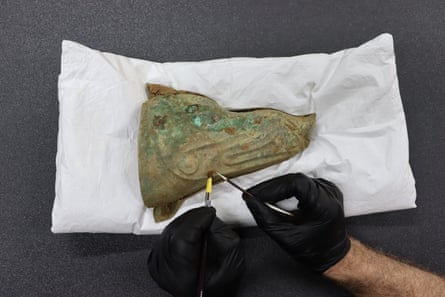
An “extraordinary” iron age war trumpet that may have links to the Celtic tribe led by Boudicca in the period they were battling the invading Roman army has been discovered by archaeologists in Norfolk.
The bronze trumpet or carnyx is only the third ever found in Britain, and the most complete example discovered anywhere in the world. Fashioned in the shape of a snarling wild animal, the object would have been mounted on a long mouthpiece high above the heads of warriors, allowing it to be sounded to intimidate the enemy in battle.
It was found last summer, during excavations ahead of a new housing development in west Norfolk, among a collection of iron age military objects, which also included a bronze boar’s head battle standard – a unique find in Britain – and five shield bosses.
Tantalisingly, the area where the hoard was discovered falls within the territory of the Iceni, the British tribe that in AD 60 staged a fierce but ultimately doomed rebellion led by Boudicca against the Roman army. Archaeologists believe the hoard was buried at some point in the first century AD.
Mark Hinman, chief executive of Pre-Construct Archaeology, whose experts made the discovery, said the hoard was “a once-in-a-lifetime, once-in-a-career find. I’ve been doing archaeology for over 40 years and I’ve never seen anything like this.”
While the artefacts are sensational in themselves, their possible connection to one of the few named figures of the British iron age make the find even more special, he said. “We are absolutely within the heartland of the Iceni – whether it was they who buried the hoard or not, we just don’t know.
“[But] almost certainly the items were buried in the first century AD, and that brings us closer to the Iceni and to Boudicca. They are of such quality that … any important people from the Iceni and other groups would have known these objects.”
The fragile artefacts are still undergoing conservation work before they can be examined in detail, but the potential link to the Iceni “is an obvious question and one that we will definitely be focusing on once we’re able to get closer to the objects,” said Hinman.
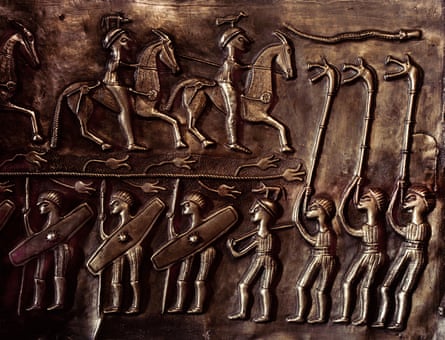
A number of Greek and Roman writers described warrior tribes in Britain, Gaul and elsewhere sounding carnyces to terrify their enemies. “Their trumpets are of a peculiar barbarian kind; they blow into them and produce a harsh sound which suits the tumult of war,” the Greek historian Diodorus Siculus wrote in the first century BC. The Gundestrup cauldron, found in Denmark and dating from the same period, depicts three players holding their horns aloft.
Part of a boar’s head carnyx, until now the only surviving example in Britain (after another was melted down by antiquarians), was discovered in 1816 in Moray, northern Scotland; it is now in the National Museum of Scotland (NMS).
Fraser Hunter, iron age and Roman curator at NMS and a leading authority on carnyces, described the new find as “extraordinary” and said it would “add enormously to our understanding of the iron age world. I’ve looked at carnyces from around Europe, and the full research and conservation of these incredibly fragile remains will reshape our view of sound and music in the iron age.”
The newly discovered carnyx shows signs of repair, said Hinman, indicating it was in use over a long period. While it was partially dismantled before being buried, with the shield bosses placed carefully on top, “the whole of the bell and the head are relatively complete – and it’s the only one that’s ever been found where they haven’t taken the ears off. It’s got these great big flappy ears which are wonderful, and they’re still in place.
“Objects like this remind us how little we know about so many different aspects of our past. These objects had names, people thought they were imbued by power. They may even have thought that they were alive at certain times in their existence – and all of the stories that go with them are lost.”
Looking at the carnyx, he said: “It’s hard to describe, but you kind of feel like it’s looking back at you. It’s quite a thing.”
Currently in the care of conservation experts at Norfolk Museums Service, the hoard’s legal status currently sits with a coroner who will decide on its future according to the Treasure Act 1996.
The discovery will be featured in the second episode of the new series of Digging for Britain, which will be broadcast on BBC Two on 14 January at 9pm.