2 months ago
85
2 months ago
85
It was not without satisfaction that I found my 14-year-old son making pesto the other week – for the first 13 years of his life he referred to it as either “pesto-the-bogey-man”, or “gross”. To avoid interfering and sabotaging the moment, I didn’t look too closely, so I didn’t clock the shallow bowl and immersion blender combination. I did hear the noise – a blunt churn – as the blade hit the leaves and nuts. Acting more like a leaf blower than cutter, it sent green and white oily fragments up the cupboards and over pretty much every pot, utensil and tool nearby. Impressively unfazed, he managed to scrape a good proportion of the elements into the food processor and make an extremely tasty pesto, which was mixed with linguine, green beans and potatoes. Less effective was his clearing up (mine too, for that matter), and I am still finding dried green flecks stuck to slotted spoons.
Like mash and crumble, the word pesto comes from an action, in this case pestare, which means to pound or bash repeatedly with a pestle. In much the same way, though, that mash was wedded to potato, and crumble set up home and had kids with apples, pesto came to be associated with basil, pine nuts, pecorino, garlic and olive oil. This happy combination of ingredients occurred in Genoa, in the region of Liguria, hence the name pesto alla Genovese. Such was its popularity, that the pounded sauce joined Cher, Prince and Sade in becoming a one-name celebrity. It is so beloved that some fans have suggested that other pestos are impostors.
And I understand this devotion to the classic, which is a particularly harmonious and tasty combination and a sublime pasta partner. Another thing to admire is its versatility – its beauty on soup (let Felicity Cloake be your guide here) or as part of a dressing, on pizza and baked potatoes (as per Rachel Kelly).
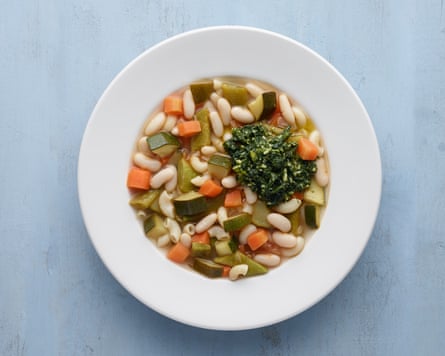
Widening the pesto parameters, though, this kind of sauce – as an ancient Roman called Columella suggested – could be made with any leaf, any nut, whatever cheese you have about, garlic if you fancy, and oil to taste – or something like that.
How about almond, basil and tomato pesto alla trapanese, a softer sauce than its Ligurian cousin and fantastic on most shapes of pasta or in a sandwich? Or Nigel Slater’s wild garlic and basil pesto, which he spreads on to hot toast and covers with mozzarella (flashed under the grill until the cheese oozes), or blobs on a spring vegetable stew of pencil-thin leeks, flageolet and broad beans? Tamal Ray also uses wild garlic in pesto, which he suggests pairing with pasta or as part of a tart.
A particularly punchy pesto is made from sage and pistachio, which can be made gentler with the addition of ricotta, and is great on toast, stirred through boiled potatoes and beans, or on top of soup (notably pumpkin and white bean), or on pasta, the heat of which wakes the scent (most shapes work). Elia Sebregondi also suggests pistachio pesto but with the addition of minced green chilli and a little citrus zest. Meanwhile, Anna Jones uses mint in her pesto, with her stew of artichokes, peas and herbs.
The other thing to remember about pesto is how easygoing it is. You can use not only whatever leaf, nut, cheese, oil you have but whatever quantity of the things you have: pound or blend them together, they will work. Just remember, when using an immersion blender, a deep bowl is best.
What I ate this week
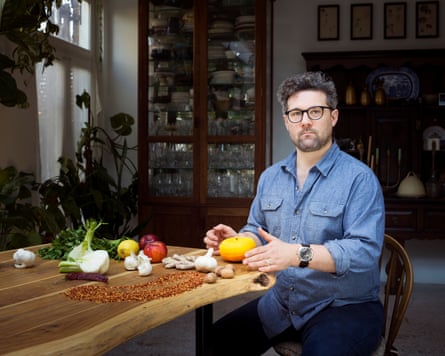
Weeknight veg | I had known Joe Woodhouse for some time before I clocked that he is vegetarian, and that all of his recipes are vegetarian. Perhaps because he never mentioned it, but maybe also because his food is so complete, brilliant and satisfying. That said, I do see the benefit of making this aspect of his cooking known to the biggest possible audience. His latest book, Weeknight Vegetarian, promises and delivers minimal ingredients with maximum flavour, celebrating seasonal eating in 90 recipes, including (for our pesto theme) spelt stew au pistou.
Chip, chip hooray! | Another of my son’s initiatives (thanks to TikTok) is loaded crisps – particularly fried egg and crispy bacon bits with an Italian brand of crisps called San Carlo 1936. I highly recommend them, as they are sturdy but also have a melting quality. I was delighted to find this batch of recipes as inspiration – although I disagree with the verdict on the anchovy and olive combination. I love it!
Eat with your eyes | A little girl and boy eating ice-cream cones, their mouths framed with white, behind them a small pavilion and the sea in Brighton; the buffet line at the mayor of Todmorden’s inaugural banquet, West Yorkshire, 1977; two men preparing lobster pots in Newlyn harbour, Cornwall. What lyrical moments photographer Martin Parr has left us with. Time looking at his website is well spent.