3 months ago
128
3 months ago
128
For 22 years, I ran around with small bags of saline water on my chest – a fact I shared with only a handful of close friends. I felt ashamed of having chosen artificial enhancement.
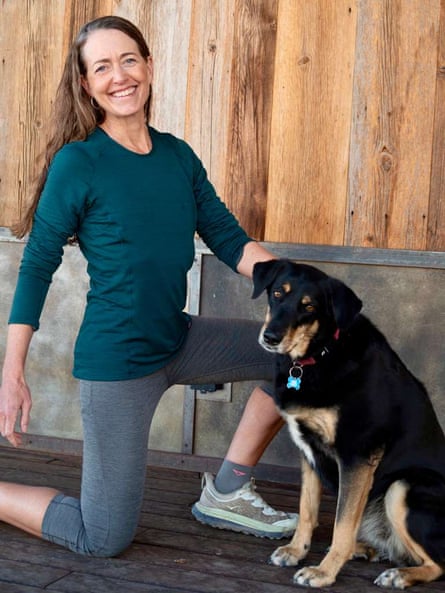
I’m an outdoorsy mountain runner. At 56, I want to model ageing naturally, but having breast implants ran counter to that. Now they are gone, thanks to explant surgery – implant removal without replacement.
I decided to speak openly about going flat-chested so more women who face implant removal or mastectomy might consider staying flat.
Like other women I spoke with who later had their breast implants removed, I originally got mine to fit a nearly impossible beauty standard: a thin body with round, fuller breasts.
My little A-cups had risen to the occasion to nurse my two babies from 1998 through 2002. They literally vanished after weaning, as if my body absorbed every cell of breast tissue. I became flatter than my husband. My fit physique developed a masculine chest that made me view my body as tough and unappealing as beef jerky.
I had been conditioned early in life, both by our culture and by parents who casually commented on “good tits”, to value the appearance of well-shaped breasts in order to please men. My mom used to test the quality of her breasts by placing a pencil under them to see if the pencil would fall or if it got stuck from the sagging. My dad used to keep his spare change in a ceramic mug shaped like a woman’s large, naked upturned breast.
It’s no wonder that after puberty hit, I padded my bras and worried about my small chest.
At age 34, I was going through a period of low self-confidence as a stay-at-home mom with a shelved career, and I was trying to redeem myself in my marriage after stupidly falling for another man’s advances. My kind, respectful husband never suggested that I get implants, but I seized on the idea as a way to make us both happier. It felt like a gift to him.
I wanted B-cup, not Baywatch, breasts, so I told the plastic surgeon: “I want runner boobs – like, ballerina boobs. I want the world’s smallest boob job.” And I got it.
The 34-year-old me wasn’t in a good headspace, and I wish someone had suggested counseling before cosmetic surgery. I also wish I had listened to my obstetrician, who said that if your breasts shrink after breastfeeding, then you’re normal and blessed that they did their job of feeding your babies.
That arc – getting implants during a period of insecurity, then feeling relief a decade or more later after removing them – is no longer unusual.
Over the past several years, demand for breast implant removal has surged. A December 2024 report by the International Society for Aesthetic Plastic Surgery found that implant removal surgeries worldwide nearly doubled between 2017 and 2022, a rise the authors describe as “escalating at a pace surpassing that of other mammoplasties” and signaling a potential shift in how patients perceive breast implants.
Jaime McDonald of North Carolina, whom I met in 2014 at an ultramarathon, got her breast implants at age 19, in 1999, when she was struggling psychologically and drinking alcohol excessively after her boyfriend took his life.
McDonald temporarily lost so much weight that her breasts shrunk to an A-cup. She told her surgeon she wanted to be a C, but she says he evaluated the implants’ fit mid-surgery and decided bigger would be better.
“I came out of surgery with a double-D, and I remember thinking, please let this be swelling. From the get-go, I was not happy with them,” she said. She subsequently regained a great deal of weight and didn’t become healthy and fit until she took up running and sobriety. At that point, she grew to dislike her artificially large and uncomfortable breasts even more.
She had her implants removed eight years ago after falling in love and marrying a woman “who loves me for me and just wants me healthy, which makes me feel comfortable and loved in my own skin”. Implant removal and a return to her small A-cup natural breasts was “the best decision I ever made”, she said. “It literally felt like a weight lifted off my shoulders. They never were me.”
My own decision to have my implants removed didn’t come all at once. Several years ago, they began to harden – like hockey pucks – making it uncomfortable to sleep on my stomach. A doctor told me it was time to replace them because I had capsular contracture, a condition in which the scar tissue surrounding an implant hardens and thickens.
About 10% to 15% of women with breast implants develop capsular contracture. The risk is higher with over-the-muscle placement, like mine – something I didn’t know when I had the surgery.
At the time I chose implants in 2004, I also wasn’t aware that my nipples could lose sensitivity (which happened to me on one side), and I paid hardly any attention to other risks or to the additional surgery I’d face in the future. The younger me focused on the short term and cared more about her looks.
The younger me also didn’t know about breast implant illness (BII), which is an umbrella term for an array of symptoms such as joint pain, rashes and autoimmune reactions that occur after breast implants (which, thankfully, I did not experience). Countless women on social media have shared stories about pain, fatigue, inflammation and rashes that they believe their implants triggered, and that explant surgery alleviated or eliminated.
Last year, I initially was inclined to replace my implants with new ones, but then I opened my mind to permanent removal and to staying flat thanks to Junko Kazukawa, an accomplished distance runner and personal trainer, who talked to me about her bilateral mastectomy from breast cancer.
I asked Kazukawa if she had reconstruction with implants or had stayed flat after mastectomy. “Flat, 100%,” she said. “I never had big breasts, but just enough to annoy me when running. The doctor also told me that if I got [implants], I’d have to replace them in about 20 years, and I don’t want surgery again.”
I realized I could be like her. I could be my flat self. Why risk new implants and face surgery again, if they hardened like my old ones or caused other complications?
My explant surgery was not covered by insurance (and cost me $5,617, compared with $8,403 if I swapped them out with a new set of implants). It left me with smiley-shaped scars under the breasts. For two weeks following surgery, I had grenade-shaped plastic bulbs hanging from tubes exiting my ribcage to drain fluid. For four weeks, I was advised to avoid high-impact exercise and heaving lifting or reaching until my chest fully healed.
While my explant surgery did not involve added procedures, many women choose a breast lift (removal of excess skin) along with their implant removal. Some explant or mastectomy surgeries also involve an “aesthetic flat closure” to remove or resculpt remaining breast tissue and leave the chest wall smooth.
I talked to my surgeon, Dr Matthew Swelstad of Grand Junction, Colorado, about explant options and why more women are getting them done. A plastic surgeon for more than 18 years, he says breast implant removal definitely has been “a growth area” in his practice.
“The overall trend [for breast appearance] is for something smaller, more athletic and more proportional, and a lot of women don’t want to wear a bra,” he said. “Size is now less important, but perky remains desirable.”
The aesthetic favored in the 1990s onwards was “truly a lot bigger”, he said, “with times changing, there are a lot of different ways to be a woman, and there’s more acceptance of those differences … You can still be feminine with a flat chest.”
While many patients come to him for explant due to perceived breast implant illness or fear of it, Swelstad said many also want their implants removed more for psychological reasons involving self-image.
“Their narrative is really similar,” he said, “and it goes, ‘I never really wanted them to begin with. I got them years ago when I was younger, and there was this other person in my life who wanted them, and I can’t believe I did this to my body.’”
Debbie Sironen, a 74-year-old athlete who lives in Idaho, had her implants removed for reasons that align with the narrative Swelstad described.
“I never wanted bigger breasts,” she said, “but my ex-husband said, ‘I just think you’d look so much better.’ When I divorced him and married the man I’ve been married to for almost 33 years, I said, ‘I really want these things taken out,’ and he said fine.”
Sironen says she would advise younger women considering implants, “Don’t do it, unless you really want to look different, but I think in the long run you’d regret it. Be happy your body works and can run, hike, work out or whatever, and just stay healthy – that’s the most important thing. Don’t worry so much about how you look and what other people think of you.”
Taking Sironen’s advice to heart is easier said than done when celebrities drastically transform their breasts, face, teeth and other body parts, and medical spas normalize injections for fuller lips and wrinkle-free foreheads.
After briefly trying Botox in my 40s – and being appalled at the cost – I said no to further injections and learned to live with the vertical lines between my eyebrows and with the folds and bags around my eyes. I’ve since come to believe that cosmetic procedures create a slippery slope: the more you do, the more hooked you become on the idea that you need to claw your way back to a younger version of yourself. It’s a trap that encourages preservation over acceptance, maintenance over meaning.
Still, having a chest as flat as a door isn’t easy. When I feel self-conscious about how I look in a tight shirt, I remind myself how much better I feel with the implants gone. My body feels wonderfully aerodynamic when I run or work out, and going braless is as freeing as unbuttoning a too-tight waistband.
As I age, it gets easier to give the middle finger to appearance expectations. At long last, I’m letting go of caring about being attractive in the eyes of others.
It’s also easier to feel at ease with my natural flat chest and walk with shoulders back for good posture when I see women I respect who made a similar choice – women like my friend Kelly Ridgway-Smith of northern California, who described her decision to stay flat after a bilateral mastectomy for breast cancer last March.
“I have absolutely no regrets” about not getting implants after the mastectomy, she said. “I like the way I am now, although sometimes I feel self-conscious. You feel like everyone is looking at your chest going, ‘What happened there?’”
Like me, Ridgway-Smith purchased prosthetic forms that can be inserted into a bra to give the appearance of small breasts filling an A-cup.
For now, neither of us is using them. “I’m getting more confident being who I am,” she said. “We don’t need that to be a full woman.”