3 months ago
130
3 months ago
130
A mass grave for 119 sailors who drowned more than 200 years ago could be exhumed to avoid their remains being exposed by coastal erosion.
HMS Invincible sank off the Norfolk coast in 1801 on its way to join Horatio Nelson’s fleet at the Battle of Copenhagen. The recovered bodies of those who drowned were buried at St Mary’s church in Happisburgh, the nearest village to the shipwreck.
Their remains are again threatened by the sea, as the graveyard is expected to be destroyed by coastal erosion in the coming decades.
North Norfolk district council (NNDC) has agreed to conduct a ground-penetrating radar survey of the graveyard later this summer to pinpoint the exact location of the mass grave for a possible exhumation.
The GPR survey follows a request from The 1805 Club, a charity that preserves naval heritage from the era. It is seeking permission to exhume the remains of the sailors, and then plans to rebury them at sea with the help of the Royal Navy.
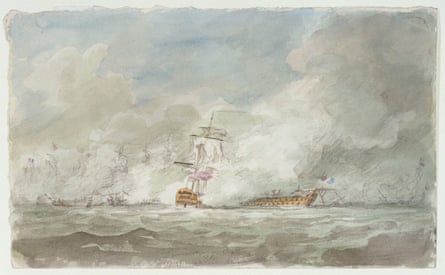
The identities of most of those who drowned are unknown, but they include the ship’s captain, John Rennie. According to a contemporary newspaper report, he almost made it to a rescue boat, but then “exhausted with fatigue he calmly resigned himself to his fate. Lifting up his hands, as if to implore the blessing of heaven … he went directly down without another struggle.”
The disaster was blamed on the ship’s pilot who ignored warnings about the presence of shallow sand ridges off the Norfolk coast. Out of a crew of 590 men only 190 survived. Many of those drowned were washed up on the beach at Happisburgh and taken in cart loads to the church for burial.
The mass grave was unmarked until 1998 when a stone was placed above it that includes the biblical inscription: “And the sea gave up the dead that were in it.”
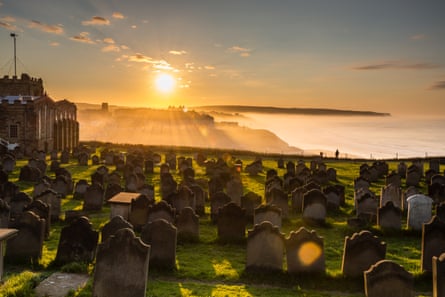
The threat of coastal erosion to the Happisburgh mass grave was highlighted in a report to NNDC. It warned that without intervention, human bones could be exposed by the sea as occurred at the cliff side graveyard at St Mary’s in Whitby, North Yorkshire, when coastal erosion caused a landslide.
Following publication of the report, John Rodgaard chair of the 1805 club, wrote to NNDC to suggest the grave should be exhumed. He said: “After reviewing the options presented, we reached a consensus that the remains should be disinterred, but not reburied at an inland location. Instead, we feel the remains should be committed to the North Sea, and as near as possible to the wreck of HMS Invincible.”
He added: “We realise that burial at sea would, in all likelihood, involve the Royal Navy.”
Ray Aldis, a historian of the Nelson Society which celebrates the life and times of the admiral, agreed that exhumation was the best option. He said: “It will have to be done. I can’t see that it being acceptable for it just to fall into the sea. It will just be a case of raising the funds. I think it shouldn’t be too difficult. This grave is unique, and there’s nothing quite on that scale anywhere else I’m aware of.”
Robert Smith, a member of The 1805 Club and secretary of the Fenland Archaeological Society, said GPR was a “non-invasive” way of locating the sailor’s remains to avoid disturbing other graves in any exhumation. “The aim will be to facilitate an accurate exhumation of the mass grave. The final resting place for the contents has not yet been decided.”
Smith said the nearest precedent was the discovery in 2016 of the remains of Scottish soldiers who died at Durham Cathedral after being taken prisoner in the Battle of Dunbar in 1650.
He added: “Those remains were treated with great respect and reburied elsewhere with the customs and services that would have been familiar in the 17th century.
“With that in mind, one possibility would be to rebury the dead sailors at sea in accordance with the Royal Navy customs and service that would have been used at the start of the 19th century.”
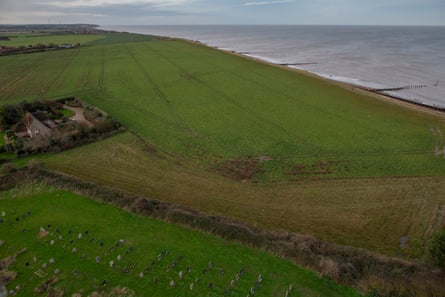
Rob Goodliffe, a coastal transition manager at NNDC, said the survey would be funded through the government’s coastal transition accelerator programme.
He said: “NNDC is working with the church at Happisburgh and the diocese to commission a GPR survey of the churchyard, including the mass grave of sailors from the 1801 shipwreck of the HMS Invincible. It is anticipated that the survey will help understand the location further and support future discussions.”
Katherine Gazzard, curator at Royal Museums Greenwich, said: “Wooden warships like the Invincible were not only state-of-the-art military hardware. They were also floating homes where socially disparate groups of men lived and worked together under constant threat of danger, both from battle and from the sea itself.”