2 months ago
132
2 months ago
132
Relations between Britain and the Pacific kingdom of Hawaii didn’t get off to a great start. On 14 February 1779 the global explorer James Cook was clubbed and stabbed to death at Hawaii’s Kealakekua Bay in a dispute over a boat: it was a tragedy of cultural misunderstanding that still has anthropologists arguing over its meaning. Cook had previously visited Hawaii and apparently been identified as the god Lono, but didn’t know this. Marshall Sahlins argued that Cook was killed because by coming twice he transgressed the Lono myth, while another anthropologist, Gananath Obeyesekere, attacked him for imposing colonialist assumptions of “native” irrationality on the Hawaiians.
It’s a fascinating, contentious debate. But the aftermath of Cook’s death is less well known – and the British Museum’s telling of it, in collaboration with indigenous Hawaii curators, community leaders and artists, reveals a surprisingly complex if doomed encounter between different cultures.
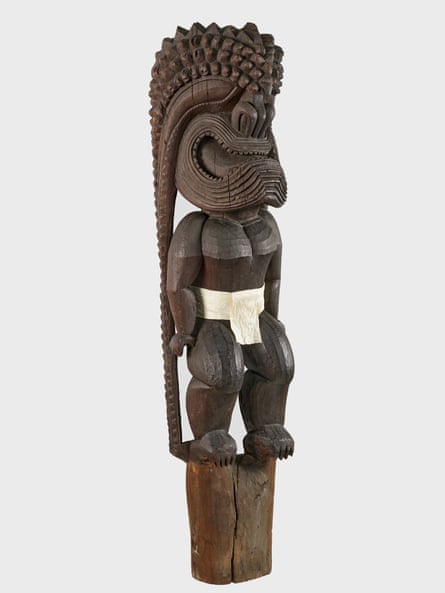
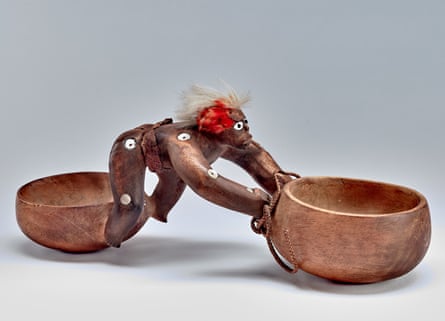
Cook isn’t mentioned in the wall texts or portrayed in the show, but his ghost is everywhere in the objects he and his men brought back to Britain. And what marvels they are. Before Cook’s voyages the peoples of the Pacific, connected with each other by epic canoe crossings that linked the Polynesians from Hawaii and Easter Island to Tahiti and New Zealand, created cultural forms that we now call art. Giant pink feathered faces of gods with mother-of-pearl eyes grimace and gurn while a club embedded with tiger shark teeth combines beauty and menace. Bowls carried by naked figures on their backs embody how Hawaiian chiefs and monarchs were feasted and respected.
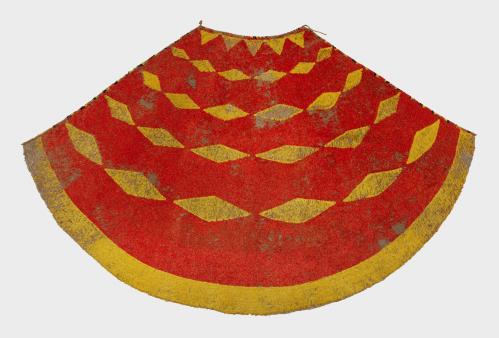
Monarchy is at the heart of this show, a common language shared by the otherwise chalk and cheese Hawaiians and Britons. After the death of Cook, which was heartily regretted on both sides, Hawaii learned, as it were, to speak British and assert its equality with a “modern” state. It worked, for a while. In 1810 King Kamehameha I sent a magnificent, feathered cloak to George III, with a yellow diamond pattern on red – on loan here from the Royal Collection which still owns it. The king apologised that he was too far away to support Britain in the Napoleonic Wars but expressed friendship – and could Britain help if Hawaii was attacked by France? The Hawaiian cloak is wittily juxtaposed here with a glittering jewelled costume worn by George IV at his coronation: idiosyncratic customs existed on both sides of the world.
Forget Cook, the show suggests: remember King Liholiho. In 1824 he and his Queen Kamamulu set out on a journey that reversed all those British “discoveries”. They set sail for Britain laden with gifts, hitching a lift on a whaling ship (the story would be even better if they’d gone by outrigger canoe). George IV seems to have been touched by the greetings from across two oceans because he received the Hawaiians in 1824 with diplomatic honours. They were seen in the royal box at the theatre and portrayed by artists. Typically cartoonists were less generous – Cruikshank portrays the depraved George IV with his arms around a tattooed Polynesian. They also visited the British Museum where they could not have missed three of its most stunning exhibits, the feathered faces of gods brought back by Cook’s team from Hawaii which are known to have been on display at that time.
The Hawaiian treasures retrieved from the British Museum’s stores are remarkable – they should have a permanent gallery to themselves. You can’t stereotype them: the fierce gaze of a martial-looking god with a chunky wooden body seems modernist, which is no coincidence because Pacific sculptures helped inspire modernism. I mistook one of the feathered godheads with its almost caricatural eye for a contemporary artwork. It was collected by Cook.
These wonders are not reliquaries of a dead culture. There’s a perfectly preserved 18th-century dance rattle, or ‘uli’uli, brought back from Cook’s third voyage, a gourd from which purple, red and white feathers sprout and radiate. A video shows Hawaiian dancers using a modern recreation of the same instrument. To Hawaiians the artistic masterpieces their ancestors made are bearers of memory, instruments of identity.
This exhibition is a celebration of Hawaii and a defence of museums with global collections. The almost miraculous preservation of delicate, fragile artworks made with feathers, teeth, wood and bark for almost 250 years is surely to the British Museum’s credit, as is this way of seeing them as embodiments of living culture.
How does the story end? The king and queen of Hawaii gave their lives for cultural diplomacy: they both died of measles in London in 1824. George IV honoured them by sending their bodies home on a Royal Navy ship. Hawaii successfully persuaded Britain and Europe it was a nation state, with a monarchical government they could do business with – so Britain kept its greedy hands off this one place. In the end it would be the US that seized Hawaii, colonised it and eventually made it the 50th state. The objects here are weapons in a continuing cultural resistance. Look out for that shark-toothed club, Mr President.