5 hours ago
5
5 hours ago
5
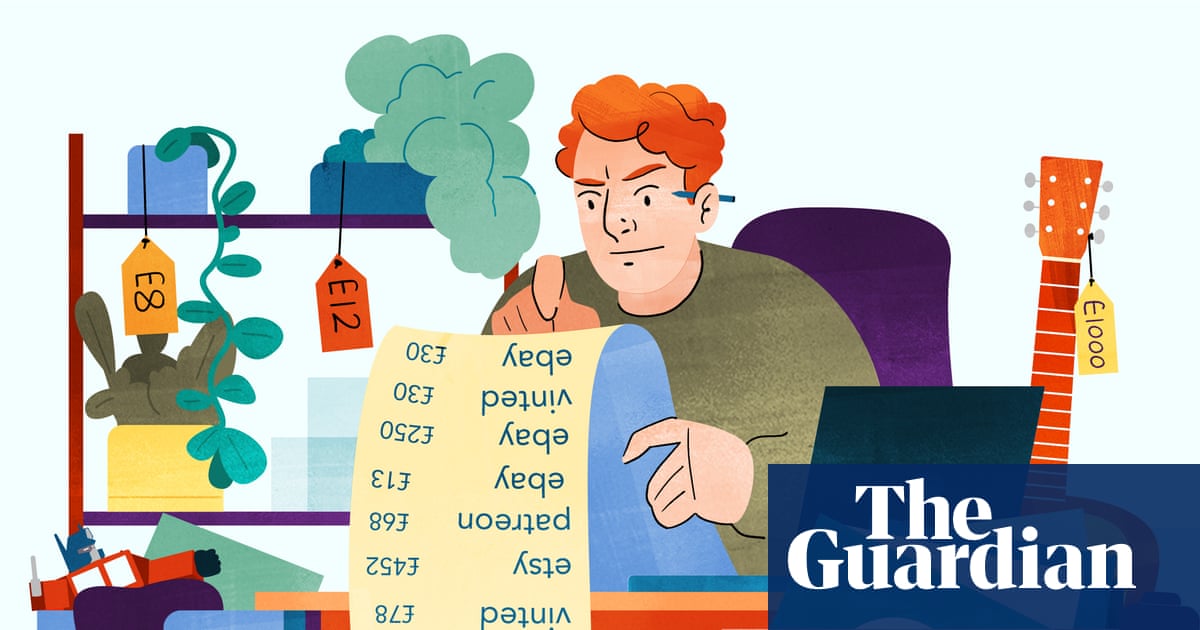
Why can no one of my generation find an affordable place to live? Andy Burnham, who makes a surprise cameo on the new Channel 4 satire How to Trick Your Way Onto the Property Ladder, has two words: “Margaret Thatcher.” The housing crisis is a policy issue, but the presenter Oobah Butler wants to trial wackier workarounds for millennials keen to game a rigged system.
Butler’s tongue-in-cheek documentary explores some elaborate parodic ideas, using himself and two young, hopeful first-time buyers, Mohammed and Insaf, as guinea pigs. Have they tried the bank of Mum and Dad? Let’s try to hypnotise an estate agent into selling us a property for a fiver. Perhaps it’s just about cutting out Netflix and coffees? Or could he swindle some property off the king?
This prankish comedy squares with Butler’s roots as a professional jokester. The film-maker got his start writing for Vice in its heyday, producing viral articles such as “I Tried to Sell My DIY Sex Robot at an Invention Convention”. Since then, he has garnered a following for pranking corporations including Tripadvisor and Amazon (tricking the latter into listing bottles of urine as the #1 drink on the site). In his latest documentary, this millennial-upstart humour continues here – and lands with varying levels of success.
There’s an extended bit on that aged stereotype about millennials spending too much money on avocados. It feels tired the first time it rears its head, let alone the third. When Butler provokes talking heads in the style of Philomena Cunk, you wonder occasionally if the payoff made these comedic excursions worth everyone’s time.
That said, the smarter and more unexpected ones are hilarious, such as when Butler explores the possibility of buying a graveyard plot instead of a flat. It’s 200 times cheaper than the average London rent, we learn – but you need a death certificate.
As things progress across the show’s 47 minutes, there’s a sense that while jokes are par for the course for Butler, this is a rigorous takedown of Britain’s housing market. The documentary takes a clear, well-researched and radical political position: that the housing market is rigged because it is politically and economically convenient for those in power. Early on, Butler produces news-style graphics to support his claim that real estate is the single largest sector of the UK’s GDP, and to show how many economic stakeholders rely on house prices going up. Burnham explains the intricacies of the failures of the Conservatives’ right-to-buy scheme, launched in 1980, which gave tenants of council houses in Great Britain the ability to buy their properties at a discount (and is still active in England).
We hear from an impressive range of case studies and experts. As well as Burnham, they include Aydin Dikerdem, Wandsworth’s cabinet member for housing, and Ben Twomey, the outgoing chief executive of Generation Rent, plus MPs, mortgage experts and people affected by the housing crisis. We learn about the political contours that laid the groundwork for the state of affairs in which young(ish) people find themselves. There’s also a sense of the ironies they face. The monthly cost of owning a home can be cheaper than renting, for example, but you have to be rich enough to put down a deposit. As is the case in many areas of life, being poor makes you poorer.
Butler also exposes less-discussed aspects of Britain’s housing injustice in his discussion of the Duchy of Lancaster’s bona vacantia privileges. This feudal hangover allows the duchy – in effect, King Charles – to collect assets from people in the north-west of England who die intestate and without a known next of kin. In recent years, it has raised tens of millions of pounds, some of which has been used to benefit the king’s property portfolio. (The duchy has said that the income after costs is passed to its charity, the Duke of Lancaster’s Foundation.) Butler stages an intervention with a gathering of elderly people, encouraging them to write wills. Again, you find yourself feeling slightly sorry for these unwitting subjects. Things feel stronger when Butler returns to punching up, by going after King Charles and wryly describing Buckingham Palace as public housing.
There are sections here (most likely aimed at baby boomers) that rattle off truisms. Yes, loads of us live with mould; yes, studio flats are cramped; yes, council housing has been decimated. The idea that these realities of daily life could shock anyone in the UK feels frustrating to me as I write from my council-owned studio flat.
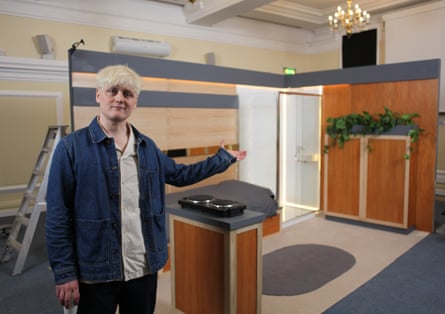
But How to Trick Your Way onto the Property Ladder also asks the question of what this means for the future. UK house prices are projected to rise by at least 19% over the next five years, according to Savills estate agency. While the government has pledged to deliver 1.5m new homes, Butler shows us a model of a flat the size of a prison cell and manages to get MPs to sing its praises as the future of affordable housing. He also lists it online and manages to find a prospective renter who offers £2,000 a month. As Dikerdem points out, we are facing a race to the bottom, where desperate tenants are faced with little choice.
Amid its more juvenile ruses, this documentary offers a couple of light, serendipitous human moments. Harry Hill, the co-founder of Rightmove, of all people, pops up as a last-minute hero. A number of boomers reach into their pockets to support Butler’s, Mohammed’s and Insaf’s flat-buying venture.
But, as Butler concedes, we’re screwed. “Turns out, there is no quick hack or magic loophole,” he says. “No silver bullet that could possibly unlock the closed-shop housing market, which bakes in inequality by design. The only trick that actually seems to work is access to wealth, or being born at the right time.”
Not trying to sell avocados to baby boomers for £20 (the price they would be if they had increased in line with house prices); not buying a space the size of a storage cupboard for £40,000; not setting up shop on a graveyard plot. The third scenario is a throwaway gag. But it does feel as though there’s something symbolic in the suggestion that we’ll only experience a better cost of living when we’re dead. Even then, the king may still seize our assets.
How to Trick Your Way onto the Property Ladder is streaming on Channel 4 now