2 months ago
108
2 months ago
108
Reetta Vaahtoranta used to go running in the evening along the Greenway, a four-mile (7km) pathway stretching across east London. But increasingly, she found herself receiving unwanted attention from lone male passersby. She switched her running clothes to baggier options, because “the less attractive and weirder you look, the less likely you are to get people following you”.
“In the end, I just decided it was not worth it to come jogging here after dark,” she said. “If I know it can be a bit dodgy, then I just stop doing it. Which is a shame because in the centre of the borough there aren’t that many green spaces.”
Vaahtoranta’s experience is not unique, and has driven her to become a campaigner for her home borough of Newham with Living Streets, a national charity that aims to improve the walking environment.
This week, new official guidance for English councils, produced by Active Travel England (ATE) in collaboration with Living Streets, put women’s safety while walking on streets and in public spaces at the top of the agenda.
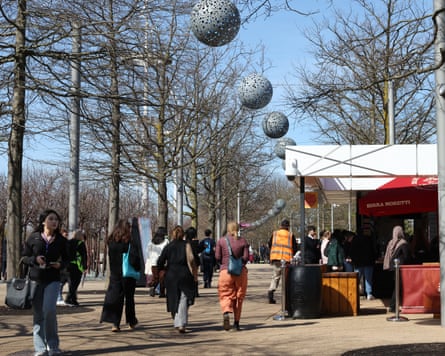
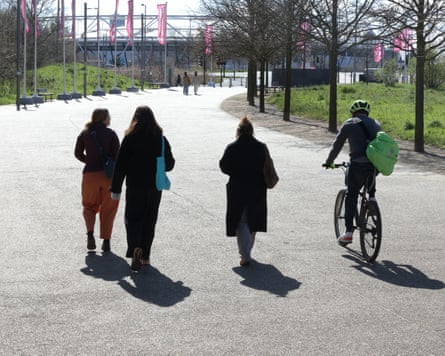
Vaahtoranta, who is a software developer at the Guardian, notes that the dimly lit Greenway, which has no exit points for a person to make a quick escape if they are being followed or harassed, would not reflect the guidance. She contrasts this with the neighbouring Queen Elizabeth Olympic park, which was built on brownfield land to house key sites in the 2012 Olympic Games, and was designed with walking, socialising, running and cycling in mind.
The park’s wide avenues thrum with people at all times of day: parents pushing prams, schoolchildren working on projects, friends meeting for coffees, and – unusually for a London park – joggers and cyclists who feel safe to be there from morning until late at night. This is not accidental, but rather the outcome of intentional design and consultation with women and girls.
“It’s just really mixed use,” said Vaahtoranta. “So it has a lot of reasons for people to come there and it means that it’s always used. You need quite a density of people to feel that if something happened to you, someone would step in and help.
“It’s really well lit as well. So I don’t have a problem walking through it to get to the train station at night.”
In future, more public spaces will be redeveloped this way, in line with the guidance on how to create streets that are safer for women and girls, which aims to address a fundamental issue of fairness as well as boosting levels of physical activity.
The guidance being drawn up by ATE is expected to include measures such as better lighting and CCTV, and replacing dark underpasses with street-level crossings. Councils will be able to bid for public money to fund improvements.
The approach takes inspiration from other countries, for example schemes in Spain and Sweden that allow women to ask bus drivers to drop them between stops at night. It will also build on pioneering schemes nationally, such as Liverpool’s “halo points”, which are well-lit, highly visible devices linked directly to emergency services and CCTV.
Tanya Braun, the director of external affairs at Living Streets, said their research had involved speaking to women and girls to understand what made them feel safe, something she felt was not done enough when public spaces were being developed.
“We know that lighting’s really important in terms of women and girls feeling safe getting out and about, passive surveillance. There being lots of people on the streets and things like benches, well-connected walking routes and CCTV has been cited as something that’s quite important as well. Just that feeling of someone’s watching you,” she said.
“I think there’s a growing understanding that more needs to be done. A lot of our towns and cities have been built without consultation with certain groups of lived experience. That really needs to happen, because without consultation how is a designer supposed to know what that local community needs?”