2 months ago
90
2 months ago
90
Mornings begin with a silent inventory, conducted in the dark before the curtains are drawn: can I breathe easily today? The question is stripped of all poetic veneer. When you have stage four lung cancer, breath is no longer a background process; it is a finite currency I must spend with the caution of a miser. It dictates the architecture of my day, the borders of my energy and the very cadence of my speech.
I am not a “survivor” in the triumphalist sense of the word, nor am I imminently dying. I occupy the long middle – a rarely charted territory where the body remains fragile, treatment constant, and life does not so much move forward as stubbornly persist.
This liminal state is a distinctly modern byproduct of a medical revolution. In the UK, barely a decade ago, a stage four lung cancer diagnosis was a grim cliff edge; when the NHS standard was rooted in traditional chemotherapy, long-term survival remained in the single figures. Today, the momentum of clinical progress, driven by the maturing precision of immunotherapy and the success of targeted therapies, has levelled that precipice into a vast, uncharted plateau. While median survival is now measured in years rather than months, we are seeing the emergence of “super-responders” navigating their second decade post-diagnosis. As a psychologist, I view this not just as a medical victory but as a profound existential shift: we have replaced the suddenness of the cliff with the tenuous permanence of the high ridge.
Such a progression has inadvertently birthed a new demographic: the “chronically terminal”. We occupy an interstitial space, standing in the spectre of what is destined to take us, yet still burdened with the responsibility of being within the world. This surreal duality compels us to face our finitude while tending to the unsentimental task of deciding which relationships are still worth the oxygen they require.
There is a dark incongruity to this way of living. We know our horizon with terrifying clarity, but we are still subject to the same randomness as the healthy – the theoretical bus that might strike tomorrow. But for those of us in the long middle, that bus is already idling in the driveway.
When I was first diagnosed in 2022, I was 51. I have no children of my own, but I was deeply anchored in a life that felt mid-sentence: I was a daughter, a sister, a partner and a friend, with decades of shared history still to navigate. There were more countries to add to the 50 I’d already visited, a wedding to plan with the person I loved and the simple, essential expectation of being present for my family’s future. The prognosis arrived with the cold finality of a court sentence: 11 months.
But then came the “however”. In the clinical reality of lung cancer, where UK statistics show most patients are diagnosed between the ages of 70 and 74, I was a statistical outlier. Because I was relatively young and fit, the statistical horizon began to ripple and recede. My oncologist and I interrogated the data until the “disease-free” benchmarks of the literature felt like dusty relics. I turned away from the sterile percentages and looked instead to the lived reality of my peers – those 10 or 12 years post-diagnosis who were still present, still radiant, still here. I stopped measuring my life in the frantic increments of weeks and began the audacious task of calibrating it in decades.
While science is rebranding metastatic cancer as a “manageable chronic disease”, our social and psychological maps have failed to update. This progress has carved out a profound “survivorship gap”. When you are cured, the world cheers; when you are dying, it mourns. But when you are simply maintaining, the world is at a loss. We navigate the “scanxiety” of the quarterly CT and the eerie, metallic hum of the MRI, planning for a future that medicine hands back to us one prescription at a time. We are playing in the “extra time” of a match where the whistle refuses to blow, except the scoreboard has long since stopped working.
This absence of a final whistle necessitates a new, tempered kind of stamina. Here, strength is rarely about the “fight”. Military metaphors such as “battling” and “warrior” are a leaden weight for those of us who cannot “win” in the traditional sense.
Fatigue in the long middle is not mere tiredness; it is a heavy, systemic gravity that shortens patience and magnifies anxiety. To manage it, I have had to cultivate an almost clinical coldness – the art of being disagreeable enough to protect my own peace from the well-meaning but exhausting attentions of others. There is a particular invisibility to this existence. Friends assume I am “fine” because I look luminous, unaware of the two hours of horizontal rest required before I can leave the house, or of the mental negotiations required to ensure I have enough breath to finish a sentence.
I see this camouflage among my peers. My friend Freja recently entered a relationship haunted by the fear her partner “might not know what he’s getting into”. Her symptoms are masked by an impeccable sense of style, with her clothes serving as both agency and veil. Last year, three couples in our orbit married. Beyond mere romance, these are radical acts of hope. Love renders the diagnosis a secondary character – a testament to the instinct to stay present in a body constantly trying to retreat.
The same fire that forges some bonds becomes a solvent for others. In the sharpening light of the long middle, my own engagement eventually buckled and broke. In stage four, where every breath is a high-stakes investment, I realised I could no longer afford the emotional cost of a partnership that required me to perform a version of myself that no longer existed. To end a future while fighting for a present is a harrowing act of integrity; it is the ultimate refusal to spend my finite currency on a narrative that has fundamentally lost its truth.
This instinct to remain present, even when it means standing alone, is constantly at odds with a culture that demands we stay “productive”. My background in cross-cultural psychology prepared me to dismantle the ways societies value humans through the narrow, clinical lens of output. In our achievement-oriented culture, women face a relentless demand for performance. We are conditioned to believe our worth is a direct variable of our “doing”.
Chronic illness, however, has a way of eviscerating those scaffolds, forcing a merciless reorientation from a life of “doing” into a life of “being”. I had to rebuild my definitions of worth in the dark, often while simply fighting to catch my breath.
I recently attended the funeral of Astrid, a friend who shared my diagnosis. Her husband’s eulogy contained a plea that sparked a sudden, sharp resistance in me: “Don’t let the diagnosis define you.” For years, the diagnosis had defined me; it dictated my movements, my social calendar, my very identity. Even so, as I sat, I realised Astrid had practised a low-key, sovereign rebellion. She had used her illness as a form of “clearance” – a licence to stop performing. She cultivated “deep time” with friends and celebrated the “non-event” milestones of a stable scan. To refuse to be defined by an illness is not an act of denial; it is a refusal to let medical terminology be the only language spoken in the house of your soul.
I see a different version of this self-possession in my friend Sebastian. He operates in the high-velocity world of tech sales, a field fuelled by quotas and relentless forward motion. In exchange, the long middle has given him a radical freedom. He navigates the hustle with a detachment that can only come from knowing exactly what is at stake. He continues to work, but he refuses to buy into the stress. It is a masterclass in psychological boundaries: working inside the system while remaining entirely outside its emotional grasp.
When I joined my patient support group, we were a collection of disparate lives tethered by a reluctant masonry. We spoke in bruised shorthand: comparing palliative care, clinical trials and the provisional nature of plans. There was an unexpected symmetry in this shared vocabulary. We began as strangers, yet were quickly bound by a radical intimacy that made conventional friendship feel almost superficial by comparison.
But mortality is a notoriously capricious auditor. Some of us, through an opaque quirk of biology or the blind luck of a genetic mutation, traverse the wreckage, while others are overtaken by it. Porous by nature, I absorb the emotional charge of others with an unguarded ease. Consequently, when a peer such as Saskia admits in our group chat that she has reached the end of her options, messaging from an old house in the middle of nowhere about “hospice at home” and texting until she no longer can, the loss feels like a physical removal, an erosion of my own internal geometry.
One by one, the people who anchored my arrival have dissolved into the periphery. I am deeply, almost guiltily, grateful to still hold this high ridge, yet this endurance carries a unique ache: the survivor’s inheritance of watching the original cohort fall away. Newer patients join the group now, carrying the same wide-eyed terror I once wore as a primary identity. I attempt to be their steadying point, to offer a hand through the fog, but the resonance has shifted. The charter members, those who first taught me how to abide in this stateless state, are thinning out. I am learning that in the long middle, grief isn’t a detour from our lives; it is the terrain itself.
I have always been fascinated by how we “wear” time. Most of us live by chronos: the quantitative time of the clock, the five-year plan and the corporate calendar. It is a predator that treats every passing second as a theft. But the long middle demands a migration toward kairos: a qualitative time. Kairos is not measured by the accumulation of minutes, but by the “rightness” of a moment. It is a frequency shift: moving from a life lived for the next milestone to one lived for the morning light of the kitchen table or the depth of a single conversation. In this state, time is no longer a resource to be spent, but a medium in which to dwell.
The philosopher Martin Heidegger called this “being towards death”. While the phrase carries a morbid chill, he argued it is the essential catalyst for an authentic life. He suggested that we usually spend our days “falling”: getting lost in trivial noise and the performative expectations of others. The long middle forces an end to that fall. When death is no longer a distant “some day” but a persistent, breathing neighbour, the ego’s vanities slowly evaporate. You cease being an actor in your own life, shedding the borrowed costumes of status to inhabit your raw, unvarnished self.
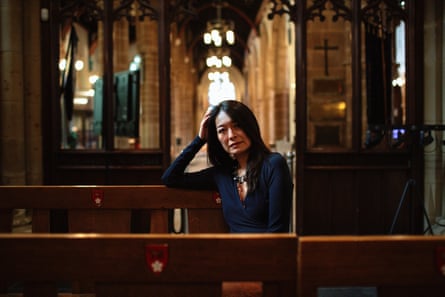
After the physical trauma of surgeries – the invasive reordering of my body – I found myself back in church on Sundays. I wasn’t just looking for a psychological crutch; I was looking for a miracle. While my medical team spoke in the measured language of “progression-free survival”, I sought the unmeasurable. Faith furnished me with a different architecture for endurance: it offered a vocabulary for hope.
But for every person who finds a sanctuary in their faith, there is another who finds a crime scene. I often think of Samuel, a member of my support group. His experience is the mirror image of mine: shattered and reflecting a much harsher light. “Why me?” he asked during one lunch, his voice thin with a resentment that years of Sunday school had not prepared him for. Samuel had been a “cradle Christian”, attending church with his parents since childhood and following the invisible contract that says: I am protected by God. Now, faced with the long middle of his illness, he feels the sting of a divine breach of contract. He has refused to set foot in a church since his latest scan. For him, the silence of God isn’t peaceful; it’s an abandonment.
This is the magnificent, unspoken schism of the chronically terminal. To some, the diagnosis is a clarifying fire that burns away the trivial, leaving a refined spiritual core. To others, it is an acid dissolving everything they once held.
I do not have an answer for Samuel, just as he does not have an indictment for my peace. We sit in the same circle, breathing the same long middle air, yet our internal landscapes are unrecognisable to one another. My belief acts as a platform, holding me upright when the weight of the long middle threatens to collapse my resolve. For Samuel, that same frame is what fell on him.
In the Saturday morning hush of a church or the sterile Tuesday light of an oncology ward, we are both searching for the same thing: a way to exist amid the absurdity.
If the long middle offers a silver lining, it is the brutal sharpening of one’s discernment. It leaves only the essential, revealing that meaning resides entirely in the quality of our attention. To walk through a park, to watch the sunlight catch a river or to register the laughter of children against the thrum of a passing bus is to realise these are no longer background noise; they are the destination.
We rarely speak of the psychological tax of persistence, of the unseen labour required to carry on when the tank is empty. Viewed as such, my illness is a visible manifestation of a universal struggle: the constant, weary negotiation between what the body can endure and what the world demands.
Living with stage four lung cancer has taught me that strength is not a metric of productivity or a narrative of “recovery”. It is found instead in staying present within a life that no longer fits the frantic success stories we are sold. In a culture that fetishises the loud “bounce-back”, choosing to live gently, attentively and on one’s own terms is an act of quiet defiance. The long middle is not a waiting room, nor a preamble to a finish line; it is a demanding, vibrant and profoundly human place to be alive.