3 months ago
153
3 months ago
153
South Korea is awaiting one of the most consequential court rulings in decades this week, with judges due to deliver their verdict on insurrection charges against the former president Yoon Suk Yeol and prosecutors demanding the death penalty.
When Yoon stands in courtroom 417 of Seoul central district court on Thursday to hear his fate, which will be broadcast live, he will do so in the same room where the military dictator Chun Doo-hwan was sentenced to death three decades ago. The charge is formally the same. Last time, it took almost 17 years and a democratic transition to deliver a verdict. This time, it has taken 14 months. Chun’s death sentence was later reduced to life imprisonment on appeal, and he was eventually pardoned.
Under the country’s criminal code, the charge of leading an insurrection carries three possible sentences: death, life imprisonment with labour, or life imprisonment without labour. South Korea has not carried out an execution since 1997, so in practice a death sentence would mean permanent exclusion from society with no possibility of parole.
But as the ruling approaches, there is a sense of exhaustion and division in South Korea as the months-long saga, in which 27 people have been indicted over the martial law crisis, continues.
Dowon Kim, a 32-year-old office worker in Seoul, no longer discusses politics with friends, some of whom still support Yoon. “Society is too exhausted,” he says, “and my energy feels wasted trying to persuade them.”
South Korea has now impeached two presidents in under a decade, and Kim says people simply want to move past the cycle: “Those who should be punished should be punished, and we need to move forward.”
Song Ji-won, a 24-year-old student in Incheon, west of Seoul, says what happened was a national embarrassment. “I just want to stop hearing about it.”
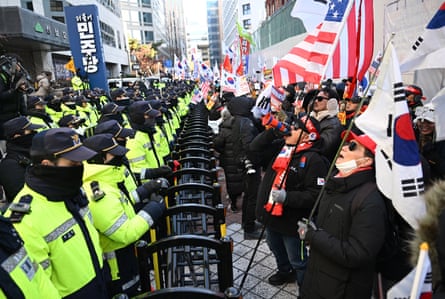
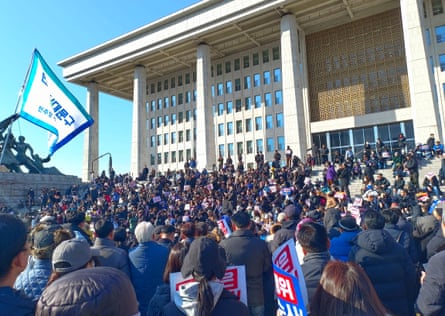
The K-pop light stick protests that once brought millions on to the streets have long subsided. Maga-inspired pro-Yoon rallies have dwindled to the fringes. At a recent gathering where 2,300 registered supporters were expected, about 20 appeared. The political fallout has been devastating for the People Power party, which has been unable to divorce itself from Yoon’s legacy. It polled at just 22% last week, according to Gallup Korea, against 44% for the ruling Democratic party.
From martial law to impeachment in 11 days
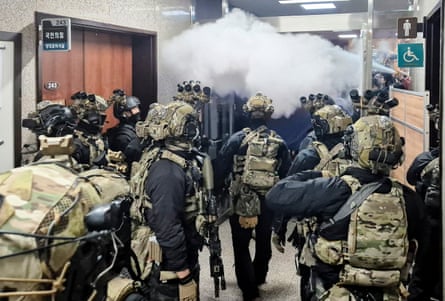
On the night of 3 December 2024, prosecutors allege Yoon declared martial law and attempted to use military force to paralyse the legislature, arrest political opponents and seize control of the national election commission. Yoon said he was rooting out “anti-state forces” and alleged election fraud.
Prosecutors allege he had plotted for more than a year, strategically placing loyalists in key military positions. It was the first emergency martial law declaration in the country in 44 years, shattering the assumption that military rule was a relic of South Korea’s authoritarian past.
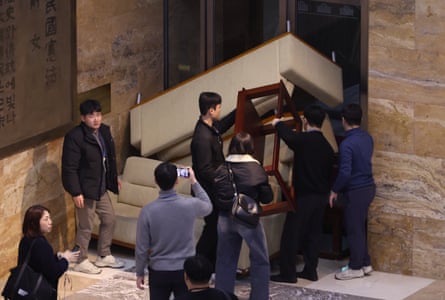
The response to Yoon’s move was swift. Within hours, 190 lawmakers broke through military and police cordons around parliament to pass an emergency resolution lifting martial law. Parliament impeached Yoon within 11 days. The constitutional court removed him from office four months later. Three separate special prosecutors were appointed, and across their investigations more than 120 people have been indicted, from the president himself to cabinet ministers, military commanders and intelligence chiefs.
Despite the relative quiet in the build-up to this week’s court ruling, the weight of the moment is not lost on South Koreans. Over the past few weeks, they have watched as the courts established key legal findings through related cases.
On 16 January, Yoon received five years for obstructing his own arrest. Days later, the former prime minister Han Duck-soo was given 23 years in a ruling that formally found the events of 3 December constituted insurrection, describing it as a “self-coup” by elected power more dangerous than traditional uprisings. The sentence far exceeded prosecutors’ 15-year demand, signalling judicial willingness to impose severe penalties.
On 12 February, the former interior minister Lee Sang-min was jailed for seven years for his role in the insurrection, including relaying Yoon’s orders to cut power and water to media outlets.
But Thursday’s verdict rests with a different presiding judge. The insurrection findings in the earlier cases, while significant, do not bind this panel. It will make its own determination on whether 3 December crossed the criminal threshold for insurrection.
Sangchin Chun, a professor of sociology at Sogang university, said the final blow to Yoon’s movement may not be the verdict itself but whether people feel their daily lives improving under the president, Lee Jae Myung. “Ending the insurrection seems to have become less a legal matter than an everyday economic one,” he said. Lee, who has focused heavily on bread-and-butter issues such as the cost of living and housing, maintains a solid approval rating of 63%.
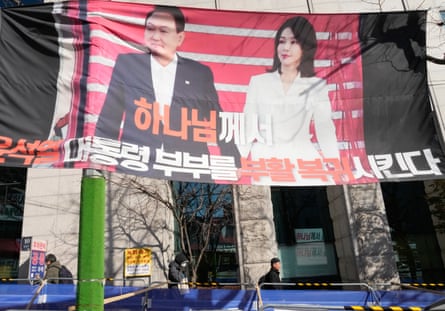
In Yoon’s last court appearance, he characterised the investigation as a “political conspiracy”, described martial law as having “enlightened” citizens, and offered no apology. At one point, he appeared to laugh as prosecutors demanded the death penalty. Prosecutors have cited a complete lack of remorse as an aggravating factor. Under South Korean sentencing principles, genuine repentance is a formal legal consideration.
He faces further legal battles: six additional criminal trials, two of which stem from the martial law crisis, including a treason indictment for allegedly ordering drone incursions into North Korean airspace to provoke a confrontation that could justify military rule.
For South Korea, the verdict will mark the culmination of one of the most extensive exercises in democratic accountability against a former head of state in its history, with the court also handing down judgments against seven co-defendants including senior military and police officials implicated in the plot.
Many of those watching will have lived through the authoritarian era of the 1980s that the 2024 martial law declaration so starkly echoed. The democratic guardrails they fought to build are being tested. By Thursday afternoon, the country will know whether they have held.