3 months ago
131
3 months ago
131
It was an arresting image and an irresistible story. A group of tough Thai police officers – five men and one woman – all wearing elaborate festival-style dresses, surrounding a drug dealer they had caught while undercover.
The image, released by local police, was so compelling that it found its way on to the front page of the UK’s Daily Star, as well as in picture stories in the Telegraph, the Sun and the New York Post.
The Sun wrote: “The burly crew of five men and one woman slipped into skin tight sequins and feathers for the covert mission in Thailand.” The Daily Star wrote: “The team of five blokes and one woman shared a snap of themselves in frilly dresses with the nicked suspect on Facebook.”
There was just one problem: while the arrest was real, the image was an AI-generated fake.
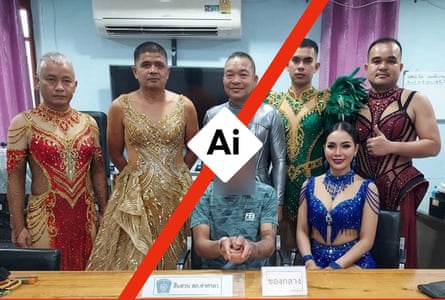
The real image, which has now been posted on the Facebook page of Tha Luang police station in Thailand, shows the five male police officers in their regular clothes. The woman dressed as a dancer is not in the original at all.
The administrator in charge of the station’s Facebook account, which released the AI-generated image, had been trying to create “a friendlier image” for the police, intending to show “a cute and humorous side”.
The Telegraph, the Daily Mail, the Sun and others have now made clear their stories were based on a fake AI image supplied by the police.
The absurdity of the image may have rung alarm bells with some readers. However, the fact that the faked image came from a seemingly official source has highlighted the difficulties media outlets face in verifying images.
There are no foolproof ways to check whether an image is real without a direct relationship with the person who took the picture. It is becoming a time-consuming and precarious task for those overseeing the images used by large outlets, and AI verification tools are not reliable enough.
The problem is made even more difficult as the use of AI-generated imagery has crept into seemingly official sources. As a result, editors are braced for the reality that it is unlikely that all AI images will be spotted before publication.
Media outlets and other organisations are also facing the opposite problem – with viewers wrongly suspecting that some genuine images have been generated with AI.