5 hours ago
12
5 hours ago
12
David Katz’s introduction to the world of Lee “Scratch” Perry was bewildering. The Jamaican producer had been living in London for several years, and Katz, a Jewish reggae historian who had fallen in love with the music as a teenager in San Francisco, had moved to the UK capital in 1987 and wanted to interview the notoriously evasive artist.
Katz tracked him down to a recording studio in Rotherhithe, just over the river in south London. Perry welcomed him before insisting he present him with “13 stones from your country” with no further explanation. When Katz informed him he could hardly just pop back to the west coast, Perry told him to “go down to the River Thames and get me 13 stones!”.
When he returned, Perry counted the rocks then walked over to a TV monitor. “He unscrews the monitor, puts the stones inside, screws it together, and goes back to work,” says Katz. He then spent a few hours with Perry, which involved attempting to mic up an alsatian dog.
The whole thing seemed to be a hazing of Katz – who would later work with Perry on his biography – and an initiation into the production pioneer’s eccentric, inscrutable and utterly unique approach to making music.
As bizarre as Perry’s methods were, they bore spectacular results. Before moving to London, he helped Bob Marley and the Wailers shape their sound on Soul Rebel and Soul Revolution (before a violent bust up over royalties). He produced Super Ape, arguably the most important dub record of all time, and through his own Black Ark studio came up with almost a decade’s worth of peerless roots reggae.
His productions, which featured samples of crying babies, sub-bass low enough to crack a rib and an often overlooked penchant for a beautiful melody, attracted artists from beyond Jamaica who wanted his counsel. The Beastie Boys sought him out, as did the Clash and Keith Richards, while it is said that John Lydon tracked him down at the Black Ark to rework some of the Sex Pistols’ back catalogue, although Lydon’s representatives told me that story is apocryphal.
Five years after his death, as fans try to unpick the lies from the lore, a much-needed reappraisal of reggae’s great eccentric is taking place. Katz’s new book, Dub Revolution, explores the genre through its practitioners such as Perry, and is part of a wave of activity. This year has seen a spate of reissues featuring classic productions, including the Congos’ sensual spiritual, Ark of the Covenant. Another book – illustrated doorstopper Lee “Scratch” Perry: Black Ark – unveils the secrets of Perry’s famed studio; and there’s his “final” album, a collaboration with German electro outfit Mouse on Mars recorded two years before his death.
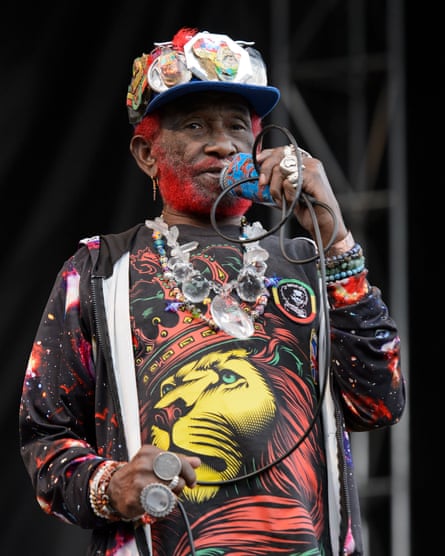
Perhaps part of the reason for this burst of activity is a desire to truly grasp Perry, an artist who is seen by many in Europe as reggae’s court jester. Towards the end of his life he was often draped in fluorescent clothes, sported dyed red hair and beard, spoke in riddles, and declared himself a “madman”. A lack of quality control during his last decade didn’t help.
There was also his tendency to turn interviews into farce. Krishnan Guru-Murthy famously tried to interview him in 2009. I say try, because he might as well have been talking to a cloud of smoke. Perry delivered his answers in rhyming couplets while intermittently sticking his tongue out, saying things like: “I kill the devil brain, so that the devil can’t reign.” Jools Holland once asked Perry why he’d placed a toaster on top of a breeze block wall in his Jamaican compound. “It means that I’m a toaster,” he replied, deadpan. (Presumably he was referring to “toasting”, or emceeing, but he seemed to enjoy implying that he believed he was a small electrical appliance.)
Adrian Sherwood, his longtime collaborator and friend, says Perry revelled in a good wind-up. The pair once sat next to each other at a screening of Volker Schaner’s 2015 documentary, which followed Perry’s exploits over 15 years. Whenever he was shown baffling an interviewer during the film, Perry would turn to his friend. “He kept elbowing me in the ribs and laughing,” says Sherwood, who believes Perry “always loved mischief”.
Katz tells me that if you want to understand Perry, you need to go back to Jamaica. Born in 1936, Rainford Hugh Perry grew up in Kendal in the north-western parish of Hanover. His father was a dance champion and manual labourer, while his mother practised obeah, a form of west African spiritual healing and “magic” that was outlawed by British colonists in the 16th century and is still illegal today (Perry’s first hit with Marley, Duppy Conqueror, satirised attitudes towards the practice).
Katz’s “stone initiation” on the Thames can be traced back to Perry’s belief in obeah, which he thought provided guidance throughout his life. After working in a quarry as a young man, he claimed that the sound of clashing stones directed him to Kingston (“I go up to King Stone”) where he ended up working for Studio One’s Coxsone Dodd as an A&R and handyman. He discovered the Maytals, worked with a young Delroy Wilson and had hits of his own, such as Chicken Scratch, which gave him his nickname.
after newsletter promotion
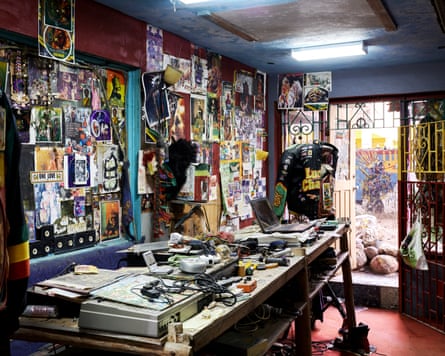
But it was in his studio, the Black Ark, where Perry’s legend grew. Completed in 1973 on the grounds of his house in Kingston’s Washington Gardens, it boasted a rudimentary setup and was attached to an annexe and recording booth. The original mixing desk was bought for £35 in London, the drum kit was reportedly once owned by Ringo Starr, while tracks were assembled on an inexpensive four-track Teac 3340. A Roland Space Echo delay showered Perry’s productions in cascading reverb. What he lacked in cutting-edge gear he made up for in theatrics and ceremony: he blew weed smoke into the desk; poured whisky and urine on some of the equipment; and buried recordings in the garden. Compared with other Jamaican studios, Perry’s was underpowered but his skill meant nothing that came out of his production house was puny.
The artist Edward George, who has demystified the world of reggae via his Strangeness of Dub radio series, says the technical brilliance of Perry is only one dimension of his – and the Black Ark’s – greatness. It was also part community centre, part spiritual sanctuary. “The idea of the Ark was that it would be something through which black people, Jamaicans in particular, could be saved and rescued through music,” says George.
Rastafarians were always welcome at the Ark and the politics of black empowerment flowed through his output. “On the one hand, it was a production house, but it also had this kind of metaphysical cultural and political aspect to it,” says George.
The open-door policy at the Black Ark made it a chaotic space, open to abuse by hangers on and grifters who posed as devout Rastas. Perry initially closed the space to outsiders in 1978. Then there was a botched redesign – which culminated in him throwing some of the faulty equipment into a septic tank. In 1982, after he set a fire to “cleanse” the space, he burned down the control room. Perry maintained he did it intentionally; family members who were present said it was an accident. Either way, the episode brought a tragic end to one of the world’s most important recording studios.
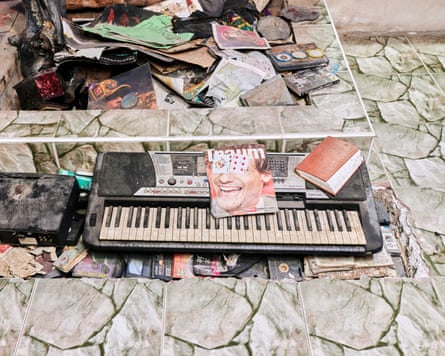
Despite the classic records made at the Black Ark such as Super Ape and Heart of the Congos, some Scratchheads swear that his earlier era as a gun for hire moving between studios was his best. My favourite version of Perry is him as the Black Ark producer, or the “Black Emperor” as one recent compilation cast him, sprinkling his genius on other people’s songs. Listen to Junior Delgado’s Sons of Slave, a thunderous roots anthem, or his ode to Rasta, Don’t Blame It on I by the Congos, then stick on Leo Graham’s Doctor Demand, where a simple keyboard line and a wah-wah effect on a guitar provide a sparse backdrop. They’re sonic opposites, but all are imbued with Perry’s magic, his own aural obeah.
Sherwood argues that Perry’s antics often mask his genius. “What upset me in later years was people marvelling at him as some kind of joke,” says Sherwood. People saw a clown, when they should have seen someone who re-engineered music. From reimagining the studio as an instrument, pushing dub reggae to the sonic limits or inventing sampling, few producers have come anywhere close to matching Perry’s impact.
“When you listen to those records, what he achieved, it’s astounding,” adds Katz. “He had a very unorthodox way of working and a very unusual approach to life. But the circus stuff? That’s a diversion: the genius is in the music.”
When Mouse on Mars played their album live at Barbican Centre’s Pit theatre earlier this month, there was a single chair that faced away from the band. On it was a miniature shrine to Perry, made up of a “We Love Bob Marley” mug, an empty bottle of Wray & Nephew rum, some apples and a candle. The group’s vocalist, Louis Chude-Sokei, had visited the site of the Black Ark to take field recordings, which played over the rootsy bass, drums and electronics.
As Chude-Sokei walked around the audience, Jamaican birdsong could be heard as he repeated the refrain: “This is a testament.” It felt like a fitting one to Lee “Scratch” Perry: the reggae innovator, the mischief maker, dub’s Black Emperor.
Black Ark: Lee ‘Scratch’ Perry is out now (Edition Patrick Frey); Dub Revolution by David Katz is published on 2 July (White Rabbit); Lee ‘Scratch’ Perry and Mouse on Mars’s album Spatial, No Problem is out now on Domino Recordings.