2 months ago
105
2 months ago
105
Skye has a thick duvet in the van she calls home in Cornwall. In winter, the 25-year-old goes to bed in several layers of clothes and is grateful for the extra warmth of her cat. She parks up late, often in car parks well away from beaches, and never stays more than one night in case local people get angry and bang on her windows. This is van life. It can be a very different world from the tourist dream.
“Some winters I’ve had ice on the inside of my van windows, and the door handles frozen shut with me inside,” says Skye, a special educational needs teaching assistant. One year her diesel air heater packed up, and she spent the whole winter feeling cold. “That was genuinely awful.” Even with the heater on in the evening, those nights and early mornings when the temperature drops below zero are tough. “I often get dressed in bed,” she says. “You just have to adjust.”
-
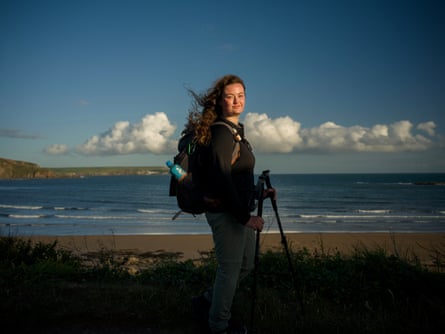
Skye, 25 arriving back at her van after a day of walking
Skye is one of an unacknowledged cohort of young Cornish people who are buying old vans to live in because they can’t find or afford a rental property. The lure of picturesque coves and seaside cottages brings 4 million tourists to the county every year. They drive Cornwall’s economy, but their presence also means the county has become more lucrative for landlords to own one of an estimated 24,000 Airbnbs and holiday lets than to look for longer term local tenants.
What is the Against the tide series?
ShowOver the next year, the Against the Tide project from the Guardian’s Seascape team will be reporting on the lives of young people in coastal communities across England and Wales.
Young people in many of England's coastal towns are disproportionately likely to face poverty, poor housing, lower educational attainment and employment opportunities than their peers in equivalent inland areas. In the most deprived coastal towns they can be left to struggle with crumbling and stripped-back public services and transport that limit their life choices.
For the next 12 months, accompanied by the documentary photographer Polly Braden, we will travel up and down the country to port towns, seaside resorts and former fishing villages to ask 16- to 25-year-olds to tell us about their lives and how they feel about the places they live.
By putting their voices at the front and centre of our reporting, we want to examine what kind of changes they need to build the futures they want for themselves.
With about 13,000 visitors also owning second homes, long-term rental properties are thin on the ground in many Cornish areas. Employment in the county can also be unreliable, with many young people relying on the sort of seasonal work that makes it hard to commit to regular monthly rental payments.
A van offers a different path. Some days these young people may be “living the dream”, watching the sun set over the sea, but unlike many of the self-styled van lifers on Instagram they are not just having an adventure for a summer. Many are living like this all year round.
Skye moved to Cornwall from Milton Keynes with her mother and father when she was 16 and fell in love with the place and with surfing. But three years later, when her parents’ marriage started to break down, she moved out and spent months sleeping on friends’ sofas.
With earnings from her job as an agency SEN teaching assistant, Skye teamed up with her then-boyfriend and another friend to try to rent a house. All three had jobs, but they kept losing out on the few rental properties they could afford because someone else had got there first. On one occasion, someone from London even swooped in and took what they had hoped could be their home. Frustrated, Skye took out a loan and bought a “really nice but old” van to live in.
-
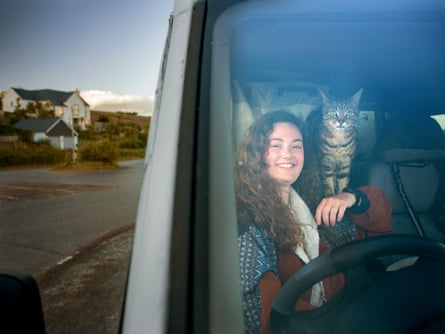
Skye and her cat Atlas – whose additional warmth is welcome during the cold winter months
Five years later, she is still in that van, but “it has broken down a fair few times and every time it’s an absolute nightmare”. She is now paying off a £2,000 repair bill in monthly instalments. Nevertheless, she does enjoy the freedom living in a van gives her and acknowledges that she would now feel “trapped” moving to a house. “I’ve fallen in love with the lifestyle,” she says.
Like many permanent van lifers in Cornwall, Skye feels the need to keep moving. “I don’t stay anywhere for more than a night,” she says.
Caroline Dann, who hosts a weekly drop-in support session for van dwellers in St Day, a former tin mining village near Redruth in mid Cornwall, says Skye’s experience of highs and lows is typical.
“You have days when the weather is great and you’re looking at the waves and life is good,” she says. “But when the rain is beating down and you’re cold it can flip quickly from being an idyllic experience.”
Traveller Space, the local charity Dann runs, has found that many younger van-dwellers are struggling. Often they are Cornish locals who have moved out of their parents’ houses and have nowhere to go.
“Some are living in vans you can’t even stand up in,” she says. “Many are cold. A lot don’t have anything to cook on, so they are living on cheese sandwiches.”
Her Tuesday drop-in is a chance for van dwellers to have a free hot meal and a shower. They can also wash and dry clothes or bedding.
Dann’s charity has supported Traveller and Gypsy communities in Cornwall and Devon for 20 years, so she knows all about the challenges of life on the road. But when the council asked her in 2024 to survey the growing number of people parked up overnight in vans in car parks, laybys and seafronts, she quickly saw a stark difference in how they were coping.
“Travellers have grown up like this. They know how to get water, they know someone who can fix their vehicle, they know how to keep a van warm,” she says. “What we’re seeing with the van dwellers is that they don’t have these skills.”
Young people often pile all their savings into buying an old van, but have no idea how to insulate it, where to park, or how to manage cooking, she says. Every week the charity receives desperate calls from van-dwellers who have broken down.
Another big challenge can be isolation. Traveller communities such as the one in St Day are just that – a community. But Dann sees people on the Cornwall van life Facebook page saying things such as: “I haven’t spoken to anyone for a week and I’m feeling really lonely.” She says that, shut away inside their vans, young people sometimes struggle with a sense of shame, knowing some local people “don’t understand” and don’t want them there.
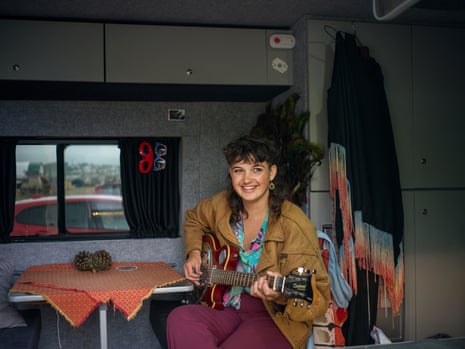
Louella, a 33-year-old singer-songwriter who has been living in her van in Cornwall since she was 26, comes to the drop-in centre for a shower. She says: “Sometimes you don’t shower for a week because you don’t want to have to keep asking your friends if you can come and use theirs.”
-
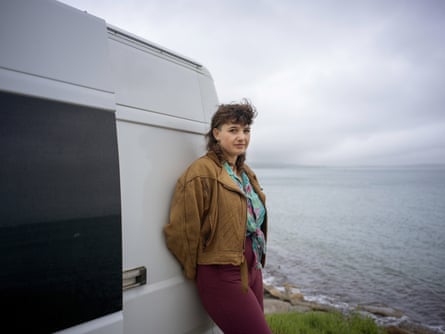
Louella has been living in her van for seven years. She avoids campsites as they are too expensive
But she also values the sense of community here. She says winter can be the loneliest time, because the weather means she is shut inside alone in a small space more.
“It’s easy to end up going to the pub because you just want company,” she admits.
Before the van, Louella lived in a friend’s shed. She says: “I can’t afford to pay rent and pursue my music career.”
With the cost of living rising, she can’t imagine a time when she will be able to afford a house. She has several friends who have had to move out of one rental and then really struggled to find another.
Louella says she loves her van and the freedom it affords her. Yet she agrees that this lifestyle has “big peaks and troughs”.
Beyond proper campsites, which she mostly avoids because they are “too expensive”, Louella feels that the facilities available to support people in vans are shrinking. She says: “There aren’t many public toilets, and they are often closed when you need them.”
-
Louella says wet weather can be challenging as the cramped space gets muddy quickly, which can feel overwhelming.
Finding water for drinking, cooking and washing is also a continual problem. A friend lets her top up her water at her place, but she worries about asking too frequently. Dann has advised her that churchyards usually have a tap, but Louella says: “Some don’t like you filling up.”
Not having anywhere to dry things when it is raining can also be a real problem. Louella has done gardening jobs to subsidise her music and says muddy boots are a logistical nightmare. She says: “You’re trudging your wet boots and things in and out of the van, and in a cramped space it can all get messy quickly. Sometimes that can all feel too much.”
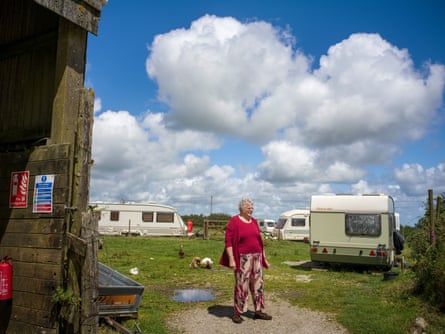
Half an hour away at Potter’s Farm, in the tucked-away village of Halvasso, not far from Falmouth, owner Sue Nicholls is currently renting out caravan spaces in two fields to 35 people, most of whom were facing homelessness. Typically they have been referred to her by local homeless charity St Petroc’s after being flagged as homeless by the council. One resident lived under a bridge in Penryn for three months before he arrived. Sue takes people of all ages, but some are young.
-
Many of the people Sue Nicholls rents out caravan space to at her farm in Cornwall were facing homelessness. Some are as young as 17
“I’ve had three who came at 17. The younger ones have often been kicked out by parents,” she says.
Here they have a roof over their heads, a local church donates food and sometimes free logs or clothes. Last week the residents came together for a big barbecue, and Nicholls says she encourages people to plant gardens by their caravans, most of which have been bought very cheaply and are old and shabby.
Pointing at the main field, which she says became “like a bog” last winter, she doesn’t dress up how grim this life can be. She says: “It’s remote here and in winter the wind can be horrendous. The caravans are dry but they aren’t very warm.”
This is a long way from those van life dreams on Instagram, and Nicholls is angry that people who end up here don’t have more external support. She says: “Everyone here is vulnerable. They are all struggling with their mental health. I wish there was more for them. But it feels like they are on their own.”
Skye says van-dwellers worry that the council may crack down further on vans in seaside areas. If that happens she may not stay.
For now, she will just see what the future brings. She says: “It is nice to have a base. Maybe one day I’ll get a bit of land to call my own and park my van on it.”
Some details in the images have been changed for safety reasons
-
Readers can meet Polly Braden, along with some of the young people who have been involved in the series, at a preview of the Polly Braden: Against the Tide exhibition, in collaboration with Guardian Seascape, at the Arnolfini gallery in Bristol on the evening of 26 June. The exhibition then runs from 27 June to 27 September in Bristol and from 1 October to 1 March 2027 at Firstsite in Colchester.