2 hours ago
5
2 hours ago
5
In a bare, gloomy room on the beachfront at Saint-Louis, in the north-west of Senegal, dozens of young boys sit on a concrete floor chanting verses from the Qur’an, surrounded by fishing boats and piles of rubbish. It is early in the morning but the children have already been up for hours, not to study but to walk the streets begging for food and money.
Every day, these talibés, or students of the Qur’an, join thousands of other boys, some as young as five, on the streets of the city in search of a piece of baguette, a handful of rice or a few coins. They beg not just to fill their own stomachs but also the pockets of their Qur’anic teachers, or marabouts.
Talibés are sent by their parents from impoverished rural regions of Senegal, and as far away as the Gambia and Guinea-Bissau, in the belief they will get an education in Qur’anic schools, known as daaras, in the country’s cities. Many marabouts care for their students but, far from the watchful eyes of their families, others are sent out on to the streets in a practice that human rights groups say amounts to human trafficking for forced begging.
-
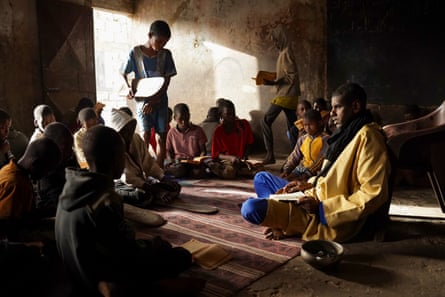
Talibés prepare to study the Qur’an under a marabout, or religious teacher, at a daara, or Qur’anic school, in Saint-Louis
“It’s a business,” says Issa Kouyaté, founder of Maison de la Gare, a Senegalese organisation that provides support, healthcare and education to talibés in Saint-Louis. “It’s not about the Qur’an – it’s about the money.”
Sending children to study under Qur’anic teachers is an old and deeply embedded tradition in Senegal and much of west Africa. Yet, with the onset of urbanisation, the practice shifted from schools, supported by the local community, to daaras in far-off cities – where some marabouts spotted an opportunity to make money from children rather than educate them.
-
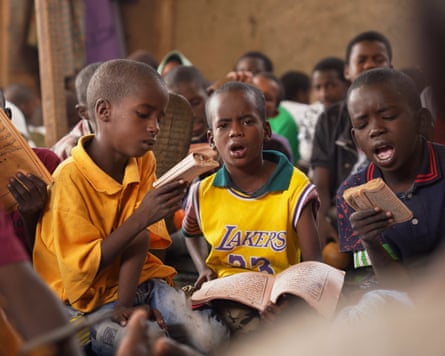
Talibés recite the Qur’an at a daara in Saint-Louis. The oral tradition, of listening to a teacher and repeating verses aloud, is the accepted method of learning scripture across the Muslim world
-
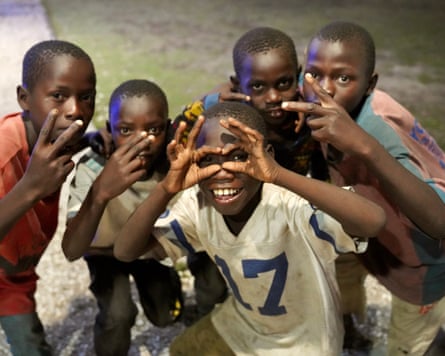
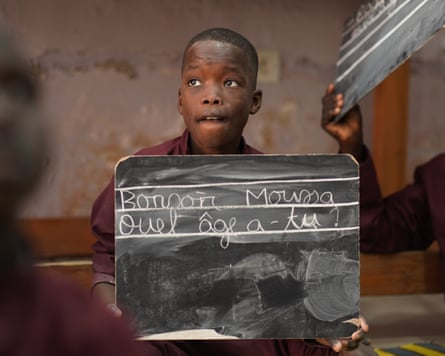
Talibés on the streets of Saint-Louis. Despite the treatment they endure, these boys are resilient, energetic and street smart. Children are taught French as part of a residential programme run by Maison de la Gare, a secular Senegalese charity that provides support, healthcare and education to talibés in Saint-Louis
Human Rights Watch estimated in 2019 that at least 100,000 talibés were forced to beg in Senegal for money, food or both.
Fatimata M’Baye, a Mauritanian human rights activist and a trustee of the UN Voluntary Trust Fund on Contemporary Forms of Slavery, says: “While this practice was once socially accepted, the situation is increasingly devolving into exploitation, mistreatment, sexual abuse and trafficking, particularly when these children migrate between countries and are left to fend for themselves.”
Many marabouts do not force them to beg, but talibés in the worst daaras face a daily torrent of abuse. They are often given quotas for the amount of money they must earn each day from begging and some face severe beatings if they fail to meet their targets. In the worst cases, talibés have been found shackled in chains to stop them running away.
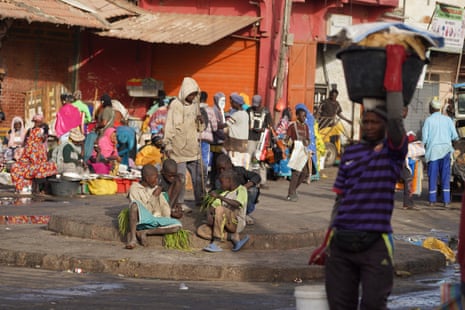
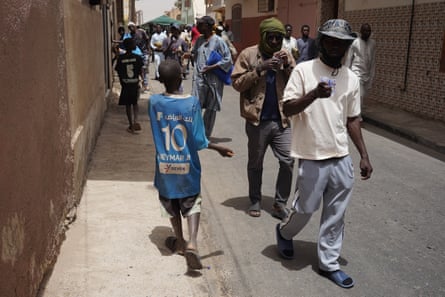
Thousands roam the streets and markets of Saint-Louis each day, dressed in dirty old football shirts and often barefoot, clutching ubiquitous plastic collection tubs. Some are resourceful and streetwise, targeting tourists or running errands for small change. Others wander alone or curl up on the pavements to sleep.
-
Children selling goods at the main market in Saint-Louis. Many of the talibés have quotas for how much money they must earn each day
-
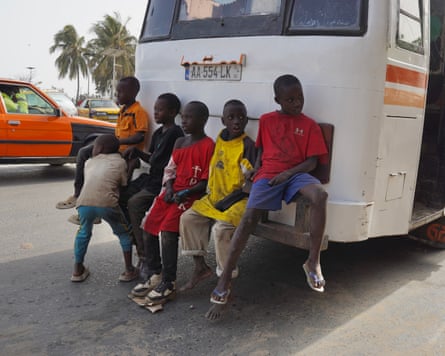
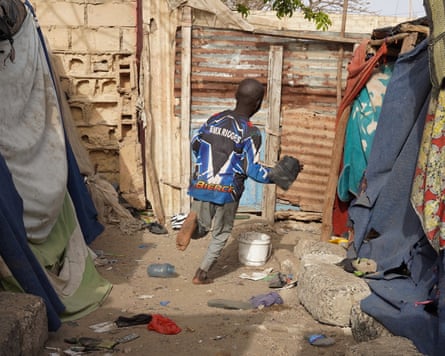
Talibés hitch a ride on the back of a bus in Saint-Louis. There have been numerous cases of talibés being injured or killed in traffic accidents. Talibés are often housed in squalid, overcrowded shacks like this one in Saint-Louis made from sheets of plastics, cloth and corrugated iron
Mamadu* does not know his age, but he looks about 10. He was brought to Saint-Louis in 2022 from his home in Guinea-Bissau by an older boy from his village, he says. As he crossed the border into Senegal, he was told to hide under the seats of the vehicle he was travelling in.
“I beg every day; there is never a day off. I have to collect 250 west African francs [35p] a day. If I don’t, the amount carries over to the next day,” he says. “Sometimes it’s easy. Sometimes it’s hard.” He has a scar above his eye, which he says he received when he was beaten while out begging.
-
Talibés beg for alms after Friday prayers as men leave a mosque
When he left home, he was excited about the prospect of a better life in Senegal, but in the four years since he arrived in Saint-Louis he has never spoken to his parents. “I want to go home now,” he says quietly.
A large number of daaras are little more than run-down shacks or rooms in abandoned buildings. There is often no electricity or running water, and toilets, where they exist, are just holes dug in the ground. Packed in overcrowded and filthy spaces, talibés frequently develop severe skin infestations.
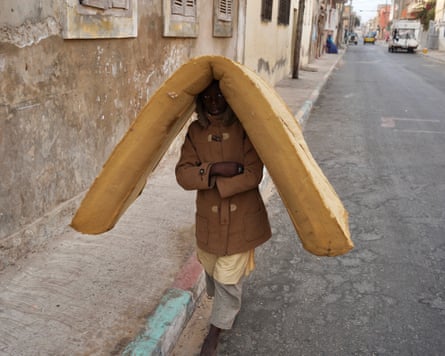
In one small compound strewn with rubbish, the talibés sleep under pieces of rusted corrugated iron and tattered sheets of plastic and cloth hung over a wooden frame. Asked what happens when it rains, one of the boys says: “We sleep in the puddles.”
-
A talibé walks through the streets of Saint-Louis with his bedding in the early morning. When it rains, one boy says, ‘We sleep in the puddles’
Rights groups say the government’s efforts to end the practice have been limited and ineffective – obstructed by marabouts who oppose reform.
In its 2019 report, Human Rights Watch says that while forced begging and smuggling people across borders is prohibited under a 2005 anti-trafficking law, “even when judicial investigations are opened, prosecutors and judges are often subject to pressure from religious leaders, the community or politicians to drop cases, reduce charges or provide more lenient sentences.”
Kouyaté argues that respecting cultural traditions should not be at the cost of children’s rights. “There is no verse in the Qur’an that says children should be exploited through forced begging,” he says, or be made to “eat leftover food, rummage through garbage, walk barefoot, wear tattered clothes or go without medical treatment when sick or infected”.
* Name changed to protect his identity