2 months ago
85
2 months ago
85
As the residents of Tunbridge Wells trudged down their sodden high street in the pouring rain, the idea that they had run out of water – for the second time in just a few weeks – seemed farcical.
At the end of November the local water treatment centre, which had been flagged as at risk by the regulator in 2024, was forced to shut down, leaving 24,000 households without water for two weeks. The Drinking Water Inspectorate later said this outage was foreseen and was due to a lack of maintenance at the site.
Now, for many here, it’s Groundhog day, with more than 30,000 homes across Sussex and Kent spending up to six days without water after South East Water blamed freezing weather for leaks in its ageing pipe network.
No one knows exactly when the water will be back. Schools have shut, businesses have closed. Struggling pubs and restaurants have had to shut their doors. “We can’t wash up, every day we have to decide what to cook based on how much water we have. We’ve been showering at the local gym,” said Gary, who has faced intermittent water for a week.
“Sometimes the water comes on for an hour or two in the mornings. Sometimes too late for my wife to shower before she goes to work. And without being too disgusting, our toilet is currently full,” he said.
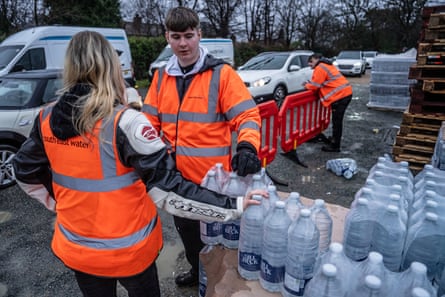
Local MP Mike Martin, who is a Liberal Democrat, rushed back to the constituency from parliament after hearing there were problems with the water bottle supply centre. His in-laws are in the “red zone” with no water and have been showering at his house.
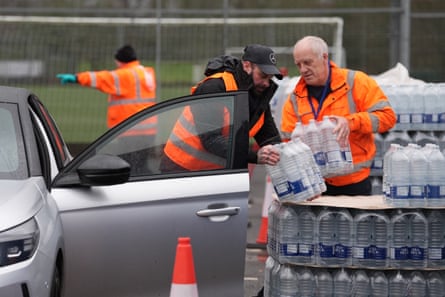
Standing in the rain at the local rugby club, where water was being handed out, he said: “Vulnerable people are emailing in just terrible stories, people with young children, elderly people, people who are ill, people who just come out of hospital. You know, it’s a real disaster not having water.”
Kama Bass, 53, has had almost no water for a week. “I’ve had to organise with a friend when to shower at her house,” she said.
“I’m fortunate that I have no children at home and my husband is away, so it’s just me, but it’s still been pretty grim. I actually am getting stressed about the amount of plastic water bottles I am having to use. I don’t know how families are coping – the amount of bottled water you need to cook and to wash up and to keep the children hygienic. It’s horrific.”
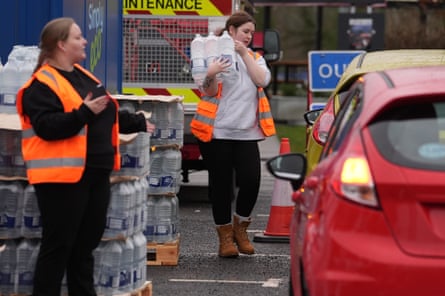
Her neighbour, Hugh Wilson, 65, has been struggling with the lack of water. “I have a disabled daughter, so it’s been very difficult,” he said. “It’s a guessing game when we will be able to wash. Because we’ve only got a limited amount of water in the hot water tank, so you don’t want to run that down.”
Everyone in the Forest Road area, where Kama, Hugh and Gary live, were concerned about the local pub, the Bull, which has said its future is on “thin ice” after being forced to shut for a second time in a matter of weeks. On Tuesday afternoon the pub was empty, with a sign up saying “due to no water, we have no option but to close.”
Meanwhile, one local cafe, fortunately unaffected, was acting as a makeshift creche for children whose schools were forced to close due to a lack of running water. “We rushed here from Beckenham, my daughter and son in law have work today,” said a grandmother completing worksheets with her grandson, who was off school.
“It has to be done and we love spending time with him but it is very inconvenient for everyone in Tunbridge Wells. It’s bad management … it seems to be so many issues and still the CEO gets a big bonus.”
Dave Hinton, the chief executive of South East Water, has been largely absent from media during both crises. Everyone appears to be aware of his large pay; he has a base salary of £400,000 and received a bonus of £115,000 last year. Hinton recently told the environment, food and rural affairs parliamentary committee that he did not do interviews during the last outage because the questions would focus on his pay and bonus, which he believes to be a distraction.
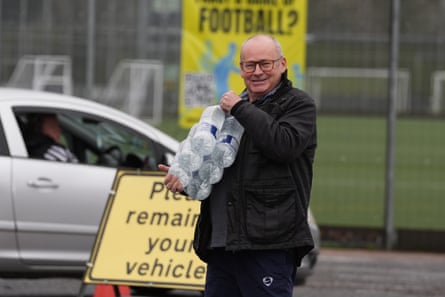
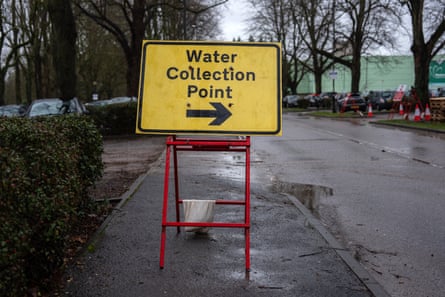
Dozens of cars were arriving at the water collection centre at the rugby club throughout the morning, although the club sporadically closes after running out of water.
Scott Richardson, who lives nearby, was picking up bottles, and told the Guardian he’d had no water for three days.
Of Hinton, he added: “It’s costing businesses fortunes worth of money, and he’s not really that apologetic about it, and he’s got quite a big bonus. He should be handing that back.”
Richardson said England “must be the mock of the globe. We can’t even get water from our taps”.
For South East Water’s part, the company seems pleased with its response. At a recent Efra committee hearing, Hinton gave himself an eight out of ten for dealing with water shortages.
The chair of the company wrote on Tuesday to the committee, disputing the drinking water inspectorate’s evidence for the reasons for the previous outage and announcing the water company would be conducting its own internal investigation, with the results coming in April.
Martin said: “That’s their regulator, right? They are accusing their regulator of being wrong. I wish them luck with that. They’ve also been recalled to the select committee to correct their evidence, so the net is tightening around these guys.”
Mike Keil, chief executive of the Consumer Council for Water, said this shows how unprepared water companies are for climate breakdown and the extreme weather it brings.
He told the BBC: “Time and time again we see in particular South East Water’s patch that their service fails when the weather throws something a little bit extreme at it. We see in the summer it get’s too hot they don’t have water, and now it’s too cold and you don’t get water. We all know our climate is changing, we are going to see extreme weather events. If a company cannot deal with today’s weather, they are going to really struggle in the future.”
Keil said this showed the infrastructure needed to be improved through investment.
South East Water has said is doing “everything it can” to support affected customers and said its repair teams are working “around the clock” to restore supplies.
It added that it has not received a consistent bulk supply of water from a neighbouring company, as it normally would.
“Following the recent cold weather and a subsequent breakout of leaks and bursts across Kent and Sussex, our drinking water storage tanks are running very low, and there are currently around 30,000 impacted properties across the two counties,” incident manager Matthew Dean said.
A South East Water spokesperson added: “David Hinton, chief executive, remains committed to resolving the immediate issues facing customers in both Kent and Sussex, whilst continuing to seek to obtain the investment to deliver the much needed improvements in resilience to the South East Water network, detailed in the company’s business plan.”