7 hours ago
7
7 hours ago
7
16. Circle of Violence: A Family Drama (1986)
Issue-of-the-week TV movie about elder abuse, with Tuesday Weld as a harried mum taking out her frustrations on her own ageing mother. Phoenix slaps on the hair gel as the essentially decent son who blasts his music too loud, lets his rowdy if unusually spiffy pals put their feet on the furniture and resents the new house guest: “Grandma is really getting on my nerves!”
15. Silent Tongue (1993)
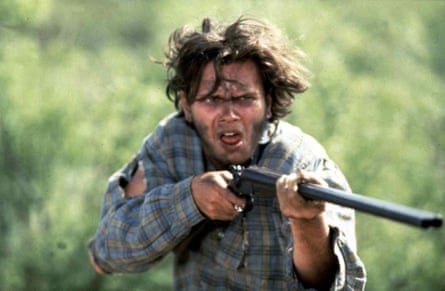
Sam Shepard’s turgid western premiered at Sundance in early 1993, then sat on the shelf for a year. As with his unfinished final film, Dark Blood, Phoenix plays a desert-dwelling widower gone mad with grief. In this case, his father (Richard Harris) steals a second wife for him from the travelling showman (Alan Bates) who sold him his first. Nuance is not required from Phoenix here, just doleful, brooding twitchiness. A family connection: his brother Joaquin later played Harris’s son, too, in Gladiator.
14. The Thing Called Love (1993)
Directed by Peter Bogdanovich, this was the last film Phoenix completed. Samantha Mathis (his then girlfriend), Dermot Mulroney and a pre-fame Sandra Bullock are aspiring country-and-western musicians convening in Nashville, but their warm, lively work only underlines how ill at ease Phoenix seems on screen. As the most gifted performer of the bunch, he is remote in ways that can’t easily be explained away as acting choices. “He looks ill,” observed the critic Roger Ebert, who thought the performance “should have been seen by someone as a cry for help”.
13. Little Nikita (1988)
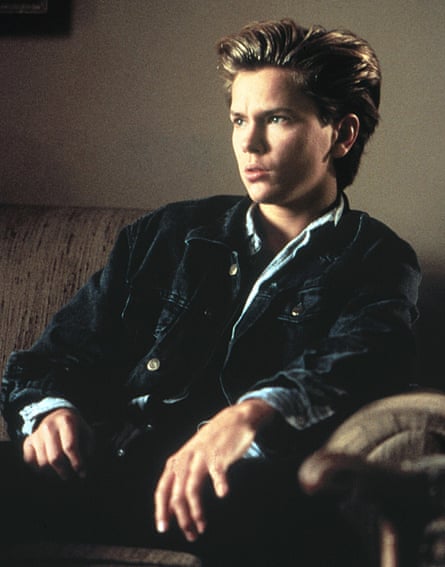
Espionage for dummies. Phoenix is the all-American high-schooler Jeff, who has no inkling that he is really Nikita, son of Russian sleeper agents. That’s until undercover FBI man Sidney Poitier cosies up to him and spills the beans. Both deserve better than this minefield of spy-movie cliches, but you’ll never catch Phoenix coasting. He delivers the line “Truth has no meaning in this house!” with all the conviction of James Dean in Rebel Without a Cause screaming, “You’re tearing me apart!”
12. Surviving: A Family in Crisis (1985)
Despite a strong cast (Ellen Burstyn, Molly Ringwald, Paul Sorvino) and direction by British television veteran Waris Hussein (Doctor Who, Henry VIII and His Six Wives), this TV movie about a teen suicide pact is mostly soapy and simplistic. Phoenix is affectingly uninhibited, though, as the grieving sibling: “Boy, he must have hated us,” he weeps after the death of his beloved older brother. He won a Young Artist award for his troubles, beating his co-star, Poltergeist poppet Heather O’Rourke, who died three years later at the age of 12.
11. Dark Blood (1993/2012)
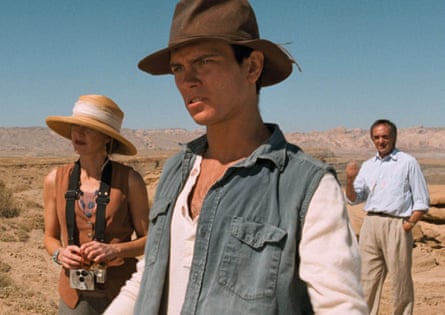
A little more than half of Phoenix’s final movie was in the can when he died of a drug overdose on 31 October 1993. Director George Sluizer stole the footage to prevent it being destroyed, then used stills and narration to plug the gaps in a patchwork cut which premiered in 2012, two years before his own death. Phoenix plays a widowed recluse who rescues a married couple (Jonathan Pryce and Judy Davis) after their Bentley breaks down near his desert shack; Knife in the Water-style thriller dynamics ensue. Phoenix is a haunted, enigmatic presence but only Davis’s performance truly coheres. On-set tensions were rife between her and Sluizer; he accused her of giving Phoenix hell, though producer Stephen Woolley recalls the young actor kissing Davis’s feet.
10. I Love You to Death (1990)
Broad, wacky comedy about a wronged wife (Tracey Ullman) plotting to murder her philandering husband (Kevin Kline, whose performance in A Fish Called Wanda beat Phoenix to the best supporting actor Oscar in 1989). She is encouraged and assisted by, variously, her own mother (Joan Plowright), who sets the plan in motion; an earnest hippy (Phoenix), whom the couple employ at their pizza joint, and who has his own reasons for wanting the husband out of the way; and a pair of stoned amateur hit-men (William Hurt and Keanu Reeves). Phoenix denied that his character, with his crystals, beads and mysticism, bore any resemblance to himself (“Nope, no similarities whatsoever”) but he feels at the very least like a riff on the actor’s persona.
9. Sneakers (1992)
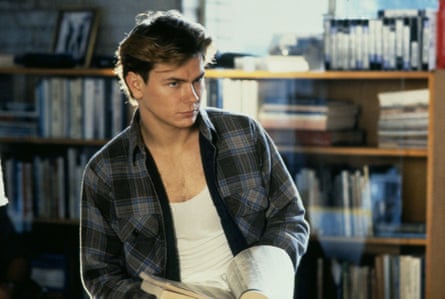
According to Esquire magazine, Phoenix was embarrassed by the commercialism of this engaging code-breaking caper, and even advised his friends not to watch it. Admittedly, there isn’t a whole lot for him to do on screen, but at least he and Poitier, previously paired in Little Nikita, get to participate in a superior espionage adventure this time around. They’re part of the eccentric tech-security team headed by Robert Redford (who had just picked Brad Pitt for the lead role coveted by Phoenix in the fly-fishing drama A River Runs Through It). The rest of Redford’s crew includes David Strathairn and Dan Aykroyd, who in one scene is wearing a T-shirt advertising Aleka’s Attic, the jangly folk-pop outfit fronted by Phoenix.
8. A Night in the Life of Jimmy Reardon (1988)
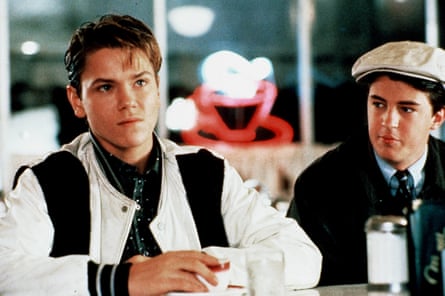
Phoenix was a reluctant heartthrob, so it follows that his one bona fide teen movie would be unorthodox and melancholy. As Jimmy, a slick, priapic but troubled young poet whose sexual partners include one of his mother’s friends, Phoenix flirts with the dislikable and unsympathetic. In one scene, he loses interest during his girlfriend’s elaborate masked-intruder sex fantasy: “I don’t feel like Jack the Ripper today.” In another, he is scolded by his best pal (a pre-Friends Matthew Perry), who tells him: “Your goddam pecker leads you around like a mule chasing a carrot.” Twentieth Century Fox re-edited the movie as a splashy comedy; director William Richert’s cut, retitled Aren’t You Even Gonna Kiss Me Goodbye? after his original novel, is the classier version. He and Phoenix were reunited when Richert played the Falstaffian vagabond Bob in My Own Private Idaho. Richert died in 2022; his website still advertises a crowd-funding campaign to pay for “deepface [sic] technology” that would insert Phoenix into the director’s version of The Man with the Iron Mask.
7. Indiana Jones and the Last Crusade (1989)
The most delirious part of this threequel is its breakneck, origin-story prologue, with Phoenix (who was recommended for the role by his Mosquito Coast co-star Harrison Ford) showing how the young Indiana Jones acquired his bullwhip, battered fedora, chin scar and ophidiophobia. It’s such a hoot that only a spoilsport would ask why a strictly-parented Boy Scout in 1912 Utah sports the unruly surfer-dude fringe of a 1980s teen idol.
6. Explorers (1985)
Joe Dante used his Gremlins clout to make this charming goofball fantasy starring Phoenix and Ethan Hawke, both 14, as friends who build and pilot a rinky-dink spaceship. Making his movie debut after several years of TV work, Phoenix was already on course to be a teen pin-up but was cast against type as the boffin Wolfgang. Hawke recalls seeing his co-star for the first time walking back and forth outside their motel: “[I] asked him what he was doing, and he said he was trying to figure out how Wolfgang walked … from that moment forward he was always ahead of me.” Next to him, said Hawke, “I never felt more ordinary in my life.”
5. The Mosquito Coast (1986)
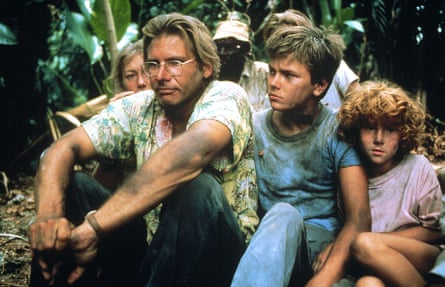
Peter Weir’s dogged, Paul Schrader-scripted adaptation of Paul Theroux’s novel about a ranting, idealistic inventor who drags his family off to live in the Central American rainforests is dominated by Harrison Ford’s oppressive performance. The rest of the cast, including Helen Mirren as his wife, scarcely get a look-in, though Phoenix makes a strong impression as the adoring eldest son whose idolatry gives way to mounting horror at his father’s murderous insanity. Phoenix’s then-girlfriend, Martha Plimpton, has a memorable scene in which she speaks for his thousands of teenage fans by admitting: “I think of you when I go to the bathroom.”
4. Dogfight (1991)
Hot from his Oscar nomination for Running on Empty, Phoenix was granted director approval for this drama about a group of callous young Marines competing in a “dogfight” to find the ugliest date during their last night before being shipped off to Okinawa, and then to Vietnam. He wisely chose the film-maker Nancy Savoca, who brings a complex tenderness to the emotional tussles between Eddie (Phoenix) and his prey, the shy waitress and amateur balladeer Rose (Lili Taylor), who turns out to be nobody’s fool. Phoenix doesn’t soft-pedal Eddie’s cruelty, which makes his pangs of conscience even more resonant. “How did we get to be so full of shit?” he asks his fellow Marines the morning after the dogfight before. “How did we become these fucking idiots?”
3. Stand By Me (1986)
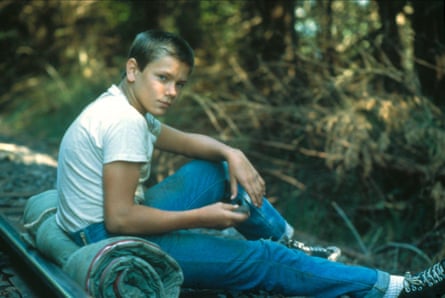
If modern audiences want to know why Phoenix was so loved, said Ethan Hawke in 2014, “Go watch Stand By Me … James Dean has got nothing on that kid.” As the toughest but most complicated of the 12-year-old friends who trek into the woods to find a corpse in the late Rob Reiner’s film of Stephen King’s novella The Body, Phoenix evokes vividly the boy’s inner tensions, his hurt at the unfairness of his bad reputation; “I’d like to go some place where nobody knows me,” he sobs. Then there’s his exit. Each of the actor’s three greatest films gives him a killer final shot which has only gained in poignancy since his death. But it is his silent farewell in Stand by Me – waving at the camera, then plodding away and literally dissolving into thin air as the voiceover reveals that his character died prematurely – that hits the hardest.
2. Running on Empty (1988)
Phoenix received his only Oscar nomination for this fine drama about a pair of former radicals (Christine Lahti and Judd Hirsch) wanted by the FBI for their involvement in a bombing years earlier. He plays their eldest son, a sensitive piano prodigy who has learned never to let down his guard, which causes complications when he falls for his music teacher’s daughter (Plimpton). Under the direction of veteran auteur Sidney Lumet, who declared that Phoenix “couldn’t be ordinary if he tried”, the actor is achingly sad and true as the boy unfairly shouldering his parents’ burdens. It’s striking, too, that even in his short career, Phoenix starred in so many portraits of mysterious, idealistic and/ or itinerant families not unlike his own. This one, though, is the best.
1. My Own Private Idaho (1991)
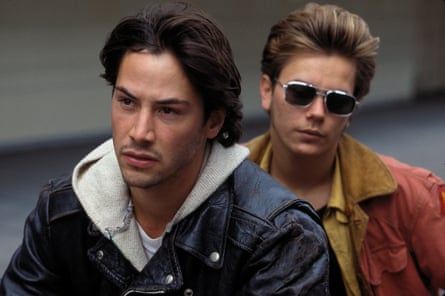
Three decades ago, queer parts for straight-identifying actors were still thought of largely as awards bids (see William Hurt’s transparently covetous performance in Kiss of the Spider Woman) or career-killers (even at the end of the 1990s, Matt Damon, Brad Pitt and Leonardo DiCaprio all turned down Brokeback Mountain). In that context, the boldness of Phoenix and Keanu Reeves in unselfconsciously playing sex workers in My Own Private Idaho, a kind of Midnight Cowboy cross-pollinated with Shakespeare’s Henry plays, should not be underestimated.
But the narcoleptic hustler Mike, who turns tricks while searching for his mother, was no ordinary job for Phoenix. “He was already this amazing actor,” said writer-director Gus Van Sant, “but with this film, he was able to have an effect on what the film was becoming … He was very excited he could control the destiny of his character.” The most obvious example is the campfire confession in which Mike admits his true feelings for Scott, the Prince Hal figure played by Reeves. The dialogue was scripted by Phoenix himself and scribbled on napkins, the scene moved to the end of the shoot so that he could build up to it emotionally. “The character I wrote was blasé and noncommittal,” said Van Sant. “River made him gay and committal; he redeemed him with emotions.”
He did the same for the film, too. Van Sant’s innovative touches – shirtless studs coming to life on the covers of porn magazines, or the eerie pseudo-freeze-framed sex scenes – are cunning and cool, but it is Phoenix’s performance, from his opening orgasm to his final collapse on a deserted country road, that gives the movie its heart and its kick.