3 months ago
243
3 months ago
243
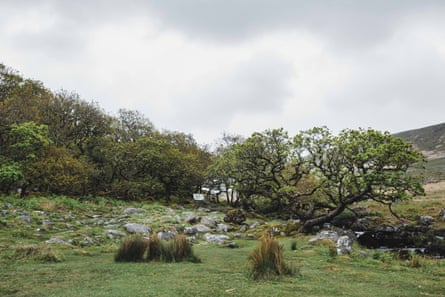
Along a steep-sided valley, with the West Okement River roaring at its floor, the woodland emerges like an oasis in a closely grazed bare landscape.
Squat, tightly clustered, with root systems heavily covered in thick lichens and mosses, the oak trees of Black-a-Tor copse are a tiny surviving cluster of European temperate rainforest dating back to the bronze age.
Today this 29-hectare (72-acre) copse provides an insight into the oak woodland that would once have covered 20% of the British isles.
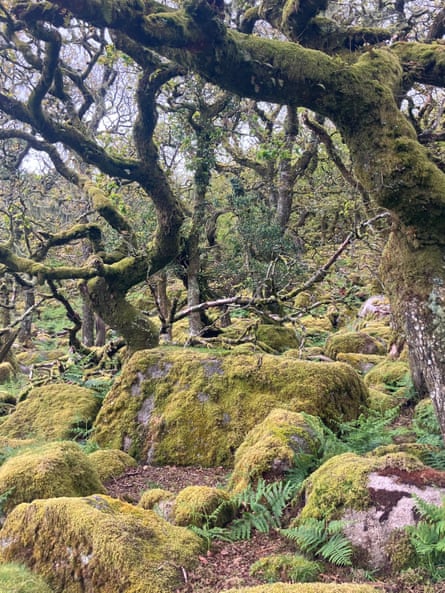
But like much of the temperate rainforest pockets that still exist in the UK, it is in a poor state, affected by grazing over many decades. This is one of just three remnants of the woodland on Dartmoor today, existing in spots where there is natural protection by granite boulders or spiky gorse.
Now campaigners from Dartmoor Nature Alliance (DNA) are calling for the temperate rainforest across the national park to be doubled in size.
As the campaigners unfurled a banner at the copse, their plea was met in some part by the Duchy of Cornwall, which owns one-third of the national park. It announced a new commitment to double the size of Black-a-Tor and another temperate rainforest pocket at Wistman’s Wood by 2040.
Announcing the new target, Emma Magee, head of communities and nature on Dartmoor at the Duchy of Cornwall, said: “The level and pace of commitment from the duchy and our partners is increasing.
“Our ambition is to double the extent of duchy-managed Atlantic rainforest on Dartmoor by the early 2040s, and we welcome the focus this campaign brings to these rare, beautiful and important habitats.”
The new commitment came as the government announced £30m of ringfenced funding to restore and create wildlife-rich habitats across England, from Dartmoor to the Lake District, through grants within the farming in protected landscapes fund, including for ancient woodland restoration.
Temperate rainforest is one of the rarest habitats in the world. Surviving pockets are found in western Scotland, Cornwall, Devon, Wales and parts of Cumbria, but most in are in a poor or unfavourable state.
Lisa Schneidau of DNA, which formed recently to give nature a voice in decision-making across the national park, said: “These woodlands are part of our heritage – they are some of the best in Europe – and yet they are not in a good condition.
“To extend and regenerate them we need to exclude grazing around these areas, because all of these sites are dying on their roots.
“We are not talking about much land area – we are talking about a gesture towards nature. We could see a lot more woodland along the valley areas that are not particularly good for grazing and are really marginal for farming.”
Above the copse, near the top of the valley, attempts are already being made to protect tiny emerging oaks from animal grazing. Natural England has installed metal cactus guards around small stumps of young trees to protect them.
The campaigners hope this is the start of a turning point and a moment of hope for rainforest regeneration.
The seeds of their regeneration are coming from the ancient trees themselves, some of which are thought to be several hundred years old. Last autumn the charity Moor Trees collected 800 acorns from the oaks of Black-a-Tor, which are now growing in their nursery, ready to be planted at the copse when the saplings are strong enough.
“We are acutely aware of the impact that land management practices on the moor have on the ability of these precious habitats to naturally regenerate and be resilient,” said Helen Aldis, the chief executive of Moor Trees.
It is delicate work they have already carried out at Wistman’s Wood, where 1,200 saplings have been planted in the last two years.
A recent report from Natural England seen by the Guardian underlined how grazing pressure was affecting Black-a-Tor copse. It stated “the most pressing concern around woodland condition here is the suppression of recruitment by livestock browsing”. The report concluded that “the arguments for increasing woodland cover at Black-a-Tor copse seem conclusive”.
But about 200 farmers, known as commoners, have common grazing rights across the moor and will have to be part of the solution for the woodland. At Black-a-Tor the copse is unfenced and sits in the middle of two areas of common land, where grazing rights are owned by the Okehampton commoners.
The Guardian has approached the Dartmoor Commoners’ council for comment but at the time of publication had received no response.
Guy Shrubsole, whose book The Lost Rainforests of Britain popularised the woodlands and helped to stimulate action, welcomed the duchy’s announcement. But he said there needed to be an upping of ambition for rainforest restoration, and the campaign wanted to see a doubling of the total area of rainforest on Dartmoor’s commons, which would require more natural regeneration and tree planting in areas where tree cover has completely disappeared.
Back at the copse, Tony Whitehead of DNA pointed to the tiny oak saplings emerging at the edges of the wood, testament to the optimal habitat in the valley and a sign of the optimism he now feels.
“The woodland is just waiting,” he said. “It has been waiting for a long time for us to just back off a little bit, reduce the grazing pressure and allow these amazing forests to come back to life.”