3 months ago
127
3 months ago
127
John Lennon once described Yoko Ono as “the world’s most famous unknown artist. Everybody knows her name, but nobody knows what she does.” Others were more vicious, portraying her as a family wrecker (the family being the Beatles), a cultural vandal, an Asian virus, a shrieking harridan. As ventriloquised by Paul Morley in his appallingly titled Love Magic Power Danger Bliss, they saw her as someone whose “sole reason to be on the planet was to drive them up the wall with her lack of talent and decency”. Or, only slightly more generously, a “disorganised diva channelling the assumed genius of male creators”.
Morley’s book focuses on Ono’s life and art before she ran into Lennon at London’s Indica Gallery in 1966. The Beatles he refers to as “that other business”. His Ono is headstrong, questing. Born in 1933, into a wealthy banking family (her schoolmates included the sons of Emperor Hirohito), she survived the firebombing of Tokyo and took refuge in the country where she and her mother, now virtual beggars, were mocked by locals. Later, she would become the first woman to be accepted into the prestigious Gakushuin University philosophy department. She left early, just as she would also leave Sarah Lawrence College in upstate New York after two terms.
Ono found her way to downtown New York where a ragtag flotilla of dancers, musicians and artists were starting to occupy abandoned industrial buildings to make work that was scoffed at by blue-chip galleries. Droning music; “event scores” in which everyday tasks (preparing salad, massaging hands with Nivea cream) were reframed as art; antic physicality (Nam June Paik’s Zen for Head required him to dip his head in a bowl of ink before dragging it along a blank roll of paper): was this inspired or idiotic? Both?
Morley points out that quite a few of the artists who moved in these circles were, like Ono, expats and exiles. Paik was Korean, George Maciunas – founder of the Fluxus art movement – was Lithuanian, Joseph Beuys was German. Each, in their own ingenious fashion, was exorcising an awful past. Each was imagining a brave new world in the aftermath of wars and displacements. The book, despite its subtitle, doesn’t quite do justice to this side of its story. Instead there are many lists, lengthy asides and capsule summaries – concerning 19th-century political theorist Henri de Saint-Simon, the witty “incohérents” art movement, dada, futurism, surrealism – that, while tracing suggestive genealogies for Ono’s work, too often come across as padding.
“Facts have their importance,” Morley writes, “but they can also be where a biography comes to grief.” Anyone hoping for fresh facts about Ono’s stay at a psychiatric hospital in Tokyo in the early 1960s or her custody battles with second husband Tony Cox will be disappointed. It’s strange, in a book that’s teeming with characters, where the Fluxus scene itself is such an important character, that other female Japanese artists in New York – among them Shigeko Kubota and Takako Saito – get short shrift. Stranger still, given the author’s anger at the sexism fuelling so much anti-Ono invective, is his failure to cite any of the women (Chrissie Iles, Brigid Cohen, Lisa Carver, take your pick) who, over the years, have flown the flag for her work.
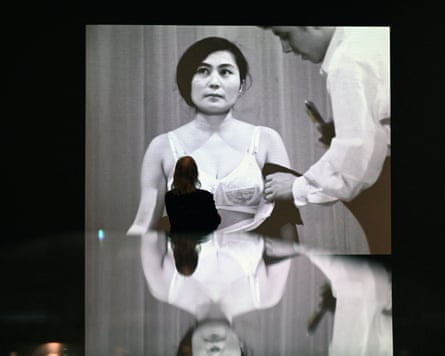
Morley’s retellings of key projects such as Cut Piece (1964), in which Ono invited audience members to scissor off as much of her clothing as they wished, are excellent. He also does well to capture some of her dry humour – she placed a casting call in the UK underground press for Bottoms (1966), an 80-minute film consisting of closeups of people’s backsides: “Intelligent-looking bottoms wanted for filming. Possessors of unintelligent-looking ones need not apply.”
Most important is Morley’s defence – no, his celebration – of Ono’s vision of art which “especially when it is ephemeral, confounding and non-linear, fundamentally defines humanity”. Her avant gardism – tactile, open-armed, rich in reverie and wonder – rebukes “the authoritarians, the controllers, the soulless, the digital rulers” of our own times. To celebrate Ono is to celebrate “one of the last witnesses, one of the last survivors of a strange, innocent, elaborate fight for freedom”.