3 months ago
91
3 months ago
91
Could lynx, the elusive wild cat driven to extinction in Britain more than 1000 years ago, become the new Loch Ness monster? “Whether Nessie’s there or not, she draws tourists,” said Margaret Luckwell, a resident of Moray, Scotland. “It would be the same with lynx. I’d love to see a lynx in the wild.”
Luckwell’s view is a majority one among local people gathering at village halls across the Highlands, as a painstaking consultation slowly gathers momentum for the apex predator’s return to Scottish forests.
A six-year effort by the Lynx to Scotland coalition of charities does not aim to simply create a supportive majority – 61% of Scots are already in favour, according to a 2025 poll – but build acceptance among residents likely to remain opposed to lynx, including farmers, gamekeepers and deer stalkers.
Trees for Life, Scotland: The Big Picture and The Lifescape Project will follow the 42 “information sessions” that have taken place over the past month with scores of one-to-one conversations with concerned farmers and other stakeholders this spring, in the hope that the charities can develop a bullet-proof application for a licence to return the animals to Scotland.
The fascination with the shy, labrador-sized predator, which poses no risks to people, was striking at a consultation event that drew 70 people to the village of Fochabers on a bitterly cold day.
Farmers, deer stalkers and foresters were surprised to find the information videos, banners and assembled wildlife charities so blunt about the livelihood complications caused by lynx.
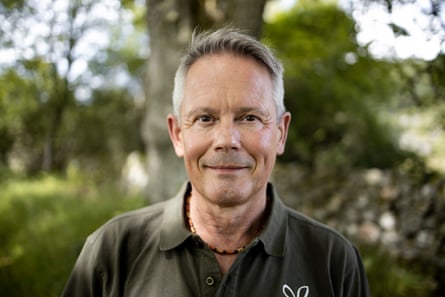
“We’re not saying they won’t take sheep – they absolutely will,” Steve Micklewright, chief executive of Trees for Life, told two visitors. “But their preferred prey is roe deer. My question is: can we get an animal like this back into the Scottish landscape and coexist with it, which we’ve forgotten how to do?”
The charities insist they are presenting facts and seeking to understand how to overcome the “barriers” to lynx reintroduction. Last year, a 50-hour consultation with 50 stakeholders, including farmers and gamekeepers, identified predation of sheep and game as the main challenges. Now the charities are working out how losses could be compensated for.
Even so, a significant minority are implacably opposed.
“Why?” asked Rob Green, a visitor to the Fochabers consultation. “Are they going to reintroduce polar bears because polar bear teeth have been found in the north of Scotland? Are the lynx going to stay in the forest and be good creatures and chase the wild deer? Are they not going to come out and take the neighbour’s cat or my dog or a little lamb? It’s people trying to make names for themselves – ‘I’ve done this’ or ‘I’ve done that’. When are people going to stop meddling?”
Others at the consultation disagreed. “It’s all ‘meddling’,” said Jenny from Garmouth. “The landscape we have in Scotland is not our natural landscape. It’s been created by the introduction of sheep.”
Trees for Life has spent six years on lynx reintroduction in the Highlands. “We’ve almost run out of money, if I’m honest,” says Micklewright. They will fundraise to continue and Micklewright says any lynx reintroduction must be self-funding – including providing compensation – for at least five years so it isn’t a burden on government.
Some rewilders criticise Lynx to Scotland’s epic consultation for not making progress. But Micklewright says they’ve forged a clear pathway to reintroduction.
“It’s a matter of when, not if, but the ‘when’ could be quite a long time away,” he says. “The government has set us the challenge of being ‘well supported’ and ‘broadly accepted’.”
The latter is crucial, says Micklewright: it means that opponents have the support they’ve requested in place and will grudgingly accept the lynx rather than persecute reintroduced animals.
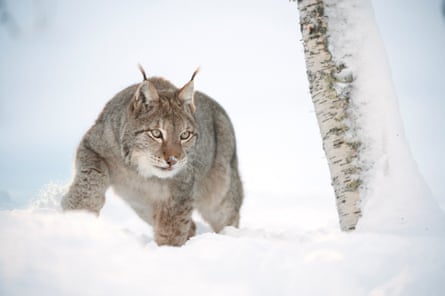
Four lynx were illegally released into the Cairngorms last year, with some speculation it was undertaken by rewilders frustrated by the glacial pace of lynx reintroduction.
As signatories to the Berne convention, the UK is obliged to consider restoring extinct native species. In England, two separate efforts to reintroduce lynx have been focused on Kielder Forest in Northumberland. The Lynx UK Trust this year launched legal action against the government in England for refusing to consider its application for a trial lynx reintroduction.
The rogue Cairngorms release led first minister John Swinney to rule out the legal reintroduction of lynx to Scotland. But Micklewright insists that “politically it’s all to play for”, with some MSPs from all parties and some Reform UK candidates supporting lynx reintroduction ahead of Holyrood elections this spring.
Conservationists believe that even if a lynx licence application is rejected on “political” grounds by the Scottish government, that rejection could be challenged in the courts – if the application is thorough enough.
Lisa Chilton, chief executive of Scotland: The Big Picture, said: “There’s a risk we consult people endlessly with no end-point because there’s always a challenge, there will always be uncertainty and questions remaining about how [reintroducing lynx is] going to unfurl in Scotland.
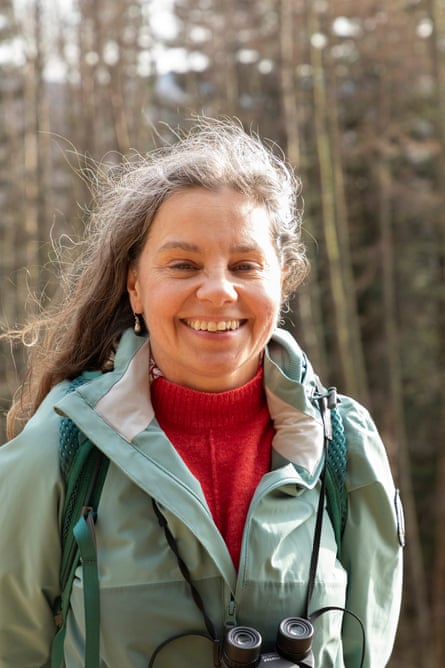
“We could use that uncertainty as an excuse never to do anything, but that’s not what we want from this. We all know the urgency of the situation with nature but if you don’t bring society with you it can’t possibly work.”
Is this great grassroots effort softening the lynx-sceptics?
A deer stalker attending the Fochabers session said he’s still sure there will be a job for him, because even if slow-reproducing lynx eventually expand to 250 animals – the carrying capacity in Highland forests, according to scientists – they will barely dent Scotland’s million-plus deer population.
A forest manager said she had “absolutely no issue with lynx” but was concerned that future regulations governing their protection would create “huge” exclusion zones, preventing forestry operations such as the clear-felling of commercial timber. “As a country that imports 85% of our timber, we can’t be excluding the few areas where we produce timber,” she said.
Donald MacLellan used to farm Suffolk sheep and Aberdeen Angus cattle near Maud, Aberdeenshire. “Compensation is very important and it’s important that it is acted upon quickly,” he said. “The animals are not just numbers. Losses are not just a sheep or a calf – there can be human generations breeding these animals to get the best.”
That said, MacLellan said he is ready to accept the lynx. Are the majority of Scottish farmers? “That I don’t know,” he said, but he cites 20mph speed limits and the smoking ban. “Just do it, and people will accept it.”