6 hours ago
8
6 hours ago
8
A lone visitor looks for a garden outside an empty monastery. A morose housekeeper won’t let anyone behind the door of her own home. A retired general living alone on a crumbling estate waits 40 years to confront the only friend he ever had. Melancholy, an affinity with oblivion without a concrete cause, suffuses the Hungarian fiction translated for foreign audiences over the past 30 years, from the tortured tales of Sándor Márai to the taut novels of Magda Szabó.
In his book In Praise of Melancholy, essayist László F Földényi tells the story of an Englishman who monomanically decides to teach himself Hungarian. For Földényi, the commitment to studying a language with 26 cases and with no connection to any other language, from a culture besieged by centuries of invasion, is to embrace melancholy, a seductive “capacity for despair”. To read Hungarian literature as an outsider, the poet János Pilinszky claimed in 1972, is to acquire unique spiritual insights that come from centuries of rootlessness, alienation and strife.
Over the past year, international interest in Hungarian melancholy has surged again. In May, eight months after László Krasznahorkai won the Nobel prize in literature for his dystopian single-sentence monologues, Péter Nádas – known for his ruminative multigenerational novels – was elected a member of Germany’s Pour le Mérite order of science and art, one of the country’s highest honours.
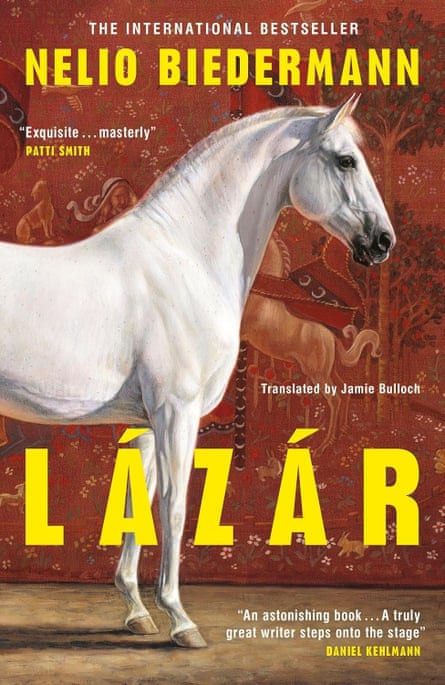
The Swiss writer Nelio Biedermann’s Lázár, about fading Hungarian nobility, has been translated into at least 25 languages, while British-Canadian David Szalay’s Flesh, featuring the minimalistic narration of the lugubrious Hungarian man István, won 2025’s Booker prize. The latter two books are fantasies of Hungarian melancholy relayed by outsiders: Szalay moved to Hungary for a decade to explore his father’s birthplace, while Biedermann modeled his novel’s genealogical mythology after his ancestors’ Hungarian family history – neither author writes in Hungarian.
Yet in Hungary itself, the same forces that have fuelled the melancholia of the literature enjoyed by foreigners – autocratic rule and isolation – have prevented more writers from gaining broader readership.
In the wake of strongman prime minister Viktor Orbán’s April loss to reformist challenger Péter Magyar, Hungary’s leading professionals in publishing, theatre, radio, museums and universities have released sweeping, mobilising reports on the fallout of Orbán’s 16-year rule. On 27 May, six prominent book insiders published a joint polemical statement in the Hungarian literary magazine Litera claiming that since 2010 “many excellent Hungarian authors have lost the opportunity to publish abroad … as foreign partners have lost trust in Hungarian state institutions”.
The joint statement specifically called out the dysfunction and financial mismanagement of the Petőfi Cultural Agency, the state literary programme launched by Orbán’s government in 2019 that has been accused of cronyism and opaque selection processes. On 1 June, the director of the Petőfi Cultural Agency announced his resignation.
As the country emerges from Orbánism, more publishers and literary organisers are declaring that Hungary’s cultural institutions cannot remain as melancholic as the literature itself. Endre Balogh and Anna Menyhért, former presidents of the József Attila Circle literary association before its demise in 2019, describe “a generation socialised into literary public life in an environment of uncertainty, suspicion, and an us-them divide”. This summer has already seen the launch of a new governmental initiative to support literary translators and a new literary trade union.
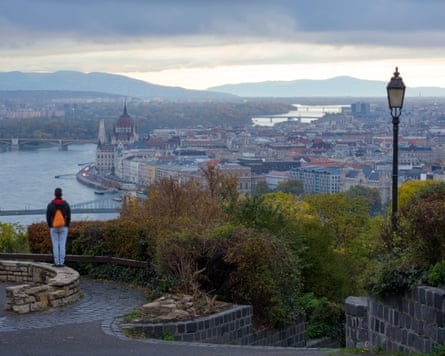
While the country rehabilitates its cultural institutions and opens more opportunities for writers and translators, foreign publishers and international readers may also need to revise what typically Hungarian literature entails.
Melancholy may remain the dominant theme, but it doesn’t have to be wholly bleak. In much of the greatest Hungarian literature of the 21st century, melancholy is a portal to unusual pleasure. Péter Esterhazy’s 2001 epic Celestial Harmonies is a catalogue of his once-aristocratic family’s ribald joy. The narrator’s father (who appears in 371 different forms over different centuries) is a glutton for food and for books: “He got so fat, the chairs had to be fortified with iron cross bars … But due to the above-mentioned obesity, his fingers turned into sausages.” In Fateless, ostensibly a novel of Holocaust remembrance, Imre Kertész intersperses the Jewish protagonist’s internment with flashes of bittersweet delight: the paradoxical appeal of an irresistible green-ribbed grey SS jumper, the sugar cubes distributed by a French doctor, the fun of hearing so many languages in one place. Kertész, himself a survivor of Auschwitz, lets his narrator say: “For me, the happiness there will always be the most memorable experience.”
after newsletter promotion
The prolific András Gerevich writes poems of uncontainable desire in an atmosphere that feels like perpetual summer (“a sweat bead / hitting the desk, your trousers / tightening”). Short story writer Edina Szvoren’s tale of a Hungarian couple’s summer escape to Scandinavia and the erotic hospitality of their innkeeper blends melancholy and ecstasy: the innkeeper’s thyme omelettes studded with “sweet-smelling, nearly liquefied slices of apple” are preludes to “lengthy, persistent, and yet decisive and greedy caresses”. Meanwhile, the couple’s young son has been infected by a deadly bird flu, and at home the Great Hungarian Plain is flooded. The story is from her collection Moments from the Life of a Hedgehog and Other Stories, appearing in English later this year.
The theorist of melancholy himself, Földényi, whose essays document experiences of unknowable euphoria, refuses to claim melancholy as a specifically Hungarian state of mind. His response to the question of whether he’d have written In Praise of Melancholy if he’d been “born in another country, raised in a different culture”: “My answer is univocal: I do not know.”