3 months ago
136
3 months ago
136
Metropolitan police officers are to start scanning citizens’ faces using automated facial recognition technology to check their identities, in a move backed by the mayor Sadiq Khan but branded “alarming” by opponents.
The pilot was revealed on Thursday when Khan said 100 officers would use the roaming technology – commonly deployed on smartphones – for six months. He was responding to questioning from an opposition politician amid rising concern about the rollout of AI-powered policing tools. The Met’s website still states it “does not presently use the so-called operator initiated facial recognition”.
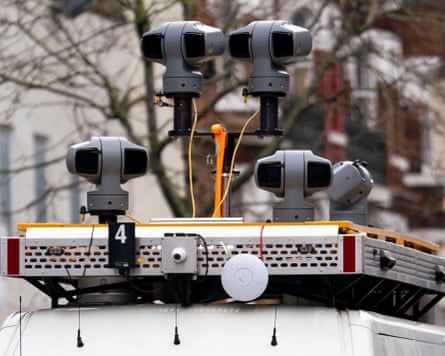
The move by the UK’s largest force will extend the spread of face scanning in policing which has already been deployed with cameras on vans and in fixed locations including in Croydon, Manchester and South Wales. Retrospective facial recognition systems are also widely in use across the UK.
This week the Guardian revealed how police arrested a man for a burglary in a city 100 miles away that he had never visited after software confused him with another person of south Asian heritage. It also emerged the Met has signed a £490,000 three-month contract with the controversial US AI firm Palantir to try to detect rogue officers based on their wider conduct.
Zoë Garbett, the Green party London Assembly member whose question triggered Khan’s announcement, called the Met’s latest tech pilot “an alarming change”.
“It’s a new technique, and it really changes the relationship with the public,” she told Khan during a City Hall meeting on Thursday. “They’re going to be able to literally walk up and scan people’s faces on the device.”
Khan denied this and said it would be used during police stops and when officers were not persuaded a member of the public had identified themselves correctly.
“The only alternative the police have is to arrest that person and take them to the police station,” he said. “So one of the advantages of this device … is to avoid that huge inconvenience and to see if the person they are speaking to is somebody whose face matches with somebody whose face they’ve got on the custody record.”
The pilot emerged as the Equality and Human Rights Commission called for a new independent oversight body to regulate the use of facial recognition technology in the UK. Sarah Jones, the policing minister, has called the technology “the biggest breakthrough for catching criminals since DNA matching”.
But the chair of the equalities watchdog, Mary Ann Stephenson, said: “There is a danger that these technologies can be inaccurate and falsely identify people. The data shows that there are racial disparities for false positive identification, causing human rights infringements and distress to those affected. That is why a strong legal framework is needed.”
Operator-initiated facial recognition is already in use by South Wales police where police run NEC’s “NeoFace” algorithm on their smartphones. Officers can use it “to confirm the identity of an unknown person who they suspect is missing, at imminent risk of serious harm or wanted, in circumstances when they’re unable to provide details, refuse to give details or provide false details”, the force says.
It can also be used to identify dead or unconscious people but cannot be used covertly. Another police definition says it can be used if there is “intelligence to suggest that they may pose a risk of harm to themselves or others”. Civil liberties campaign group, Big Brother Watch, has described this as “nebulous” and offering “vast scope” to use the technology in non-crime situations.
“It’s shocking that I had to force the mayor to disclose that they are trailing operator-initiated facial recognition technology,” said Garbett. “We already have no clear legal framework for live facial recognition and now it’s being further expanded with handheld devices that allow officers to walk up and scan people’s faces. In Britain, no one has to identify themselves to police without very good reason and this unregulated technology threatens that fundamental right.”
In March 2024, Khan told the London Assembly: “If the MPS were to use operator-initiated facial recognition, I would expect the MPS to consult stakeholders, including the London policing ethics panel, as well as undertake careful consideration of legal, policy, community, data protection and ethical impacts.”
In December Home Office policing minister Sarah Jones launched a 10-week consultation on facial recognition technology, and said: “It has already helped take thousands of dangerous criminals off our streets and has huge potential to strengthen how the police keep us safe. We will expand its use so that forces can put more criminals behind bars and tackle crime in their communities.”
The Met said that more than 100 wanted criminals were arrested in the first three months of the Croydon live facial recognition pilot when cameras were mounted on lamp-posts.