3 months ago
94
3 months ago
94
IDF begins 'wide-scale' wave of strikes on Iran
The Israeli military announced Monday that it had begun a “wide-scale wave of strikes against infrastructure of the Iranian terror regime” in across Tehran, Isfahan and southern Iran.
The announcement came shortly after a man was killed and several more injured in an airstrike fired toward central Israel. It is unclear who launched the attack.
Key events Show key events only Please turn on JavaScript to use this feature

Jennifer Rankin
EU and Middle Eastern leaders are holding talks on how Europe can better support countries most affected by the US-Israeli war on Iran and on bringing the conflict to an end.
The president of the European Council, António Costa, and European Commission president, Ursula von der Leyen, said they had invited Middle Eastern leaders to take part in a video conference on Monday.
Attendees include leaders or senior ministers from Jordan, Egypt, Bahrain, Lebanon, Syria, Turkey, Armenia, Iraq, Qatar, Kuwait, the United Arab Emirates, Saudi Arabia and Oman, according to the EU side. The EU’s foreign policy chief Kaja Kallas will also dial in.
The meeting “will provide an opportunity to hear leaders’ assessments of the situation and to discuss further support from the EU and its member states to countries in the region, as well as ways to bring the current conflict to an end,” a spokesperson for Costa said.
Speaking on Monday to EU ambassadors, von der Leyen said Europe had to focus on the reality of the situation. First of all, she stressed “there should be no tears shed for the Iranian regime”, which, she said, had slaughtered 17,000 people and caused devastation and destabilisation across the region. She went on: “We are now seeing a regional conflict with unintended consequences”, citing spillover effects on energy, finance, trade, transport and the displacement of people
“The people of Iran deserve freedom, dignity, and the right to decide their own future – even if we know this will be fraught with danger and instability during and after the war.”
Cyprus will not engage in any military operations surrounding the Iran conflict but will focus on its humanitarian role, president Nikos Christodoulides said on Monday.
It comes as Cyprus’s foreign minister said there are “questions” about the future of the UK’s military bases on the island after the drone strike last week.
The attack on RAF Akrotiri, suspected to have been launched by Hezbollah in Lebanon, caused minimal damage and did not result in casualties.
Iran's foreign ministry dismisses idea of talks while country is under attack, SNN reports
Iran’s foreign ministry spokesperson downplayed the likelihood of a ceasefire as long as attacks continue, Iran’s Student News Network reported on Monday, adding that Iran would continue to defend itself.
“There is no point to talks about anything but defence and crushing retaliations against enemies,” Esmaeil Baghaei said, before reiterating that Tehran has no war to fight with its Muslim neighbours but must target “facilities used by aggressors” for its legitimate defence.
The foreign ministry spokesperson also denied any Iranian attack against Turkey, Azerbaijan and Cyprus, pointing instead at what he called “false flag attacks.”
Turkey’s defence ministry on Monday said a ballistic missile fired from Iran was intercepted in Turkish airspace by Nato defence systems, in the second such incident in five days.
“A ballistic munition launched from Iran and entering Turkish airspace was neutralised by Nato air and missile defence assets in the eastern Mediterranean,” it said in a statement.
Some fragments from the weaponry fell in open territory in the southern Gaziantep area, causing no injuries, the ministry added.
Here’s a look at where all the latest airstrikes have taken place:
Europe already feeling ripple effects of war, says EU's von der Leyen
With oil prices surging above $100 a barrel, foreign leaders are starting to speak about the rippling economic impacts of the war. Earlier, Keir Starmer warned about deeper economic impacts, the longer the war goes on (you can see more details in the UK politics blog here.)
This morning, European Commission president Ursula von der Leyen made similar remarks in a meeting with EU ambassadors.
“We are now seeing a regional conflict with unintended consequences. And the spillover is already a reality today,” she said, adding that European citizens were being “caught in the crossfire”.
Still, von der Leyen said that “the people of Iran deserve freedom, dignity, and the right to decide their own future”.
Summary of the day so far
-
Iran has named Mojtaba Khamenei to succeed his slain father Ali Khamenei as supreme leader, signalling that hardliners remain in charge.
-
Fresh missile and drone strikes by Israel and Iran reverberated across the Middle East as the war entered its 10th day. The Israeli military said on Monday it had begun a “wide-scale wave of strikes” in Tehran, Isfahan and southern Iran after a man was killed in an airstrike fired at central Israel earlier. The Israeli military also said Monday that it had begun targeting Al-Qard Al-Hassan, a US-sanctioned financial organisation that Israel has accused of financing the Iran-backed Hezbollah, in the southern suburbs of Beirut.
-
Human Rights Watch (HRW) on Monday said the Israeli military unlawfully fired white phosphorus munitions in the town of Yohmor in southern Lebanon.
The highly toxic white phosphorus can be used by militaries to obscure operations and is not listed a chemical weapon under the Chemical Weapons Convention (CWC), but use of it against humans in a civilian setting is considered a violation of Protocol III of the Convention on Certain Conventional Weapons (CCCW). -
Unicef, a UN agency, estimates that at least 83 children have been killed and 254 wounded in Lebanon since the start of the conflict – during which time an estimated 700,000 people – including around 200,000 children – have been displaced from their homes.
-
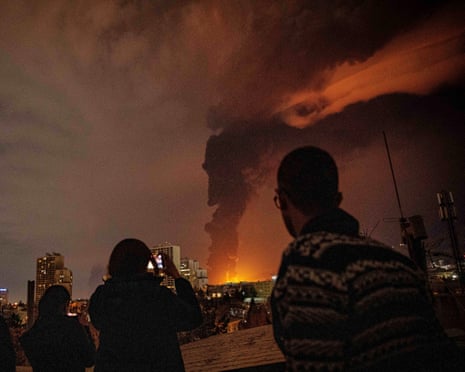
Residents in Tehran are still reeling from “apocalyptic” scenes unfolding across their city after airstrikes on oil depots over the weekend filled the sky with black smoke and covered the streets in soot. “The situation is so frightening it’s hard to describe,” one resident told the Guardian. “Smoke has covered the entire city. I have severe shortness of breath and burning in my eyes and throat, and many others feel the same. But people still have to go outside because they have no choice. Many places reopened today, but closed again because it’s impossible to stay outdoors.”
-
The war has sent oil prices surging and Asian stock markets into a nosedive. Global oil prices rose past $100 (£74) a barrel for the first time since 2022 as fallout from the war continues to wipe 20m barrels of oil from the market each day.
Lebanon parliament extends term for two years amidst US-Israeli war on Iran
The Lebanese parliament has voted to extend its term for two years as Israeli airstrikes continue in the south, according to the state-run National News Agency.
The vote was 76 in favour of the extension, 41 against and 41 abstentions, with the Associated Press reporting that Hezbollah’s 13-member bloc in parliament voted in favour as well.
The Israeli military issued a warning on Monday for residents of the southern suburbs of Beirut to heed earlier evacuation orders as it carried out an operation targeting Al-Qard Al-Hassan, the US-sanctioned financial organisation that Israel has accused of financing the Iran-backed Hezbollah.
IDF begins 'wide-scale' wave of strikes on Iran
The Israeli military announced Monday that it had begun a “wide-scale wave of strikes against infrastructure of the Iranian terror regime” in across Tehran, Isfahan and southern Iran.
The announcement came shortly after a man was killed and several more injured in an airstrike fired toward central Israel. It is unclear who launched the attack.
Unicef: At least 83 children killed in Lebanon since start of conflict
At least 83 children have been killed and 254 wounded in Lebanon since the Israeli military began targeting the country with airstrikes in response to missiles launched into northern Israel by the Iran-back Hezbollah, according to Unicef, a UN agency.
“On average, more than 10 children have been killed every day across Lebanon over the past week, with approximately 36 children injured each day,” Edouard Beigbeder, the Unicef regional director for the Middle East and North Africa, said in a statement.
Beigbeder estimated that since 2 March, 700,000 people – including around 200,000 children – have been displaced from their homes, “adding to the tens of thousands already uprooted from previous escalations”.
“Unicef calls on all parties to protect civilians and civilian infrastructure, including schools and shelters, and to uphold their obligations under international humanitarian law,” Beigbeder said. “Unicef urges immediate efforts to de-escalate the situation and prevent further harm to children.”
Deepa Parent spoke to Tehran residents for the Guardian about the “apocalyptic” scenes in their city after a night of airstrikes on oil depots over the weekend filled the sky with black smoke and covered the streets in soot.
“The situation is so frightening it’s hard to describe,” one resident said. “Smoke has covered the entire city. I have severe shortness of breath and burning in my eyes and throat, and many others feel the same. But people still have to go outside because they have no choice. Many places reopened today, but closed again because it’s impossible to stay outdoors.”
Here’s a look at what they’re seeing:

Appointing a new leader is the least of Iran’s troubles
Patrick Wintour
The election of Mojtaba Khamenei as the new Iranian supreme leader, succeeding his assassinated father, represents a symbolic and real triumph for conservative continuity at a time when the regime is under unprecedented challenge.
It also raises questions about how the hereditary principle complies with a revolutionary ideology formed in 1979 that never envisaged the post of supreme leader being passed from father to son.
More here: