2 months ago
100
2 months ago
100
Transport minister Lilian Greenwood rejects claim tougher drink-driving rules will kill off rural pubs
Good morning. Keir Starmer is taking his first PMQs of 2026 today, and it is hard to imagine that he will get through that without being able to comment on Donald Trump escalating his threats about annexing Greenland – a prospect that would tear apart Nato.
But, even with the world in crisis, domestic policy making has to continue and this morning the government is focusing on something closer to home – its road safety strategy.
The full document is not out yet, but here is the Department for Transport’s press release and here is Gwyn Topham’s overnigtht story about it.
The government wants to cut deaths and serious injuries on Britain’s roads by 65% by 2035 and it is quite a meaty strategy, with several significant proposals, albeit mostly ones that are going out for consultation, which means there is a chance they could be watered down.
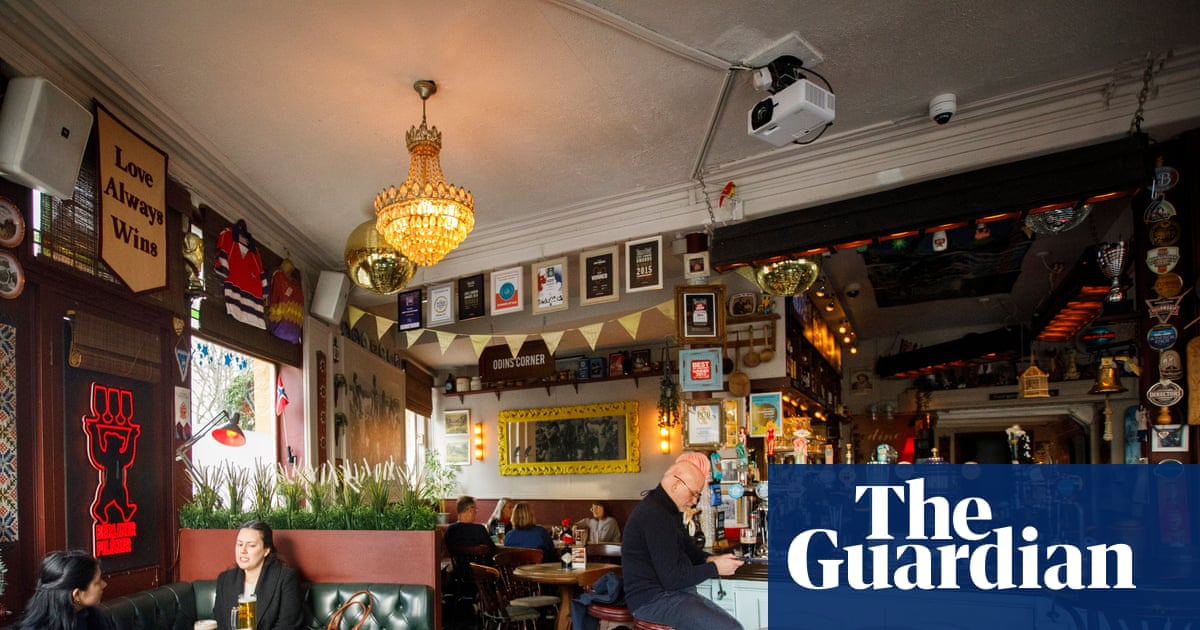
Perhaps the most controversial plan is the proposal to cut the drink-drive limit in England and Wales. It has not changed since 1967 and it is the highest in Europe, at 35 micrograms of alcohol per 100ml of breath. It could be cut to 22 micrograms, in line with the limit in Scotland since 2014.
Predictably, the rightwing papers are presenting this as a threat to rural pubs.
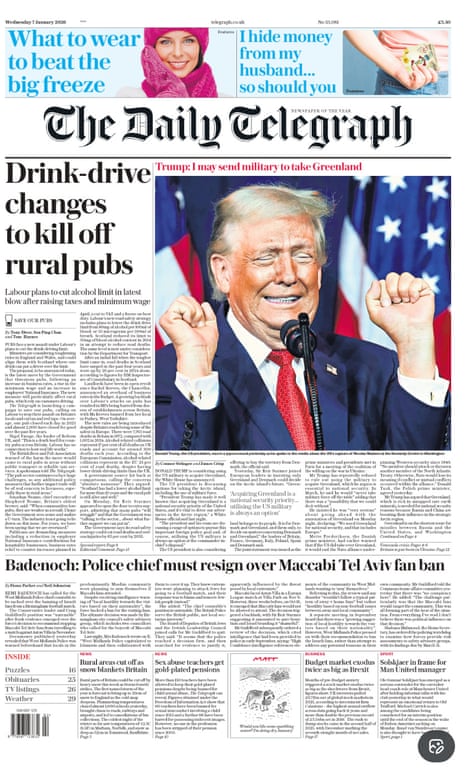
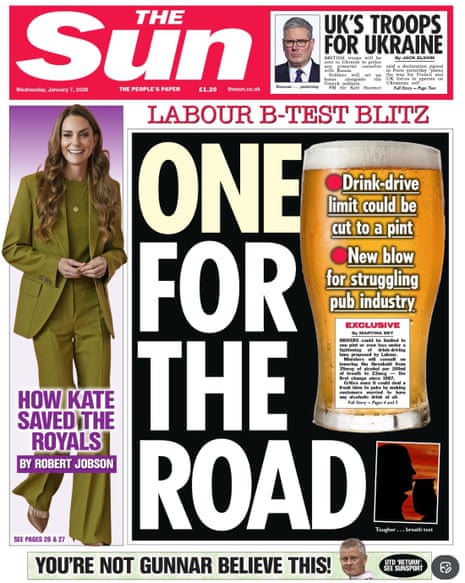
The Telegraph story quotes the British Beer and Pub Association as saying: “The pub sector continues to face huge challenges, so any additional policy measures that further impact trade will be of real concern to licensees, especially those in rural areas.”
Lilian Greenwood, the transport minister, has been giving interviews this morning, and and she has rejected the claim that a lower drink-drive limit would lead to rural pubs closing. She said there was evidence to back this up. She told Times Radio:
In drawing up these plans we’ve listened carefully to road safety experts from both in the UK and across the world. That’s precisely what we wanted to do was to be evidence-led in terms of our policy making.
Obviously the drink drive limit was reduced in Scotland back in 2014. The evidence from studies by the University of Stirling, [and from the] University of Bath is that that didn’t have a significant impact on the pub trade. They didn’t suffer as a result of that. So we have taken that into account in devising these proposals.
She also said the government did not want to stop people going to pubs.
What we’re just saying is don’t take your car. So that might mean that you know some places you’ll be able to take a bus or a taxi. In other places you’re going out with a group of mates. One of you agrees to be the designated driver. I know from working with the pub trade how many great low alcohol drinks there are out there. Now most of our favorite brands are produced in a low alcohol version. So people have lots of opportunities to do something to choose a different drink when you want to go out and you know and enjoy yourself in the pub.
I will post more from her interviews soon.
Here is the agenda for the day.
10am: Nigel Farage, the Reform UK leader, holds a press conference.
Morning: The Department for Transport is due to publish its full road safety strategy.
Noon: Keir Starmer faces Kemi Badenoch at PMQs.
After 12.30pm: MPs debate two Tory opposition day motions, on jury trials and rural communities.
If you want to contact me, please post a message below the line when comments are open (normally between 10am and 3pm at the moment), or message me on social media. I can’t read all the messages BTL, but if you put “Andrew” in a message aimed at me, I am more likely to see it because I search for posts containing that word.
If you want to flag something up urgently, it is best to use social media. You can reach me on Bluesky at @andrewsparrowgdn.bsky.social. The Guardian has given up posting from its official accounts on X, but individual Guardian journalists are there, I still have my account, and if you message me there at @AndrewSparrow, I will see it and respond if necessary.
I find it very helpful when readers point out mistakes, even minor typos. No error is too small to correct. And I find your questions very interesting too. I can’t promise to reply to them all, but I will try to reply to as many as I can, either BTL or sometimes in the blog.
Key events Show key events only Please turn on JavaScript to use this feature
Cunningham claims Sadiq Khan has created a London 'where criminals operate freely'
Laila Cunningham, who is a former CPS prosecutor and a Muslim, and who was born in Egypt, is speaking now.
She says she has raised her seven children in London. And those are seven reasons why she is standing, she says.
She says crime is going up.
Let’s just go through some stats. Knife crime in London is up 68% since 2016. Robbery is up by more than 50% during that same period. More than 100 phones are stolen every single year. And that’s just those we know about. We are living, ladies and gentlemen, through a rape epidemic.
You see, crime for me, is not theoretical like some of the journalists who say I’m scared. My family has experienced it many times. In fact, one time my kids were targeted by gangs in balaclavas who people say don’t exist. Day after day, near us, in broad daylight. We were all terrified. I turned to the police. Naturally. I was told there were not enough resources.
Cunningham says, in this case, she followed the gangs herself and took photos. The press called her a vigilante mum, she says.
She says women in particular don’t feel safe.
Why would they? There’s no police, and hardly any rape offences are prosecuted.
I speak to women who’ve been raped who have been told by the police, I’m sorry, there’s not enough evidence.
Cunningham says Sadiq Khan has created a city “where criminals operate freely”. And he does not take responsibility for it, she claims.
Farage says Laila Cunningham will be Reform UK's candidate for London mayor in 2028
Farage is now talking about London, where council elections are taking place.
He says that Sadiq Khan has said he will run for a fourth term as mayor.
(That is true, although people who follow London politics closely are confident that he won’t seek a fourth term in the end.)
He says Reform is treating the elections as a precursor to Reform taking on Khan in the next in the mayoral election.
He claims that London is collapsing. He says people do not feel safe walking the streets.
(He is sounding like Donald Trump at this point.)
He is announcing Reform’s candidate for London, he says. It will be Laila Cunningham, he says.
(Farage says the next mayoral election will be in 2027, but he is wrong; it will be in 2028.)
Farage says some commentators think the economy is doing better than expected.
But he says he does not agree, and he thinks there is a danger of a serious collapse amongst small businesses.
He still thinks the general election will take place before 2029.
Farage says he will announce Reform UK's leader in Scotland at press conference in Edinburgh next week
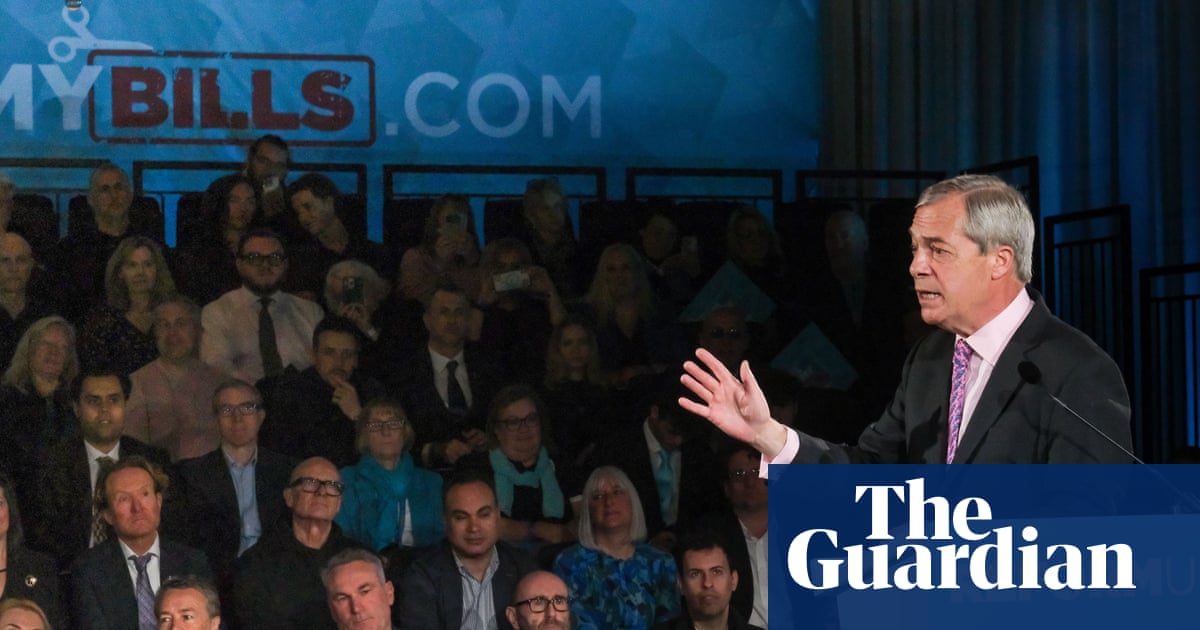
Nigel Farage is starting now. He is in front of a banner saying London needs Reform.
He says he is in the some venue where he announced on 3 June 2024 that he was coming out of retirement and returning to Reform UK as party leader. He says the party has now led in almost 200 polls in a row, normally by about 10 points.
Today he wants to talk about the local elections in May, which he says will be the most important set of elections ahead of the general election.
He will be focusing on getting the party ready, with the right candidates in place.
There has been a lot of focus on Wales already, he says. Wales “looks like a two-horse race between us and Plaid”, he says.
And in Scotland he says is amazed by how much progress the party is making there. He will do a press conference in Edinburgh on Thursday next week where he will announced the name of the Reform UK leader in Scotland.
Nigel Farage, the Reform UK leader, is holding a press conference, which is due to start at 10am.
There is a live feed here.
Reform UK accuses BBC of bias over party allegiance of audience member in Caerphilly byelection debate
Reform UK has complained to the BBC after it emerged that a prominent audience member at a byelection debate is now running as a Plaid Cymru candidate, PA Media reports. PA says:
Voters in Caerphilly went to the polls after the sudden death of Labour Senedd member Hefin David last year.
BBC Wales held a television debate with six of the candidates called Your Voice, Your Vote, in the lead-up to polling day.
During the debate, a woman criticised the party’s stance on immigration, claiming she had “never felt so unwelcome in my own home town”, telling Reform candidate Llyr Powell: “Mr Powell, I blame you for that.”
The interaction went viral and was discussed for the remainder of the campaign, the party said.
Plaid candidate Lindsay Whittle went on to win with 15,961 votes, more than 47% of the total.
Nigel Farage’s party had pledged to “throw everything” at its campaign for the seat, which Labour had held since the Senedd was established in 1999.
Plaid has since announced the audience member, Alison Vyas, as a community council candidate in Caerphilly.
A Facebook post announcing her candidacy described her as a “proud Valleys woman” who “brings the strength, warmth, and community spirit she grew up with”.
Farage said: “Trust in the BBC has been shaken by scandals in recent years, from Huw Edwards to the selective editing of a clip of President Trump. Now, this revelation will be the final straw for many people in Wales. How can there be any confidence that Reform will get a fair and balanced hearing when this is the kind of thing that happens at key election debates?”
A BBC spokesperson said: “As with all BBC election debates, the audience was selected through an established and impartial vetting process designed to ensure a fair representation of political views. All participants were selected in line with our standard editorial guidelines.”
‘Catastrophic’ MoJ leasing of jail with toxic gas set to cost more than £100m
A “catastrophic” decision by the Ministry of Justice to sign a 10-year lease on a prison where high levels of a poisonous gas had been detected is expected to cost the UK taxpayer more than £100m, the Commons public accounts committee has concluded. Rajeev Syal has the story.
MSPs vote to suspend Ash Regan for 2 days over code of conduct breach during gender recognition row

Severin Carrell
Severin Carrell is the Guardian’s Scotland editor.
Ash Regan, the independent MSP and former Scottish National party minister, has been suspended for two days by her Holyrood colleagues after she was found to have breached the devolved parliament’s code of conduct.
Regan, who quit the SNP to join Alex Salmond’s nationalist party Alba, but then quit Alba after disputes over succeeding him, was found to have twice broken the code by making public her criticisms to parliament about a Green MSP, Maggie Chapman.
One of Holyrood’s most vociferous gender critical MSPs, Regan had complained to the presiding officer about Chapman, one of Holyrood’s most vociferous pro-trans MSPs, over Chapman’s comments about the supreme court judgement on the legal definition of woman.
Although Regan had not lodged a formal complaint, she posted her letter attacking Chapman and calling for an investigation of her on X; the process is designed to be confidential.
MSPs voted by 84 votes to 18 to suspend Regan from two sitting days; eight MSPs abstained while 19 did not vote. Regan’s counter motion rejecting the sanction was defeated by 88 votes to 19, with two Labour MSPs supporting it.
Greenwood explains why restrictions on new drivers not included in road safety strategy
Although the road safety strategy is extensive, the government has not adopted a proposal backed by some campaigners – preventing new drivers carrying passengers, or driving at night, for a certain period after they have passed their test.
Asked why the government was not doing this, Lilian Greenwood, the transport minister, told ITV’s Good Morning Britain:
We’ve had to strike a balance between protecting young people and not overly impacting their opportunities to access work and education and social activities.
But she said the proposal to make learner drivers wait up to six months between taking the theory exam and doing the practical test would reduce the risk of new drivers being in charge of a car with too little experience.
As the BBC reports, Crystal Owen, whose son Harvey was one of four teenagers killed in an accident in Wales in 2023 in a car driven by a new driver, has said restrictions for new drivers should have been included in the plan.
Greenwood defends proposal to require older drivers to take eye tests
In interviews this morning, Lilian Greenwood, the transport minister, also defended the proposal to require older drivers to take eye tests. She told BBC Breakfast:
We know that our eyesight can deteriorate as we get older. I’ve had coroner’s reports where people have been killed by people who’ve got poor eyesight. Sometimes they’re driving in a reckless way when they’ve already been advised that they shouldn’t be driving anymore. In other cases, people didn’t realise that their eyesight had deteriorated.
But we’ve got an ageing population. We know that this is a growing issue, and that’s why we’re proposing this action today.
Transport minister Lilian Greenwood rejects claim tougher drink-driving rules will kill off rural pubs
Good morning. Keir Starmer is taking his first PMQs of 2026 today, and it is hard to imagine that he will get through that without being able to comment on Donald Trump escalating his threats about annexing Greenland – a prospect that would tear apart Nato.
But, even with the world in crisis, domestic policy making has to continue and this morning the government is focusing on something closer to home – its road safety strategy.
The full document is not out yet, but here is the Department for Transport’s press release and here is Gwyn Topham’s overnigtht story about it.
The government wants to cut deaths and serious injuries on Britain’s roads by 65% by 2035 and it is quite a meaty strategy, with several significant proposals, albeit mostly ones that are going out for consultation, which means there is a chance they could be watered down.
Perhaps the most controversial plan is the proposal to cut the drink-drive limit in England and Wales. It has not changed since 1967 and it is the highest in Europe, at 35 micrograms of alcohol per 100ml of breath. It could be cut to 22 micrograms, in line with the limit in Scotland since 2014.
Predictably, the rightwing papers are presenting this as a threat to rural pubs.
The Telegraph story quotes the British Beer and Pub Association as saying: “The pub sector continues to face huge challenges, so any additional policy measures that further impact trade will be of real concern to licensees, especially those in rural areas.”
Lilian Greenwood, the transport minister, has been giving interviews this morning, and and she has rejected the claim that a lower drink-drive limit would lead to rural pubs closing. She said there was evidence to back this up. She told Times Radio:
In drawing up these plans we’ve listened carefully to road safety experts from both in the UK and across the world. That’s precisely what we wanted to do was to be evidence-led in terms of our policy making.
Obviously the drink drive limit was reduced in Scotland back in 2014. The evidence from studies by the University of Stirling, [and from the] University of Bath is that that didn’t have a significant impact on the pub trade. They didn’t suffer as a result of that. So we have taken that into account in devising these proposals.
She also said the government did not want to stop people going to pubs.
What we’re just saying is don’t take your car. So that might mean that you know some places you’ll be able to take a bus or a taxi. In other places you’re going out with a group of mates. One of you agrees to be the designated driver. I know from working with the pub trade how many great low alcohol drinks there are out there. Now most of our favorite brands are produced in a low alcohol version. So people have lots of opportunities to do something to choose a different drink when you want to go out and you know and enjoy yourself in the pub.
I will post more from her interviews soon.
Here is the agenda for the day.
10am: Nigel Farage, the Reform UK leader, holds a press conference.
Morning: The Department for Transport is due to publish its full road safety strategy.
Noon: Keir Starmer faces Kemi Badenoch at PMQs.
After 12.30pm: MPs debate two Tory opposition day motions, on jury trials and rural communities.
If you want to contact me, please post a message below the line when comments are open (normally between 10am and 3pm at the moment), or message me on social media. I can’t read all the messages BTL, but if you put “Andrew” in a message aimed at me, I am more likely to see it because I search for posts containing that word.
If you want to flag something up urgently, it is best to use social media. You can reach me on Bluesky at @andrewsparrowgdn.bsky.social. The Guardian has given up posting from its official accounts on X, but individual Guardian journalists are there, I still have my account, and if you message me there at @AndrewSparrow, I will see it and respond if necessary.
I find it very helpful when readers point out mistakes, even minor typos. No error is too small to correct. And I find your questions very interesting too. I can’t promise to reply to them all, but I will try to reply to as many as I can, either BTL or sometimes in the blog.