2 months ago
81
2 months ago
81
After writing about art at the Guardian for 30 years, I have been asked by my editor to reflect on what I have learned. I am not sure I’m capable of doing that. What I can do is write about what I have seen. Even when you are an eyewitness, things get murky very quickly, and critics are among the most unreliable of narrators.
An unknown woman at a table writes a letter we can’t see, while her maid reacts to something beyond the painted window. We can’t see what she’s smiling at either. How is it that Vermeer’s 1670-71 Woman Writing a Letter, With Her Maid, makes me feel somehow privy to its intimacies when almost everything that matters is withheld? You have to make it up. The stories come barging in, something you can’t quite imagine happening in such an ordered world.
Vermeer at the Rijksmuseum in 2023 was tremendous, one of those exhibitions that form the chain in my imagination leading from the past to the present, beginning with the big Goya exhibition at London’s Royal Academy in 1963, when I was 10 or 11. Since then, Goya has never left me. Édouard Manet at the Prado in 2003, and the polychrome Spanish wooden sculptures in the National Gallery’s The Sacred Made Real in 2010, are all in there too. The list keeps lengthening.
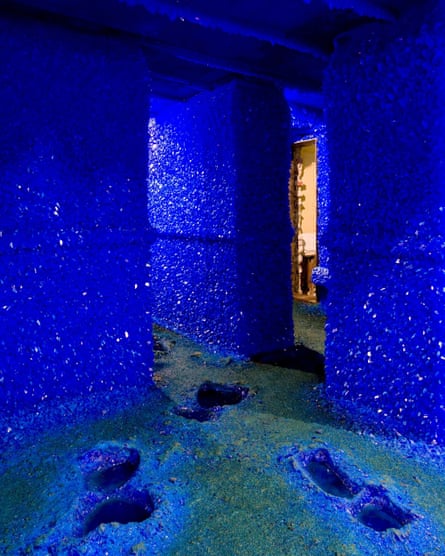
I recall several Documentas in Kassel, Manifestas in Sicily and Belgium, Zurich and St Petersburg. Too many Tate Modern Turbine Hall commissions to count and so many times at the Venice Biennale they have all become a watery blur. Don’t ask about art fairs, wherever they are. Then there was that do-it-yourself exhibition on some scraggy wasteground in Glasgow and the council flat near the Elephant and Castle that Roger Hiorns clogged with blue crystals. It all comes back to me as I revisit my reviews.
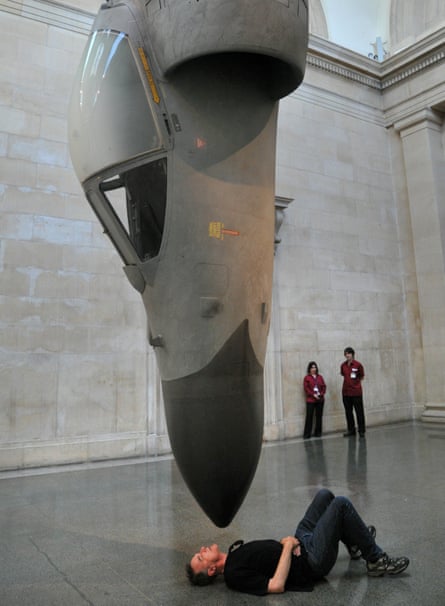
How could I forget Pipilotti Rist’s underwear, hung on a washing line at Hauser & Wirth Somerset in 2014? Or going nose-to-nose with the jet fighter that Fiona Banner hung from the ceiling at Tate Britain in 2010? Gregor Schneider’s 2004 Die Familie Schneider, with its near identical terraced houses and the sets of twins, the unseemly incidents in the shower, the boy in a bin liner, the smells and the sounds in the flue remains ineradicable, no matter how hard I scrub.
And did I see the lone orchestral conductor keeping time to no one at all in the housing projects, or was it something that happened in a painting by Noah Davis? What about Emily Jacir’s 2001-03 project Where We Come From? Photographs and documentation showed Jacir’s journeys around Palestine, travelling on an American passport, performing everyday tasks for Palestinians living abroad and unable to return. Was this imagined or real? The work came to me first as a story, and has never left me.
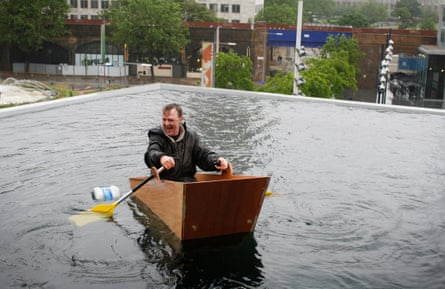
I’ve spent an afternoon boating on a flooded sculpture deck at the Hayward, and an entire night in the gallery on a motorised bed, courtesy of Carsten Höller. I remember some shows like they were yesterday, only to discover they happened 20 years ago, and I can barely recall what I wrote about last week. Often the journeys and the conversations and random encounters are as memorable as the art. The circumstances and the accidents are always inextricably linked, even if they don’t end up getting written about. The highs and lows of all those decades of looking guide my progress, but they are no good when the deadline looms and I haven’t a clue whether to give a show five stars or none. What do I really think?
I am only ever as good as my material. Some reviews almost write themselves. The work itself shows you what to say. Anni Albers’ weavings at Tate Modern, Richard Serra’s sculptures at the Grand Palais in Paris, Steve McQueen’s film Grenfell – this last was more than anything a matter of witnessing. The eye is a camera making a slow low-altitude approach from the north, with the burned-out tower block marking itself out on the smudged horizon, while road junctions and playing fields and industrial estates pass beneath us, till we find ourselves circling the incinerated flats, again and again, then lifting and leaving with the neighbourhood tilting behind us.
When I was young I didn’t get Cézanne. Even when I wrote about his 1996 Tate retrospective – my first piece for the Guardian – I had to method-act my enthusiasm, even though I’d been looking at the French painter since art school in the early 1970s, largely failing to feel the love. This psych-yourself-up rigmarole just amplifies the imposter syndrome, which I have always had and never really goes away.
At its best, and if you let it, the art not so much tells you what to think as engages you on several levels all at once, as Albers did. Looking is an embodied experience as well as a mental process. Sometimes all you have to do is report back. Turner prize-winning artist Nnena Kalu’s work somehow announced itself as I walked into her room at Cartwright Hall Gallery in Bradford last year. It snared me when I wasn’t ready for it and my reaction was unexpected. Sometimes you’ve got to let yourself go.
Looking back, I could have made a killing if I had performed the old modern-art-is-a-con switcheroo, declaring that finally the scales have fallen from my eyes and I now see clearly for the first time. There’s always a career to be had as a table-thumping reactionary, but I’d have missed so much. You have to be quick on your feet as a newspaper critic, but you’ll not fillet me of the secret to my fine-honed acumen. I was once interviewed by a Polish critic who wanted to know my methodology. He was singularly unimpressed when I said that I don’t have one. I just look at the art, hope the writing comes and make shit up. Insights such as these do not come cheap.
In the three decades since I’ve been here, everything in the art world has ramped-up: the money, the glamour, the yachts. But none for me. I could have done deals with the global mega-galleries and won big with my unerringly correct Turner prize predictions, if only I knew how to place a bet. I have managed to convince myself that I do like Cézanne more than I once did, though his bathers are still a step too far.
If you don’t get an artist first time around, stick with it long enough and they’ll be back and you can give them another going-over and maybe get it right next time, even if you don’t like them any better. As Ceal Floyer once put it, in an audio she made sampling a Tammy Wynette track from 1972: “Till I get it right, so I’ll just keep on.” She repeated it over and over, the little audio loop echoing through the Fridericianum in Kassel for Documenta 13.
For a long time it felt as if I could hardly step out the door without falling over a Howard Hodgkin exhibition or a Francis Bacon knees-up, a Lucien Freud-fest, an Edvard Munch-athon, an orgy of Frida Kahlo or an animated, interactive David Hockney experience. Time was when editors thought you had to explain to readers what an installation was, but now everything’s gone immersive.
I remember stumbling about in an utterly dark room, first in Germany, then in Paris, surrounded by yelping headbangers, people crawling around at my feet and singers keeping up a manic tempo of steam-train hisses and piston rhythms, all part of Tino Sehgal’s This Variation. It was certainly more fun than a Yayoi Kusama Infinity Room. It is expected that both curators and the critics will have something new to say every time popular artists get shown. But that’s not always how it is. Some artists change but don’t get any better. Some artists get better but never change. There are artists who change the rules of the game from show to show, but they remain themselves even when their art demonstrates an astonishing diversity, as is the case with Philippe Parreno or McQueen, Ryan Gander or Dominique Gonzalez-Foerster.
But even consistency can be deceptive, as Georges Seurat’s small seascapes, currently at the Courtauld Gallery, evidence. They sit on the wall as though caught in the crosscurrents of competing thoughts. There is something uncanny about their provincial seaside ambience, to the point at which, the more I look at them, the more unnerving and compelling and immersive they become. Nowadays, give me a quiet room with a few Goya sketches or some Seurat conté drawings, and close the door behind you on your way out. Thank you. And even if the art hasn’t changed since your last shot at it, you have. Art always changes and always stays the same.