7 hours ago
9
7 hours ago
9
While watching the 2006 animated film Happy Feet with his daughter, Origame Digital founder Naphtali Faulkner noticed something interesting. “[In the movie], they see the digger fall into the ocean, and it has an almost eldritch quality,” he says. Over time, and with plenty of iteration, Faulkner’s inspirations coalesced, from HP Lovecraft to the 1982 version of The Thing and the works of David Lynch. “I’m a big fan of horror that sits in your head rather than in your stomach,” says Faulkner.
In Penguin Colony, players body-switch between species of flightless birds, piecing together cryptic cosmic clues as they tail a Nazi expedition to Antarctica. In the process, Origame Digital draws on Lovecraft’s novella At the Mountains of Madness. “I’d always wanted to do a creature that’s a manifestation of colonial thought, energy and power, and the idea of it resting and then regrowing,” says Faulkner. “I was looking through the history of Lovecraft and him being a gigantic racist, and this idea of the Nazis sort of came out,” he adds.
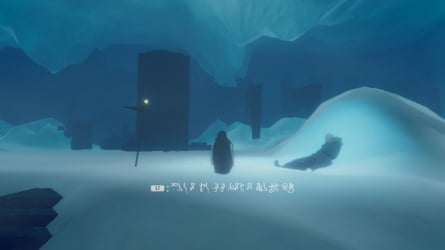
The visual style of Penguin Colony pays homage to the low-poly aesthetics of the PS2, a period Faulkner calls romantic, owing to the era’s limited technical capabilities, which led to impressionist designs. “We’re not a rich studio,” he says. “There was just a games crash; publishers aren’t funding anything, everyone seems to be out of money. So why don’t we make something very cheap to make?” It started with the game’s isolated setting, followed by a decision to have humans in the game appear as soldiers; their uniform bodies could be duplicated with only their heads swapped out. “Repetition pays its weight in gold sometimes because you aren’t having to be so meticulous. You can paint with broad strokes and really build something out.”
Penguin Colony’s Antarctic setting is predominantly open-world, allowing Origame Digital to hide enigmatic notes, photographs and soundbites across the frigid tundra. “We wanted to play into the Lovecraftian fear of the unknown,” Faulkner says. As such, instead of relying on a user interface, players are guided by their intuition.
This stylistic choice was also inspired by Dark Souls director Hidetaka Miyazaki, whose intentional vagueness evokes a distinctly pre-internet sense of discovery. “Certain things are in an alien language that players will need to decipher if they want to know what’s being said,” says Faulkner. By investigating, players also emulate the Nazi expedition’s archaeological activity. “[Later] you’ll come across some hieroglyphics, and we’ve made sure those image files contain no metadata, so players will actually have to look at them and try to decipher what it’s saying in context.”
This cryptic touch isn’t the only homage to FromSoftware. Penguin Colony features an insight system comparable to Bloodborne, which lets players interpret the game’s otherworldly aspects with greater clarity based on how they play. “I don’t want to spoil exactly what,” adds Faulkner. “But, in a dark area, if you have enough insight, you can hear something walking around behind you.”
Despite its surreal surroundings, Penguin Colony’s narrative draws on real history. “I did my research on this group called the Ahnenerbe, which was tasked with finding the Spear of Destiny and other Christian artefacts,” says Faulkner. “Nazi relic hunting went all around the world,” he continues. “They would find things with barely any connection to anything, and invent histories that don’t actually exist, and that was used as their justification for the colonial annexation of Europe.”
It’s a confronting topic, but Faulkner feels this kind of conversation belongs in games, especially since they are one of the few art forms in which audience participation is mandatory. He recalls a conversation with his mentor about playing in the grey, where you place ideas side by side and explore the feelings they can evoke. “There are people out there who, the moment you say colonisation, freak out and start stomping their feet. [That’s] not my audience … I think of it like this: if this game reaches someone who hadn’t thought about this [topic] before and they change the way they think about it, just a little bit, then it was worth it.”
-
Penguin Colony is coming soon to PC and Nintendo Switch 2.