3 months ago
208
3 months ago
208
Net immigration into UK fell by almost half in 2025, down to 171,000, ONS says
Net migration to the UK stood at an estimated 171,000 in the year to December 2025, down nearly a half (48%) from 331,000 in the previous 12 months, according to new figures from the Office for National Statistics (ONS). The Press Association says:
It is the lowest figure since early 2021, when the post-Brexit immigration system was introduced and Covid-19 travel restrictions were still in place.
Net migration is the difference between the number of people moving long-term to the UK and the number of people leaving the country.
An estimated 813,000 people immigrated to the UK in the year to June while 642,000 emigrated.
The continued fall in net migration is being driven by fewer people from outside the EU arriving in the UK for work, the ONS said.

Key events Show key events only Please turn on JavaScript to use this feature
Number of asylum seekers housed in hotels down 35% in March on previous year, at 20,885, figures show
The Home Office has also published asylum figures this morning. These show that the number of asylum seekers being housed temporarily in hotels stood at 20,885 at the end of March 2026, down 35% year-on-year from 32,326. The Press Association says:
It is the lowest figure since data was first reported in 2022, Home Office figures show.
The total had climbed as high as 56,018 at the end of September 2023.
The Labour government has pledged to end the use of hotels for asylum seekers by the next election.
Tories claim net immigration still 'far too high' after ONS figures show it almost halved in 2025
The Conservatives are saying non-EU immigration remains “far too high”. This is what Chris Philp, the shadow home secretary, is saying in his response to the net immigration figures.
Brits are leaving on a massive scale and non-EU immigration remains far too high. Mass immigration undermines our society and low wage immigration is bad for the economy. British families feel it in lower wages, longer waiting lists for public services and housing shortages.
Labour must go further and reform indefinite leave to remain before their hard-left flank forces them to abandon it altogether.
The next Conservative government will introduce a binding annual immigration cap at a very low level, close the loopholes that let temporary visa holders stay indefinitely and tighten and extend the conditions for ILR. We want a small number of highly skilled migrants and no low-skilled migration at all. But sadly, Labour do not have the backbone to do any of it.
Shabana Mahmood, the home secretary, has said the immigration figures shows the government is making “real progress” on border controls. In a statement, she said:
Net migration has fallen by 82% in just three years.
We will always welcome those who contribute to this country and wish to build a better life here. But we must restore order and control to our borders.
As these statistics show, real progress has been made, but there is still work to do. That is why I am introducing a skills-based migration system that rewards contribution and ends Britain’s reliance on cheap overseas workers.
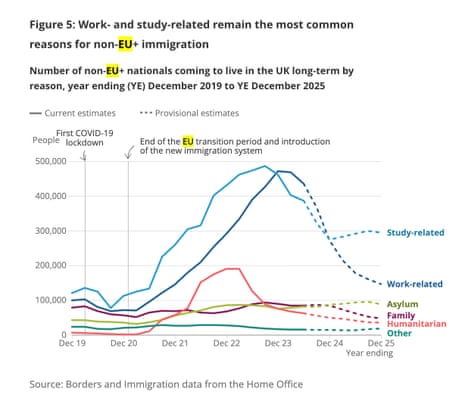
The sharp fall in the net immigration figures is largely a result of tougher rules for work visas and student visas, originally introduced by James Cleverly when he was home secretary in the Conservative government, and then mostly kept in place by Labour.
Here is a chart from the ONS report indicating this.
Reform UK and Tory supporters most likely to wrongly think net immigration has been rising, report says
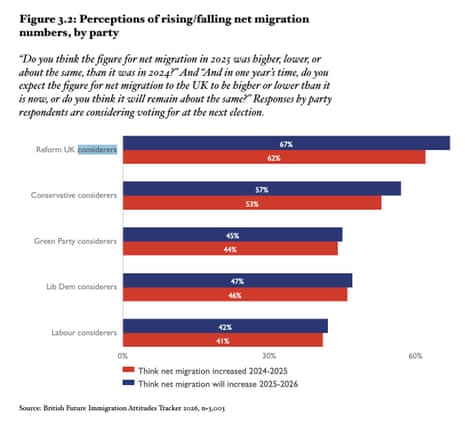
Net immigration has been falling for at least the past two years. But many people wrongly believe the opposite, according to new research from the British Future thinktank, published before today’s ONS figures came out. (See 9.44am.) Geneva Abdul has the story.
Here is the British Future report.
And this chart from the report shows that it is Reform UK and Conservative party supporters most likely to think, wrongly, that net immigration has been going up.
Net immigration into UK fell by almost half in 2025, down to 171,000, ONS says
Net migration to the UK stood at an estimated 171,000 in the year to December 2025, down nearly a half (48%) from 331,000 in the previous 12 months, according to new figures from the Office for National Statistics (ONS). The Press Association says:
It is the lowest figure since early 2021, when the post-Brexit immigration system was introduced and Covid-19 travel restrictions were still in place.
Net migration is the difference between the number of people moving long-term to the UK and the number of people leaving the country.
An estimated 813,000 people immigrated to the UK in the year to June while 642,000 emigrated.
The continued fall in net migration is being driven by fewer people from outside the EU arriving in the UK for work, the ONS said.
Matthew England from the Hansard Society has a list of all 20 MPs who won the chance to bring in a private member’s bill, listed according to whethere they were for or against assisted dying.
Desmond Swayne tops list of MPs selected to bring in private members' bills
Here is the list of 20 MPs who won the right to introduce a private member’s bill in the ballot held this morning. The list is in order, with Desmond Swayne in first place. Although 20 MPs can introduce a bill, only the people in the top seven are guaranteed a full day for their second reading debate, which means they are the MPs with the best chance of having a bill that might eventually become law.
The top seven MPs winning the ballot are: Desmond Swayne (Conservative, New Forest West), Lauren Edwards (Labour, Rochester and Strood), Mike Wood (Conservative, Kingswinford and South Staffordshire), Andrew George (Liberal Democrats, St Ives), Luke Evans (Conservative, Hinckley and Bosworth), John Whittingdale (Conservative, Maldon), and Jessica Toale (Labour, Bournemouth West).
The other MPs on the list are: Neil Shastri-Hurst (Conservative, Solihull West and Shirley), Gareth Snell (Labour, Stoke-on-Trent Central), Lincoln Jopp (Conservative, Spelthorne) Patricia Ferguson (Labour, Glasgow West), Robert Jenrick (Reform UK, Newark), Damian Hinds (Conservative, East Hampshire), Alistair Strathern (Labour, Hitchin), Clive Jones (Liberal Democrats, Wokingham), Victoria Atkins (Conservative, Louth and Horncastle), Munira Wilson (Liberal Democrats, Twickenham), Steff Aquarone (Liberal Democrats, North Norfolk), Paul Foster (Labour, South Ribble), and David Pinto-Duschinsky (Labour, Hendon).
This is from my colleague Jessica Elgot.
NEW - Two assisted dying supporters have come second and fourth in the private members bill ballot
- Lauren Edwards
- Andrew George
If they choose to take on the bill, it is possible it could still pass (but it is still very difficult)
Schools are ‘pipeline’ to joblessness for many people, says ex-Labour adviser
Schools have become a “pipeline” to worklessness for a large cohort of young people in the UK, according to an influential former Labour adviser who has called for urgent action to help a “lost generation”. Alexandra Topping and Richard Partington have the story.
Treasury minister Lucy Rigby says rich already being taxed properly, as Wes Streeting calls for 'wealth tax that works'
Good morning. It’s a big day for Rachel Reeves, the chancellor. In a Commons statement, she is announcing a series of measures to help people with the cost of living. She wants people to enjoy a “Great British summer”, she says. Reeves’s plan for what makes for a good summer is not quite the same as Samantha Niblett’s; the chancellor is talking about free bus travel for children, as Heather Stewart, Peter Walker and Sarah Butler report in their preview.
Reeves is speaking after 11.30am.
In the meantime, another Labour MP with ambitions to run the economy has been speaking out. Wes Streeting has given an interview to the BBC’s Nick Robinson for his Political Thinking podcast and he had a lot more to say about his policy agenda than he did in his resignation speech in the Commons yesterday. As the BBC reports, Streeting proposed a “wealth tax that works” – by which he means not what most people think of as a wealth tax (the Green party version – a tax on assets above a certain amount), but instead aligning capital gains tax rates with income tax rates. Streeting said this proposal – which is broadly the same as one of the main proposals in the Labour Growth Group’s report last week – could raise up to £12bn a year.
Lucy Rigby, the new chief secretary to the Treasury, was giving interviews this morning. Asked about Streeting’s proposal, she said she had not heard his interview, but she suggested Reeves was already taxing wealth. She told the Today programme:
We already tax wealth in this country. The chancellor introduced a host of measures in her first budget, and then further measures in the last budget as well, that try and make sure that tax is as progressive and fair as possible.
Here is the agenda for the day.
9am: Nusrat Ghani, a Commons deputy speaker, selects from a ballot the 20 MPs who will get a slot to bring forward a private member’s bill.
9.30am: The Office for National Statistics publishes figures for long-term migration into the UK. Separately, the Home Office publishes its quarterly asylum figures.
9.30am: Peter Kyle, the businesss secretary, takes questions in the Commons.
10.30am: Steve Reed, the communities secretary, gives a speech on “neighbourhood standards”. He is expected to suggest profits made by private providers of social care could be capped.
11.30am: Downing Street holds a lobby briefing.
After 11.30am: Rachel Reeves, the chancellor, makes a statement to MPs about measures to help people with the cost of living.
There are also 14 written statements coming today, of which at least two look particularly interesting. The government will publish information about the appointment of Andrew Mountbatten-Windsor as a trade envoy, in compliance with a Commons humble address. And Bridget Phillipson, the equalities minister, is publishing the long-awaited guidance on single sex spaces updated in the light of last year’s supreme court judgment on the meaning of the Equality Act.
If you want to contact me, please post a message below the line when comments are open (between 10am and 3pm), or message me on social media. I can’t read all the messages BTL, but if you put “Andrew” in a message aimed at me, I am more likely to see it because I search for posts containing that word.
If you want to flag something up urgently, it is best to use social media. You can reach me on Bluesky at @andrewsparrowgdn.bsky.social. The Guardian has given up posting from its official accounts on X, but individual Guardian journalists are there, I still have my account, and if you message me there at @AndrewSparrow, I will see it and respond if necessary.
I find it very helpful when readers point out mistakes, even minor typos. No error is too small to correct. And I find your questions very interesting too. I can’t promise to reply to them all, but I will try to reply to as many as I can, either BTL or sometimes in the blog.