2 months ago
91
2 months ago
91
Over the last 100 years or so, a characterful but tough corner of south Wales has become best known for its steelworks and coalmines. But the discovery of the footprint of a large Roman villa in a country park on the outskirts of Port Talbot gives an intriguing fresh insight into life here centuries before heavy industry took hold.
Found below the surface of Margam country park and close to the M4, the presence of the villa – which has been labelled “Port Talbot’s Pompeii” – suggests the area was not on the fringes of the Roman empire but very much part of it and may have been an important agricultural centre.
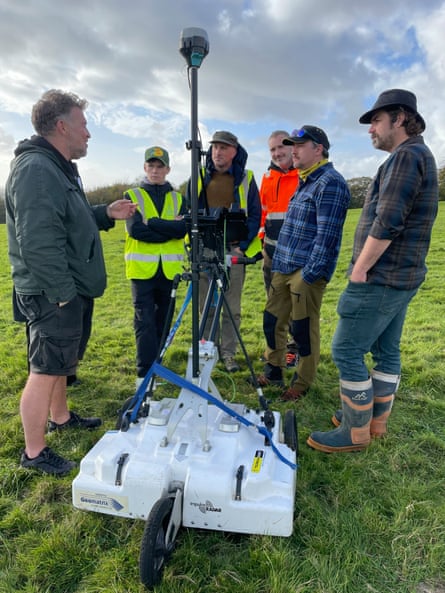
Alex Langlands, an associate professor of heritage and history at Swansea University, said he was taken aback when ground-penetrating radar suggested the hidden structure could be the largest villa of its kind in Wales.
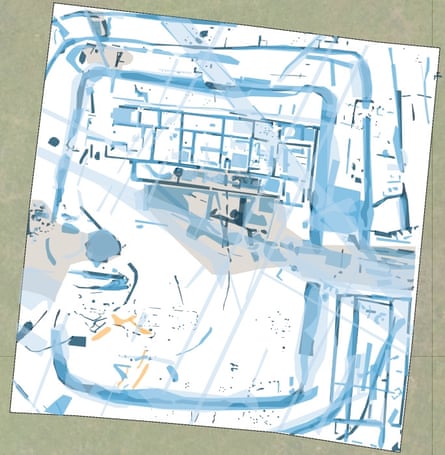
“It’s a lifetime find for me, the park and the community,” said Langlands, the project lead for ArchaeoMargam. “We suspected there was something Romano-British there but we didn’t for a moment think it would be as significant as this.
“When I saw the footprint of this site, I was like: ‘My word, this is really big.’ It changes the story. Until now Wales in the Romano-British period has, for the most part, been about legionary forts, Roman practice camps, marching camps, Roman roads.
“It’s always been around conquest, which hangs like a lead weight around Wales’s cultural identity in many respects but this paints a different picture. This wasn’t necessarily a frontier zone, an unstable place. The villa suggests, to use a problematic word, that it was civilised.”
The villa appears to be set within an enclosure measuring 43 metres by 55 metres. There was a substantial building to the south-east, either a large agricultural storage building or a meeting hall.
Langlands said the work so far suggested the Margam villa could be akin to the luxurious homes found in Gloucestershire, Somerset and Dorset.
“This may be comparable to the grand stately villas that you’ve got there, which are centres of agriculture. It suddenly feels like we were less out on some windswept frontier.”
It is not yet possible to precisely date the site but Langlands said: “I think we’re in the fourth century – it really fits that kind of late Roman flourish that we see in the south-west of Britain.”
He added that the finding of such a building here may suggest that Margam lent its name to the historic region of Glamorgan. “We’ve jokingly been referring to the site as the Port Talbot Pompeii,” Langlands said. “We don’t have a large settlement like that but what we do have is a high level of preservation because Margam is a deer park.
“It’s a deer park today, it was a deer park in the medieval period and it was probably a deer park going back to Romano-British times. That means it hasn’t been subjected to the kind of intensive ploughing that very often does irreparable damage.”
Surveys seem to show that floor surfaces and wall foundations are intact. “Fingers crossed, we’re hopeful that we’re going to have a pretty good level of survival in there,” Langlands said.
While the next steps on how to investigate the site are planned, the exact spot is being kept secret to deter “nighthawkers”, who illegally dig historical sites.
ArchaeoMargam is a collaboration between Swansea University’s Centre for Heritage Research and Training, Neath Port Talbot council and Margam abbey church.
Langlands said: “Margam is famous for bronze age, iron age, medieval and [post-medieval heritage. But we knew practically nothing about what was going on in the Romano-British period. This is the missing piece of the puzzle.”