2 months ago
49
2 months ago
49
An oil slick from a stricken Iranian ship threatens to contaminate one of the Middle East’s most important wetlands, satellite image analysis suggests, making it one of a number of spills posing a risk to the livelihoods of coastal communities in the Gulf.
The Shahid Bagheri, a drone carrier, began leaking heavy fuel oil in Iranian territorial waters near the strait of Hormuz after it was hit by a US warplane in the first few days of the US-Israel attack on Iran.
With Iran still under heavy bombardment, no one has been able to begin cleaning up the spill and the oil has travelled slowly westwards towards the Hara biosphere reserve, the largest mangrove forest on the Gulf shoreline.
The Shahid Bagheri, described as “one of the most conceptually significant vessels” in Iran’s navy, is a container ship modified to include a short runway for launching drones. Its fuel load was likely to have been significant: Iran’s Revolutionary Guards said it had a range of 22,000 nautical miles and could go a year between refuelling.
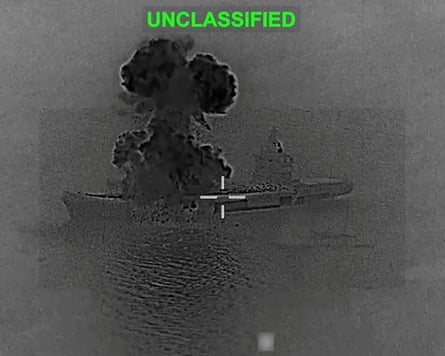
It was bombed by US warplanes on 6 March, in an attack illustrated in a social media video published by the US military. Since then it has been grounded in shallow waters in the middle Khuran strait, a narrow, ecologically important channel between the Iranian mainland and the island of Qeshm.
By 18 March the oil had travelled 16 miles south-west, in the direction of Hara, according to Tim Richards, a retired satellite remote sensing consultant who is among a number of analysts tracking the progress of the spill. He said it could be the most ecologically significant in the region since the first Gulf war.
Circular currents washing around the strait where the converted container ship was moored have meant the oil has moved slowly.
“The circulation [of the current] is that the water comes into the Gulf around the northern part of the strait, from the Indian Ocean,” Richards said. “And then it washes through the Khuran strait, where the vessel is and where the mangroves are. So there’s a general westward progression of the water despite the tides going back and forth.”
On 27 March rainfall appeared to sweep sediment into the strait, into which the oil began to mix, Richards said. “By the 28th it appears to have travelled a further 20km but it is possible that it has gone much further given the speed up through the strait at Bandar-e Pol and the flush of water from the rainfall event on the 27th.”
The impact on Hara, an important ecosystem for migrating birds and critically endangered turtles, as well as many species of fish and crustaceans, could be significant. The region’s fishing communities depend almost entirely on the sea for their livelihoods.
The spill is just the most significant currently in the Gulf. The US sank a number of Iranian ships at the start of the war, while Iran has struck a number of container ships and oil tankers with drones and missiles to police its blockade of the strait of Hormuz.
Wim Zwijnenburg, an environment analyst who has been compiling a database of harmful environmental incidents caused by the war, said he had logged three small spills off the coast of Iraq and Kuwait, and another in the strait of Hormuz from a sunken container ship. The US torpedo attack on the Iranian navy ship Dena off the coast of Sri Lanka had also caused a spill, which was dealt with by Sri Lankan authorities.
The environmental problem could get worse, Zwijnenburg said. “If you keep shooting at oil [and] chemical tankers, at some point you will create a catastrophe if it goes wrong. So, generally it’s a bad idea to fire missiles and drones at oil ships and chemical tankers. I think, so far, the environment has been escaping a disaster from all these attacks.”