2 months ago
117
2 months ago
117
The quietly intimidating interloper who wanders in to a household to stir up a family drama is not an unfamiliar dramatic trope. The intruder in Lyle Kessler’s Philadelphia household comes disguised first as victim, then slowly exerts his dominance until he is ruling the roost.
The family here consists of two oddball brothers; Phillip (Fred Woodley Evans) is the younger, more vulnerable and apparently housebound. Treat (Chris Walley) is more volubly in charge, and a petty thief in the outside world.
We only ever see them inside though, in designer Sarah Beaton’s beaten-up front room, and it is the latter brother who drags Harold (Forbes Masson) into their home one night, drunken and bearing valuable bonds in his briefcase that gives Treat the idea to hold him ransom. So Harold is bound and gagged, only for this Houdini-like “victim” to become the brothers’ free-reigning father figure cum oppressor.
There is a preoccupation with orphans – Harold speaks about his own childhood trauma of growing up parentless. He talks of the “dead end kids” around him at his orphanage and it seems to have a direct correlation to the parentless brothers before him, whom he grooms in different ways, encouraging Phillip to step into the world beyond his front door while trying to shape Treat into a gangland criminal.
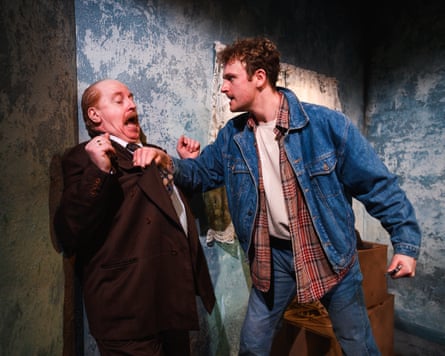
Harold’s presence is emotional kindle, messing with the power dynamic between the brothers, and he is, like Pinter’s men, a quietly chilling presence, bearing the potential for violence.
It is smartly directed by Al Miller, building claustrophobia and tension, but the play is stalled by its own setup, teetering into what might be symbolic or surreal ground, and not going far enough in the relationship between the brothers and Harold.
There are moments of open bigotry that are also unexplained. Is this a reflection of the suspicion they feel of the hostile world beyond their home, in blue-collar 1980s Philadelphia, or something else? This is a problematic feature of the play that again goes nowhere.
It feels incomplete – a peculiar gem of a revival. What stands out, ultimately, and holds you breathless, are the performances of the three actors. As outlandish as the scenario may be, they make you believe in their power play, vulnerability and pent-up anger and ambition.