2 months ago
96
2 months ago
96
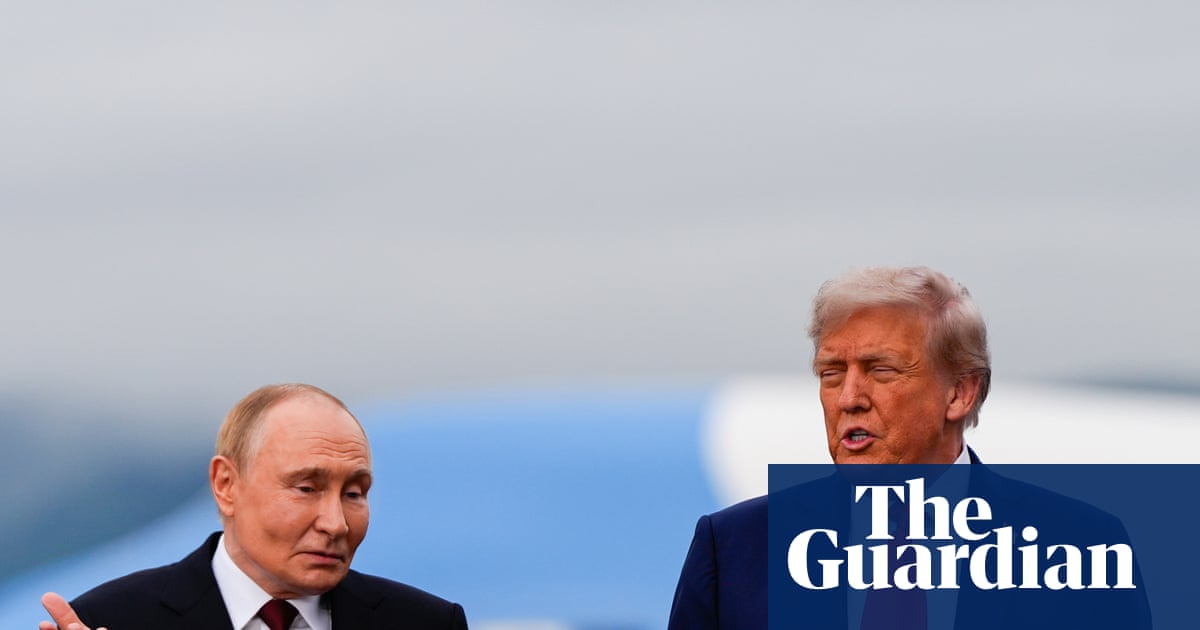
Vladimir Putin is likely to stage another Salisbury-style attack on UK soil unless the government adopts more aggressive tactics against the Kremlin, the exiled Russian billionaire Mikhail Khodorkovsky has said.
The former oil tycoon has emerged as a leading figure in Russian diaspora opposition circles and claims to be well-informed about current thinking and developments among Moscow’s elite.
In a wide-ranging interview with the Guardian, Khodorkovsky – who still fears for his life after spending 10 years in a Siberian prison after clashes with Putin – said the Trump presidency had provided the Russian leader with a “window of opportunity” to threaten Europe.
Khodorkovsky predicted that Putin was likely to mass troops on the border of a Nato country such as Estonia, to “flex his muscles” and said he believed that Russian security services were planning an attack similar to the 2018 Salisbury Novichok poisonings to destabilise the UK.
“The goal […] would not just be to get rid of certain people but to create a sense of vulnerability in the west. Like it was in Salisbury,” Khodorkovsky said. “It’s not important whether the victim dies or not, what’s important is that the sense of vulnerability has been created.
“People in the Kremlin aren’t stupid, they’re quite creative. They’ll be thinking of new ways of doing something. What is clear is that there is going to be some kind of pressure and it will take a similar form [to Salisbury].”
Putin had “chosen as his main enemy the UK”, Khodorkovsky added.
The UK government’s best strategy to prevent any further incidents similar to Salisbury may be to go on the offensive against the Russian security services, he said.
“If you cast your mind back to the 1950s and 60s when there was also quite a wave of this sort of brutal interactions, it sort of dissipated quite quickly, which was done by just giving the mirror response,” Khodorkovsky said, speaking through an interpreter.
“People who work for the intelligence services are just like you and I, they don’t want to die. They started fleeing, leaving the intelligence services. This is when it was probably decided that they should discount using the worst, the most brutal methods. I’m not sure whether British society today is ready for this kind of counter-answer, counterstrike.”
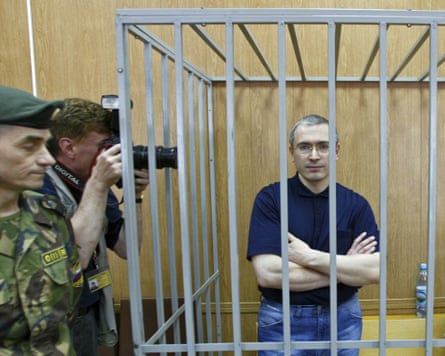
Khodorkovsky, 62, was Russia’s richest man, with a reported fortune of $15bn (£11bn) built up either side of the fall of the Soviet Union, including via his Siberian oil business, Yukos. He was arrested in 2003 after challenging Putin by advocating for democratic reforms. He was charged with fraud and jailed for 10 years, a sentence widely considered to be politically motivated. Shares in Yukos were seized by the Russian government and carved up.
After spending a decade in prison, during which he was slashed in the face by another inmate with a makeshift knife, Khodorkovsky went into exile in the UK.
Speaking at his London offices, he said it was too late for the west to avoid a new cold war with Russia but that governments’ priority should be to avoid escalation into a “hot war”, despite his expectation that Putin would attempt to provoke Britain’s Nato allies.
“I wouldn’t be surprised if in the near future we’ll see some troops amassed on the border with [Nato member] Estonia, for example,” Khodorkovsky said. “I do not believe that Putin in fact is ready to embark on another military conflict. But it will have an impact.”
“He thinks that his window of opportunity is [Donald] Trump in power,” Khodorkovsky said, adding that this window could shut if the Republicans performed poorly in November’s US midterm elections and Trump in effect became a lame duck president.
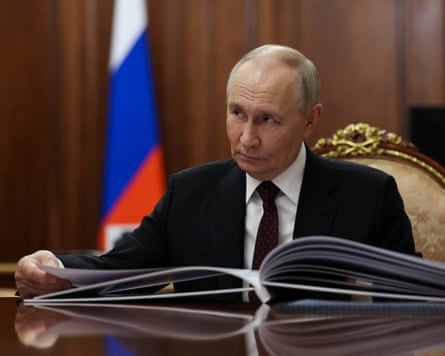
Putin’s position had not been significantly weakened by the imposition of sanctions against oligarchs or specific products or sectors, Khodorkovsky said. Politicians wanted to “impress their electorate” with sanctions against goods and trade, but in practice these were “unrealistic” to enforce, he added.
The Guardian has recently reported on concerns that Irish aluminium and carbon fibre equipment that can be used for making drones and missiles could be reaching the Russian military supply chain.
Khodorkovsky said the west’s belief that sanctions against Russian oligarchs would motivate them to put pressure on Putin to end the war in Ukraine was based on “erroneous” understanding of the relationship between wealthy businessmen and the Kremlin.
“I have been saying for the past 20 years that there are no oligarchs in Russia,” he said. “How can you reconcile oligarchy with dictatorship? If you have money without any weapons, you are just food for somebody else.”
However, he acknowledged that some oligarchs had been “agents of influence” for Russia in the west and that sanctions had neutered their power. One oligarch who Khodorkovsky knows well is the former Chelsea football club owner Roman Abramovich.
The pair were planning to create Russia’s largest oil company through the merger of Yukos and Abramovich’s Sibneft business. The merger was in progress, via a combination of cash and an exchange of shares, when Khodorkovsky was arrested and Abramovich withdrew from the deal and secured its effective unwinding.
In 2005, Abramovich sold his shares in Sibneft to the Kremlin for $13bn and used some of the proceeds to fund Chelsea FC, which he had bought two years earlier.
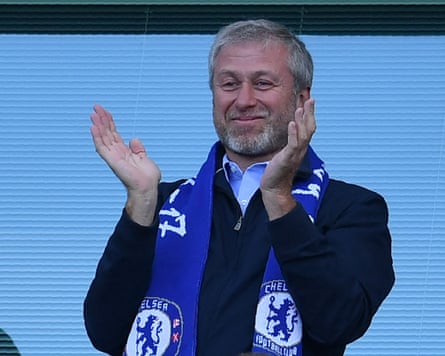
Abramovich’s purchase of Chelsea could not have proceeded without Putin’s blessing, Khodorkovsky alleged, although he said this did not mean the Russian president had ordered the takeover.
However, Khodorkovsky said he did detect Putin’s close interest in the legal dispute between Abramovich and the UK government over how the £2.5bn proceeds from the forced sale of Chelsea in 2022 should be used. The sticking point is believed to be Westminster’s assistance that funds should not be diverted to any territory under Russian control.
Khodorkovsky said: “I know – albeit from only one source that I cannot provide, that the presidential administration views the funds Abramovich is discussing with the UK government as a future resource for the reconstruction of both the part of Ukraine under Kyiv’s control and the part under Moscow’s control. I personally trust this source. You could say this is my deep-seated conviction.”
Lawyers for Abramovich said no government was involved in the purchase of Chelsea, nor in the current attempts to find a solution with the UK government to release funds towards charitable purposes. Abramovich has previously taken legal action against the publisher Harper Collins over a claim in the book Putin’s People that the Russian president ordered the purchase of the Premier League football club. He secured a clarification that this allegation was not a statement of fact.
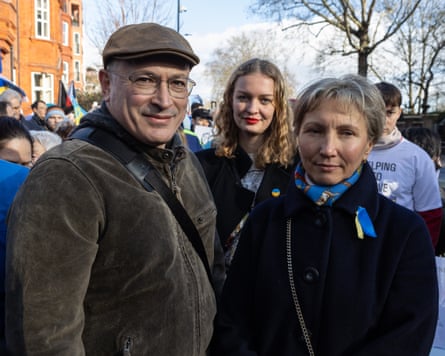
In October 2025, the Russian government declared Khodorkovsky a “terrorist” along with members of the Anti-War Committee of Russia founded by exiles and activists in 2022, accusing them of plotting a violent coup.
Khodorkovsky said he tried not to think about the risk that Putin might pose to his safety. “I spent 10 years in prison,” he said, pointing out his facial scar. “They could kill me any time.
“There is no resource of protecting yourself in the UK. So if your intelligence services are doing something I am grateful.”
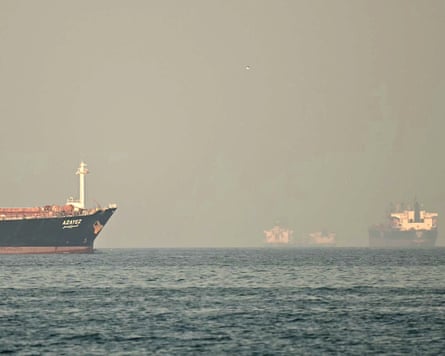
He has previously said that the US-Israeli attack on Iran would make Putin stronger in the short term. Trump has loosened sanctions on Russian oil, while the price has soared because of Iran’s blockade of the strait of Hormuz, increasing the Kremlin’s fossil fuel revenues.
But Khodorkovsky said Putin had not built a regime that could survive beyond his own death or decline. “After Putin in Russia, the system will have to be totally demolished and reconstructed, built from scratch,” he said. “The interval for real changes, the expectations is from about five to seven years from now.”
Asked whether he could imagine returning to Russia, Khodorkovsky said: “I’m 11 years younger than Putin. So I do have a chance.”