3 months ago
110
3 months ago
110
‘The White Hotel is similar to the Highlander and Keith Richards. It’s immortal,” declares Austin Collings. Collings is the artistic director of the Salford venue – housed in a former MOT garage – that over the past decade has become a generator for underground culture in the north-west. A programme that has spanned classical music ensemble the Manchester Collective, a celebration of Bertolt Brecht and Andy Weatherall’s last ever DJ set is testament to its scope. Collings, Ben Ward – the Hotel’s “caretaker” – and a tight-knit crew of friends and collaborators have built an experimental arts venue that doubles as the north’s most notorious underground nightclub.
But despite continuing to draw full houses, the White Hotel will shut up shop in January. Always on administratively shaky ground, they’re now drowning – literally. According to Salford city council’s Strategic Regeneration Framework, the White Hotel is in a flood-risk zone. “Basically,” says Ward, “it’s a swamp.” In theory, they could have hung on for a few years, but decided it was better “to go out on our own terms, long before we became a museum”.
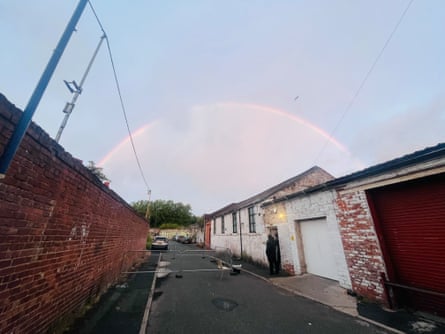
The success of the past decade – including sold-out gigs from the likes of Damo Suzuki and William Basinski – has defied logic in many ways. The White Hotel is notoriously difficult to find, tucked into a scrappy industrial estate that backs on to the River Irwell. Strangeways Prison is nearby: former prisoners have reported hearing the thud of the club at night. Its programming has always been mischievous, DIY and informed by wilful experimentalism. The initial idea was that it would be like the Colony Room Club in Soho, London, where everyone from Francis Bacon to David Bowie and Princess Margaret partied: somewhere that “was rude, but full of artists”, says Collings.
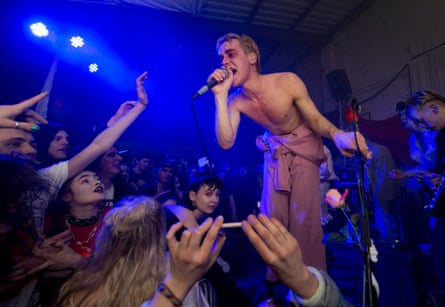
It was never meant to last 10 years. Initially, the plan was to keep the White Hotel open for a year before moving to Los Angeles (where they have music and film contacts) and then Sarajevo (where they wanted to make more). “Then, because it became popular, you realise, we’ve got to keep this going,” says Ward. Collings credits the success to an identity built around the principle of “minimum budget, maximum ideas”. The night they realised they really had a hit on their hands was in 2019 when Detroit legend DJ Stingray played and the 300-capacity space was overwhelmed.
In the early days, the organisers had a free-for-all door policy. They remember a punter who would bring a hammer on to the dancefloor. “But not in a threatening way, if that’s possible,” says Collings. The doormen were ex-special forces and brought a dog called Luther to assist: “The dog was louder than the DJ,” says Collings. On New Year’s Eve 2017, someone set off a firework and it scudded around the bar. “It was a bit like Bugsy Malone,” says Collings.
But beneath the chaotic surface, planning and execution remained paramount. No logistical challenge was insurmountable: they shipped a piano across the globe for Australian improv group the Necks. Any profit was funnelled directly back into the venue. “The early days were madcap, but never ramshackle,” says Ward. He calls their programming “a reflection about what was happening in the news at the time. We were in the moment and of the moment.” They held “Genny Lec” all-dayers for both the UK and US elections, where they played election coverage on large screens and the audience voted with their arses, sitting on seats colour-coded for each party, and a screening of the Prince Andrew interview for which they bought in Pizza Express.
Between them, the pair have an irrepressible energy and generosity, keen to namecheck all the people they’ve worked with at the White Hotel. Collings credits Ward with a rare ability to bring people together. They’re proud to be “rough-and-ready” while unashamedly into culture. Ward grew up nearby. Collings is from Radcliffe, which he calls “dogshit valley”. He previously lived in Prestwich, home of the Fall’s Mark E Smith, and ghost-wrote Smith’s memoir: “I came out from that thinking that you can be working class and avant garde,” he says. “Humour is the fuel.”
The White Hotel only ever really attracted the attention of the national press when a 2018 re-enactment of Princess Diana’s funeral, conceived by artist Stanley Schtinter, came on to the radar of the rightwing tabloids. Club regulars paraded through Salford carrying a fake coffin, accompanied by a mariachi band playing Candle in the Wind, and a recording of Jonathan Meades reading Earl Spencer’s eulogy for his sister. Collings describes the event as “weirdly heartfelt”. The Daily Mail disagreed, declaring it “sick and disgraceful”. “It got full on, it was front page,” says Collings. He says some participants found the presence of the paps unsettling, “but I didn’t mind. It was only ever going to go one way.”
Next month, the team behind the White Hotel are celebrating its spirit at a new three-day festival, the Black Lights, in venues around Blackpool including the ballroom synonymous with Strictly Come Dancing. The lineup runs from the origins of British bass music through its many futures: A Guy Called Gerald, Gescom, Space Afrika. A new work commissioned from Mica Levi and the BBC Philharmonic will debut in Blackpool Opera House. (Whether it returns next year is dependent on ticket sales.)
They’re also launching a film production company. “Me and Ben met in a boozer talking about Wong Kar-wai, so the film thing is natural,” Collings says. He co-wrote last year’s Odyssey, directed by Gerard Johnson, brother of the The’s Matt, and Collings’ directorial debut, a short titled Wild Bodies, will go on the festival circuit with a soundtrack by the Coral. “It’s very painterly, but it is funny – a nod to Powell and Pressburger and Lindsay Anderson.”
Although gentrification in Manchester is marching outward, and 7,000 homes are planned for the area around the White Hotel, the venue itself isn’t being replaced by apartments, but a wetland park. While the White Hotel’s demise will erase something very rare – a club built from the ground up fuelled by a spirit of experimentation and collaboration, disregarding the profit motive – its spirit will mutate, and neither Ward nor Collings are sentimental about losing the premises. “It’s come as a surprise that it’s lasted this long anyway,” says Ward.