2 months ago
151
2 months ago
151
Before we enter the clouds on snow-capped Helvellyn, I glance back down at Ullswater. The early morning sun is bursting around the dark corners of High Dodd and Sleet Fell, sending a flush of light across the golden bracken and on to the hammered silver of the lake.
Further away to the south, ragged patches of snow cling to the high gullies. The nearest village, Glenridding, can barely be seen behind the leafless trees and all I can hear is the gurgle of the stream. It is the quintessential Lakeland scene: the steep slopes above the water, the soft colours and hard rock, all combining into something inimitable. And judging by the photographic and artistic record, it is one that has hardly changed since the Cumbrian wind first ruffled a Romantic poet’s curls.
Our best loved national parks – the Lake District, Peak District, Eryri (Snowdonia) and Dartmoor – all officially opened 75 years ago, in 1951. It was the result of a long campaign, arguably begun by one of those Romantics, William Wordsworth, a poet whose particular love for the Lakes led him to observe that the area should be “a sort of national property, in which every man has a right and an interest who has an eye to perceive and a heart to enjoy”. The resident of Dove Cottage at Grasmere fought, successfully, against railway building, noting the stupidity of destroying something precious in the pretence of increasing its influence.
That niggling dilemma has dogged the national parks ever since, but if Wordsworth were here now, I think he might approve, at least at first glance. The fate of some Alpine beauty spots has been avoided: no high-rise buildings break through the trees, no sports infrastructure litters the summits, and engineers have not blasted tunnels for bigger, faster, road and rail connections.
The planning process is tortuous, and woe betide anyone who likes a colour not in the Farrow & Ball catalogue, but our national parks survive, without sacrificing too much of their original charm.
Back in the 1970s my dad began taking me on his hiking trips. In those days, I didn’t share his excitement at “the views”, but I instantly grasped the magic of swimming under waterfalls, scrambling along ridges and sitting on mountain tops to eat hard-boiled eggs dipped in salt. He took us to all the national parks, and introduced us to their highlights. It was the start of a lifetime of exploration.
Dartmoor
The only area in England and Wales that has legal wild camping, Dartmoor is also the most threatened. A recent report detailed the sorry decline in biodiversity on its sites of special scientific interest (SSSI), but the truth is it remains in a better state than many other places. What makes Dartmoor special is the sheer extent of heathland: over 11,000 hectares of heather, gorse, bilberry and moor grasses, inhabited by birds, lizards, snakes and some rare butterflies. The top bird here is the red grouse, recently recognised as a distinct species, making it only the second reliably identifiable endemic British bird species.
Dartmoor’s reputation for other, more controversial species, is firmly established. On my first visit as a boy, I was reading The Hound of the Baskervilles and also glued to reports of escaped large cats. When we hiked past the infamous prison, and dad told us about “the Mad Axeman” inside, Dartmoor was firmly established in my head as the single most exciting area of Britain. I’ve never had reason to change that view.
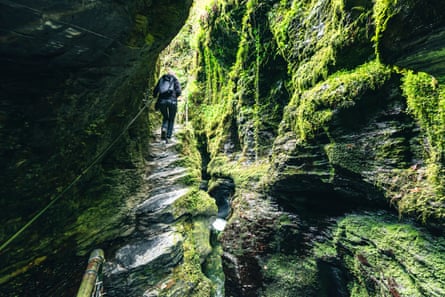
Arguably the most evocative place is Wistman’s Wood, which is accessed from Two Bridges hotel, but popularity tends to destroy mystery and this is now an Instagrammed honeypot. Other excellent woodlands can be found down the Lydford Gorge near Tavistock or the Bovey Valley near Lustleigh, a village of thatched roofs where a cream tea is the acme of snackery. Try the Primrose Tearooms.
Nearby is Haytor Rocks, a magnet for climbers, and everyone else. It’s beautiful but popular. For tranquillity, try the military firing ranges: there’s nothing like an M115 Howitzer to deter most hikers, or perhaps it’s simply the need to check live firing times. It does seem to put visitors off, and there are wonderful viewpoints to be found, such as Yes Tor and High Willhays.
Eryri
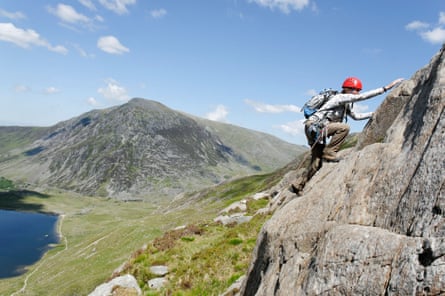
In Eryri, the hunt for peace and tranquillity has one rule: avoid Yr Wyddfa (Snowdon). Any other peak will be quiet in comparison. If you must go up Wales’s highest mountain, I suggest taking a less-frequented path, like the Watkin or Rhyd Ddu and go early – and I mean headtorch early. Another good option is the Ranger Path (Cwellyn), where the wind blew me off my feet as a nine-year-old. You might escape the crowds, but you can’t escape the weather.
Yr Wyddfa’s Crib Goch, one of Britain’s greatest ridge scrambles, can be a bit of a trial when oversubscribed, but there are many fine alternatives. Try Crib Lem on Carnedd Dafydd, accessible from Bethesda, or the Idwal Staircase, a tougher challenge that some might prefer to do roped up. Steve Ashton’s book Scrambles in Snowdonia is the essential guide.
One feature I love about Eryri is the way its industrial heritage has been repurposed to contemporary needs: the various slate mine attractions and the steam railways go from strength to strength. Bala Lake Railway has started work on extending its line into Bala town, a significant addition.
Lake District
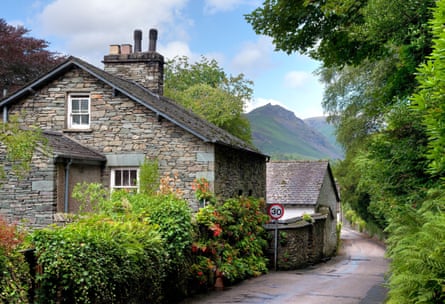
The opening of the first parks triggered a wave of interest in hiking and a demand for route information. Like many others, my dad discovered Alfred Wainwright, whose hand-drawn pictorial guides are still a good way to find routes. Wainwright’s own favourite was Haystacks Fell, with an ascent from Buttermere via Scarth Gap. My own initiation into the joys of scrambling started with Wainwright routes up Lord’s Rake on Scafell Pike and Jack’s Rake on Pavey Ark, both serious undertakings.
Scrambling and its sister sports, fell-running and scree-racing, have a proud history in Lakeland. Over in Wasdale, sheep farmer Joss Naylor was an inspiration. As a teenager, I witnessed his hell-for-leather approach to scree slopes, transforming them from places to be avoided into a new challenge.
Wasdale, with its historic inn, remains a favourite. If the trail to Scafell Pike is often busy, look out for classic treks like the Mosedale Horseshoe, taking in Pillar, a stiff challenge when torn shreds of cloud are whistling around your ears. For the sure-footed, the climbers’ trail passing beneath Napes Needle is another gem. The Needle is a satisfying climb with historic importance. Photos of early pioneers the Abraham brothers, standing on top in their 1890s hobnail boots, fuelled interest in the new sport of rock climbing.
Across to the east, the 17½-mile trek from Pooley Bridge to Troutbeck over High Street is an absolute gem, with sustained panoramas on a clear day. Another classic is theKentmere Round, which normally starts at St Cuthbert’s church, near Staveley. For sheer delight in Cumbrian topographical names, the Kentmere Round is a must: Yoke Fell is followed by Wander Scar, Toadhowe Well and Shipman Knotts, among others. The best advice is to find a fell with an unfamiliar name, get the OS map and devise a route. Asking a local also usually pays off.
After an epic day of snow and ice on Helvellyn, I take my own advice. I am staying at Another Place hotel along the Ullswater north shore. The lakeside panorama tells the tale of changing times: there are paddleboards and kayaks on the water; groups heading off on wild swims; and a mobile sauna by the shore. Hotel director and local man David Vaughan tips me off about a favourite walk, on nearby Gowbarrow Fell.
The path starts at Aira Force waterfall, a well-known attraction, and the car park is busy. Beyond the falls, however, things are quieter. At 481 metres, the Gowbarrow summit is not high, but the panorama is superb. Further on comes the real climax: a balcony walk around the contours and above the lake.
A kestrel swoops past, close enough to see the wind ruffle its chestnut feathers. At the end, the path drops down to the woods and there’s a young woman, hesitating. Her kit looks fresh from the packet.
“Is there any scrambling up there?” she asks nervously.
“No,” I say, noticing her immaculate nails. “But there’s lots of mud.”
She takes a deep breath and grins. “OK.” Then sets off. Joss Naylor, my dad and the Romantic poets would all be proud. Our parks are still doing their best for us.
Accommodation was provided by Another Place, The Lake, in Ullswater, which has double rooms from £125 B&B. Further information, visit nationalparks.uk