3 months ago
112
3 months ago
112
You know the cost-of-living crisis is biting when videos of influencers unpacking their grocery “hauls” are viral on TikTok.
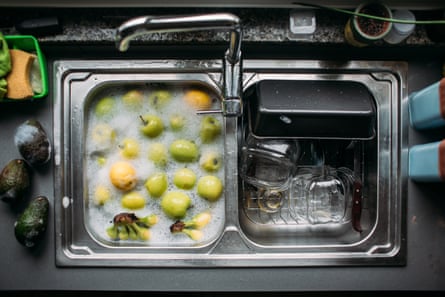
Chewing through millions of views, fruit and vegetables are aesthetically plopped into a sink filled with water, piece by piece. “Sanitising” products are then added, ranging from the fizz of baking soda and vinegar to specialised vegetable soaps (“Amazon link in my bio!”). There are even expensive electronic purifiers, which shake, shimmy and bubble away in the basin, supposedly removing any nasties.
But is ASMR deep-cleaning your fresh produce really necessary? And is it all too late for those of us who can barely remember to rinse our pears?
For Queensland’s Rebecca Scurr, who shares what it’s like to “sell fruit for a living” to her 26,000 TikTok followers, fruit-washing videos make her “cringe so much”.
“There is no fruit, even resilient ones like apples, that are going to be better off for being washed and then put away,” she says.
“Particularly if it’s something really soft, like a strawberry or raspberry – washing it when you’re not about to eat it is the worst possible thing for shelf life.”
Scurr is the fourth-generation operator of Piñata Farms, which supplies pineapples, strawberries, raspberries and mangoes to supermarkets across Australia. While she understands content creation is all about “making things more aesthetic,” she says a lot of the how-to content on FruitTok “doesn’t make much sense”.
For Prof Enzo Palombo, an expert in food microbiology and gastroenteritis viruses at Swinburne University of Technology, the key to fruit and veg hygiene is to “be cautious, but don’t be paranoid”.
He acknowledges concerns about the presence of bugs or dirt, pathogens that can cause diseases like listeria or salmonella, and the use of chemicals and pesticides. But he says: “We tend to think we need to consume 100% sterile food – you don’t. Our body is designed to deal with these things, within reason.”
Scurr says Australia has stringent regulations in place to protect consumers from pesticides and disease, “particularly if you supply a major retailer”.
Despite this, as Dr Rozita Vaskoska, who leads the CSIRO’s Microbial Food Systems group says “sometimes random things can happen,” so erring on the side of caution is always recommended, “in case something accidentally ends up there”.
Vaskoska says we should rinse produce under cold running water just before we eat or cut it. This includes vegetables and fruit with skin.
“The surface matters because as you cut it, the bacteria can move from the surface to inside in some instances,” she says, pointing in particular to rock melon, which has been behind listeria outbreaks in the past.
While they must be washed before going to market, rock melons’ rough skin makes them difficult to fully clean, so they should be rinsed again, and even scrubbed with a clean dish brush, before consumption.
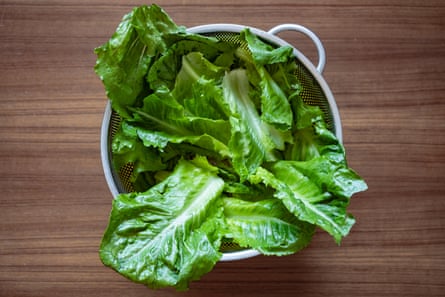
Bean sprouts, salad mix and tightly packed veg like bok choy or cos lettuce, which can end up with dirt trapped in their crevices, should all be thoroughly rinsed too.
Both rock melon and pre-packaged salads are particularly high risk for immunocompromised groups.
Palombo says problems can stem from soil contamination in the growing process, where additives like chicken manure, which can contain salmonella, have caused rare infections.
There are risks once produce reaches supermarket shelves too. “You see people pressing all the mangoes, all the avocados; where have their hands been?”
Cooking vegetables will eliminate most diseases of concern, Palombo says, with “most viruses and common bacteria like E. coli and salmonella killed by at least 60C” temperatures, though Vaskoska reiterates it’s still best to give everything a rinse prior to cooking, to reduce chemical hazards.
While there have been recent concerns about the use of pesticides, particularly in blueberry farming, Vaskoska says “all chemicals being used by the industry are regulated,” with some residue allowed to remain on the fruit, at a safe level.
But for Palombo, his “number one rule” when it comes to healthy fruit preparation doesn’t have anything to do with soaking them in a bath of essential oils.
“Wash your hands,” he says. “If you’ve come home from the shopping and you’ve touched things, you’ve got in your car, give your hands a wash and then put away your groceries.”
“If most people follow that rule, 99% of the problems would disappear.”
As for those internet-famous methods of deep-cleaning produce, Vaskoska says some approaches have shown “some slight change in certain pesticides or certain bacteria”.
But she says “if it does one thing, it might not do another”. A product that might slightly degrade some pesticides would not necessarily have a significant effect on microorganisms.
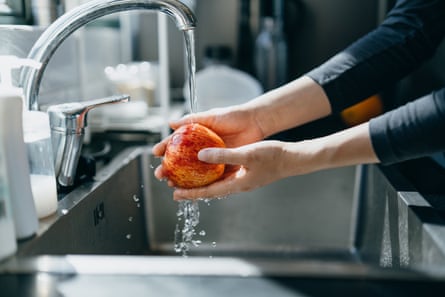
For example, one study found baking soda does degrade some pesticides on the skin of an apple, and goes further than the physical removal force of rinsing it under a tap. However, the same study concluded this method wasn’t completely effective in removing residues that had penetrated through the apple peel, with peeling the skin more effective.
Another study compared the effects of home-wash methods including baking soda, lemon and various vinegars on different types of pesticides in lettuce. It found rice vinegar removed the most pesticides on average. However, the effectiveness of each method varied across different pesticides, with tap water slightly more effective than rice vinegar in one instance, and more effective than baking soda overall.
When it comes to microorganisms, another lettuce study found while washing the leaves in water removed a significant amount of bacteria, it was not totally effective at removing all risk.
“I don’t think there is such a thing that would completely sterilise the product, unless you heat and boil it for a long time,” Vaskoska says. “Sterilising produce might not even be desirable, as there may be positive health effects of being exposed to the natural plant microbiome, an emerging area of scientific investigation.”
While Palombo agrees baking soda or vinegar could help give your produce a deeper clean, they could also affect the texture or quality of your fruit and vegetables, given vinegar is acidic and baking soda an alkaline.
Specialised fruit and vegetable cleaning products spruiked online have made some “really bold claims,” Palombo says, without providing much evidence to back up their ostensible anti-bacterial powers.
While he acknowledges it is important to be aware of the risks, he warns against paranoia.
“Don’t be alarmist and panic and be swayed by products that have been sold to you, because they’re going to make everything perfect. Nothing is perfect.”